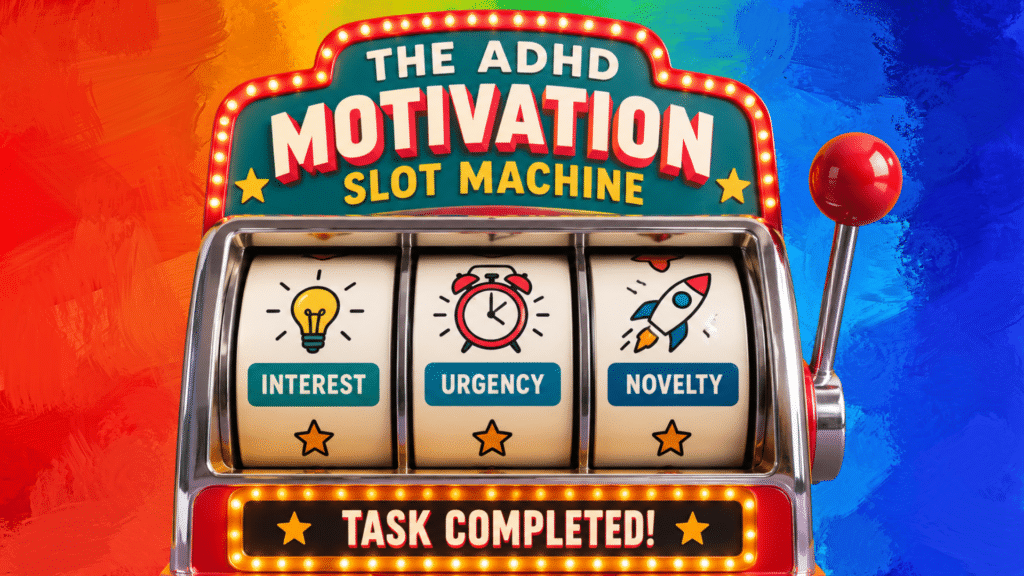
I’ve come to the conclusion that ADHD motivation appears to follow a set of rules that it’s not bothered to explain to the rest of us. And quite frankly, some of them are completely unreasonable. More often than not they appear to make zero sense.
I NEED THINGS TO MAKE SENSE!
Because this is how it rolls for me. I can know something needs doing and genuinely want to do it. I can have the time, tools, ability and absolutely no good reason not to do it. And yet somehow, there I am, three hours later, having achieved the square root of sod all. But if something mildly interesting but totally irrelevant shows up, I’m the most dedicated, focused and determined person you’ve ever met.
It’s a really strange contradiction, particularly when you’ve spent much of your life believing that motivation is something you’re supposed to be able to summon up through sheer willpower. We’re led to believe that ‘wanting it bad enough’ is all you need. God, there are a million motivational straplines backing up that fallacy, and yet it’s a lovely theory that a lot of our brains just didn’t buy in to.
One of the more discombobulating things about ADHD for me is that even when I know something is important, and that I need to get on with it, that doesn’t necessarily make it interesting enough to do!
My magpie brain pays attention if it’s interested, or the task is novel or a bit challenging. Ooh, I love a challenge….until I don’t! Add ‘urgent’ to the mix and it’s properly sitting up paying attention. What is really craves, above everything else, is the shiny new exciting thing. That almost always pushes everything else to the bottom of the stack regardless of priorities.
And don’t get me started (literally) on the familiar mundanity of the regular things I need to do. Regardless of how important they might be. “Eat the frog” was clearly not a strategy built for this magnificent brain. Get the rubbish stuff out of the way first? Erm, nope! In fact, that whole phrase is a nope for me. Far too literal! Imagine how chewy it would be.
Of course, from the outside, it can look as though we’re choosing the things we enjoy and ignoring everything else. But there’s a big old difference between choosing not to do something and struggling to find the motivation to actually do it. It’s not that we’re incapable of doing boring things. If that were true, most of us would have given up hoovering back in the 90s. To be fair, some of us did! It’s just that getting ourselves to crack on with them can be excruciatingly tricky. Which is bloody inconvenient when adulthood consists mostly of doing things that aren’t remotely shiny.
I can spend six hours researching something that started as a random thought. I’ll invest an inordinate amount of time, I more often than not don’t have, investigating every possibility. Following all the interesting tangenty goodness, emerging with the level of information that might earn me a seat opposite Magnus Magnusson, in the giant Mastermind seat….Were that still a thing. (RIP, Magnus). Even when that subject was something I knew nothing about hours earlier. The mating habits of a shrew?…….pro-level knowledge in less than a working day!
But ask me to take a few pictures of my boiler and I’m kicking that ‘bore me’ task down the road until I’ve been chased at least 3 times. And It’s not necessarily the amount of time something takes that determines how difficult it feels. Sometimes I find a complicated project is easier to start than a straightforward email. Because the project has something to explore, problems to solve and decisions that feel interesting. The email has a subject line, three sentences and absolutely no redeeming features.
And this is where, for me, the whole thing makes no logical sense, because I clearly have the ability to concentrate, often to the point where I forget to blink. And I can definitely work hard and follow things through. But those abilities don’t always come when I call them. And that can look like a lack of effort from an onlooker’s point of view. Inside it feels like I have two entirely different parts to my brain, and both of them are ignoring each other.
This is probably the part I find most difficult to explain to someone who hasn’t experienced it. Because, even as I type it, I appreciate it sounds bizarre. And yet it’s my reality nonetheless. There are times when I genuinely want to do something, and I’m definitely not avoiding it. I’m not sitting there enjoying the experience of not doing it. In fact, I might be thinking about it constantly, feeling increasingly frustrated that I haven’t started.
But thinking about doing something and actually doing it are two completely separate departments. It’s like homeware and lingerie… not even on the same floor of the building.
And it turns out there’s actually a reason for this particular bit of madness. It’s called executive dysfunction, and it’s something a lot of us who are ADHD experience. Basically, our brains can struggle with the processes that help us get from wanting to do it, to actually doing it. Stuff like planning, prioritising, organising and, rather importantly, getting started.
So we can know exactly what needs doing, genuinely want to do it, and still find ourselves sitting there waiting for our brain to read the memo.
Which is why being labelled lazy sucks. Because it suggests we can’t be arsed, when that’s not what’s happening here. The willingness is there, hanging out with intention and more often than not a whole load of frustration. It’s like a dysfunctional team meeting where everyone has turned up, but nobody’s actually doing anything.
And telling someone to just get on with it is rarely the revelation people seem to think it is. Believe me, the thought has occurred to us. Hell, we’ve said it to ourselves multiple times.
But along with its second cousin, “calm down”, and its strange aunt, “just don’t think about it”, that particular bit of advice needs to be thrown into the sea. Because the difficulty is rarely not knowing what needs to happen. It’s getting the brain on board with that idea.
And just when you’ve set fire to the idea of productivity, along comes a deadline. It swaggers into view with the arrogance of knowing that suddenly the abandoned task has just become entirely possible. Not only possible, but urgent, absorbing and worthy of every available brain cell.
It’s almost impressive. If it weren’t so exhausting. Urgency can be a powerful source of activation for people with ADHD, as the heat starts to turn up with an approaching deadline. But it’s not toll-free. Yes, it can make a task you’d filed under tedious suddenly wink at you, but it’s often late to the party and comes at a cost.
Because whilst there’s something truly exhilarating about pulling off a last-minute miracle, it’s a bit like a rollercoaster. Stay on it too long and eventually you’re going to feel sick. The stress, adrenaline and disruption to everything else are the price we pay for that buzz of knowing we got there in the end. And as I clamber out of the cave into the light after one of these occasions, I can often be heard muttering to myself, “Next time I will definitely start earlier.” But… spoiler alert… I probably won’t!
Don’t get me wrong, I meant that empty promise when I said it. I had big plans for future Hannah, but awesome as she is, she’s a creature of habit and likes familiarity, even if it raises her blood pressure. It should be noted that this last-minute productivity is not proof that we could have done it sooner but chose not to. The conditions changed, as did the possibility. So I guess the trick is finding ways to create some of those conditions earlier to avoid the blue-light situation every time something needs finishing.
I suspect there are plenty of adults with ADHD who’ve spent years believing their issues around motivation are character flaws. In fact, I know there are as I’ve spoken to plenty. They’ve been told they’re capable but inconsistent, intelligent but disorganised, full of potential but somehow not applying themselves properly. And after hearing versions of that often enough, it’s surprisingly easy to start saying those things to ourselves.
We can become our own worst critics, prioritising perfection in a bid to avoid mistakes, and noticing the mess ups rather than the big wins. Comparing ourselves to those who seem to have everything just right. Of course, no one really does. But it can feel like that. And somewhere along the way, we start feeling ashamed that we can’t just do better.
The trouble is, shame isn’t a reliable solution to executive dysfunction. It can make tasks feel even more stressful, which makes them harder to begin. And before we know it, we’re caught in a guilt loop that’s doing nobody any favours. The less we do, the worse we feel, and the worse we feel, the harder it becomes to do anything about it.
And sometimes we excuse self-criticism as though it’s perfectly acceptable to berate ourselves. Better than someone else doing it, right? WRONG! Being hit with a stick still hurts, even if you’re the one doing it. And feeling bad about something is not going to help.
Of course, accountability matters. Life keeps chucking responsibilities at us, and deadlines won’t sod of, however much we wish they would. So, I’m certainly not suggesting that ADHD provides a lifetime exemption from replying to emails. But there’s a big old difference between taking responsibility for something and repeatedly telling yourself you’re useless because it doesn’t always come easy to you. One might actually help you move forward. The other just gives you another problem to deal with.
So what do we actually do with all of this? Because understanding why motivation behaves like Uncle Tony at your cousin’s wedding is useful, but it doesn’t magically get the invoices sent.
I reckon the starting point is recognising just how unpredictable motivation can be, and that sometimes changing the conditions around a task works better than demanding more effort from ourselves. We know that interest can be a powerful motivator, so why not use that to our advantage?
When I’m doing something particularly brain-numbing but essential (accounts, anyone!?), I sometimes set myself little time challenges. Suddenly, I’m racing against the clock rather than contemplating the misery of bookkeeping.
And if starting it is the difficult part that day, I try and break it into more doable chunks. Even if that first step is ridiculously small just to get our brain out of the cave. So it might be locating my accounts spreadsheet. That can be a whole task in itself, depending on which ‘safe place’ I have stashed it! I digress. Or if I need to write something I break it down into a plan, and that often gets me curious about how it will turn out, which then sparks some motivation.
External accountability can help too, but not in the form of someone a bit scary barking ‘just do it’ at you. Obviously! Working alongside someone, arranging a check-in or setting yourself a realistic interim deadline. None of this is revolutionary, and I’m sure you’ve already developed a few tricks of your own. The point is finding what works for your brain, rather than following someone else’s idea of how productivity is supposed to happen. And yes, what works brilliantly one day might be spectacularly useless the next. Because naturally, ADHD wouldn’t want us getting too comfortable.
But perhaps that’s the bit we need to get our heads around. We can spend an extraordinary amount of time and energy trying to make our brains behave like everyone else’s, rather than accepting that they don’t, and working with that. Not against it.
Because maybe the problem isn’t how we motivate ourselves. Maybe it’s that we’ve spent so long trying to follow rules that weren’t written for us, we’ve forgotten we can make our own.

Firstly, I just want to give a shout out to any readers who have mastered the art of understanding the unpredictable beast that is ND energy. A confusing little fecker that might give you a whiff of hope that there’s some petrol in the tank… and then you do the most mediocre of chores and feel like your brain has been turned into a smoothie.
If you haven’t mastered that, then… well, how the devil are you going to protect it if you don’t even know how it works? Just kidding. As you were. Keep reading.
So, let’s assume you’ve got at least some understanding of how your energy behaves, in all its unpredictable random sparkliness. The next step is protecting it. Because you’re living in a world that won’t slow down. Not even a teeny bit. Not even if you ask it really nicely.
And this is the bit no one wants to talk about. The world isn’t going to adjust itself around your capacity. Deadlines still exist, clients still want quick replies, and life in its many forms keeps moving at the same pace regardless of how you’re feeling. Which is why protecting your energy isn’t optional. It’s sanity maintenance.
And when you’re neurodivergent, then that’s double funzies, because your energy isn’t linear. It fluctuates. It spikes. It drops. It goes out for a pint of milk and comes back 3 days later. It’s that crazy unpredictable drunk uncle that you don’t want at your wedding.
So, this isn’t about escaping the world. It’s about learning how to stay in it without acquiring yourself a one way ticket to burnout town!
Most systems are built on the assumption that energy is stable. That you wake up, work, produce, and repeat. Nice, neat, and predictable. Lovely for people whose brains behave like that. Big fan. Congratulations to them. Except that’s not how a lot of ND brains work.
Some days you can fly through work like you’ve unlocked a secret level of existence and suddenly you are unstoppable. Other days, opening your laptop feels like a hostage negotiation between your fingers and your brain. Same person. Same workload. Completely different capacity.
And yet… none of those changes how the world responds to you. You’re still expected to show up, deliver, reply, and keep things moving — even on the days where your brain has very much not signed off on that plan. No one pops up and says, “Ah, I see your brain has gone offline today, let’s circle back when it returns.”
The problem is that external demand stays consistent, while your capacity didn’t get the memo. So, when those two things collide, pressure builds. And when that pressure sits there long enough, it turns into stress, then exhaustion, and eventually burnout.
Which is why this whole “just push through” approach doesn’t really work for brains like ours. (It barely works for anyone, to be honest, but that’s a rant for another day.)
One of the biggest drains on your energy isn’t actually the work itself — it’s urgency. Everything suddenly feels important. Everything feels like it needs doing now. Everything feels like it will fall apart if you don’t respond immediately.
But a lot of that urgency isn’t real. It’s artificial deadlines, other people’s poor planning, and those “quick favours” that somehow take half your day and leave you wondering why you opened your laptop in the first place.
If you’ve spent years being reliable, helpful, and responsive, you’re probably very good at jumping straight into action mode without even questioning it. It feels productive. It feels responsible. It also quietly sucks the life out of you.
The problem is that urgency pushes you into adrenaline. And adrenaline is great … in small, occasional bursts. As a lifestyle choice? Less ideal. You end up running on “just get through it” energy, which works, right up until it really, really doesn’t.
A small but surprisingly effective shift is asking yourself: “is this actually urgent?” Not “does it feel urgent” but is it genuinely time-critical. Because those two things are very different. Even if your brain insists they’re identical.
I’m the queen when it comes to chatting about boundaries. It’s like I discovered them, 51 years later in my life, and now they are my specialist subject. In fact, it pretty much is that! But most of those conversations are about emotional ones. Protecting your feelings, managing relationships, that sort of thing. Energy boundaries are slightly different. They’re about protecting your capacity.
Because you can technically have the time to do something, but not the energy. You might look at your calendar and think, “Well, I’ve got an hour free,” but your brain is already fried, your sensory load is maxed out, and you’ve made approximately 47,000 decisions already that day. That hour is not usable. It’s like a mirage hour.
This is where one of the most useful sentences you’ll ever learn comes in: “I don’t have capacity for that.” Not followed by your life story. Not turned into something apologetic, or a giant discussion. Just that.
It sounds simple, and it is. It’s also wildly uncomfortable if you’re used to over-explaining, over-justifying, and making sure everyone else is fine first. But it works. Quietly, efficiently, and without wringing out what little energy you had left.
If you’re anything like me, saying no doesn’t just happen. It comes with a full internal production. You draft the explanation, rehearse the tone, anticipate their reaction, and try to make it sound reasonable, valid, and entirely non-offensive to anyone, ever.
The irony being that by the time you’ve finished explaining, you’ve used more energy than the original task would have taken. How’s that for efficiency…or lack of it!
The truth is most of that explanation is for us. It’s working hard to make the discomfort of setting a boundary feel safer. But “no” doesn’t require a backstory. It doesn’t require a breakdown of your week, your mental state, or your entire life context. As Stu taught me once, it’s an entire sentence. And the more you practise it, the less energy you leak trying to make your boundaries palatable for everyone involved. I promise you it starts to feel easier the more you try it on for size. In fact, it’s so incredibly freeing. Because it’s you having your own back.
One of the biggest shifts that comes with protecting our energy is realising that just because something is possible, it doesn’t mean it’s sustainable.
We ‘could’ say yes. We ‘could’ take it on. We ‘could’ push through.
But then we could also decide to deep clean our entire house at 11pm on a Tuesday night. Half of my teenage years were spent piling the entire contents of my bedroom floor onto my bed at about 10om, then crying and putting it all back onto the floor. The question is… should we?
Because every “yes” is stealing from a limited resource. And if you’re not consciously deciding where that energy goes, it gets spent by default. Usually on the loudest, most urgent, or most guilt-inducing thing in front of you.
Protecting your energy means getting honest about trade-offs. Letting go of “shoulds”, looking properly at commitments, and actively choosing long-term stability over the short-term approval that we can often crave. Sweet dopamine.
Sometimes that means making decisions that don’t look particularly impressive on paper but feel a lot safer in our body. Which, frankly, should be the only measure that really counts.
One of the sneakiest things about energy is how quickly we decide we’re “fine again”.
You have one good day. Maybe two if you’re feeling particularly wild. You wake up, your brain is cooperating, you answer a few emails without wanting to lie down afterwards, and suddenly you’re like, “Right. I’m back. Power Rangers…let’s go!.”
And off you go. Rebooking everything. Saying yes to things. Catching up on the 463 tasks you’ve been avoiding. Possibly reorganising a cupboard for emotional reasons. Fully convinced you’ve turned a corner.
Newsflash. You haven’t turned a corner. You’ve just found the exit of the car park.
Because early recovery energy is not a full tank. It’s not even half a tank. It’s more like your car has stopped making that alarming flashing noise and you’ve gone, “Great, let’s drive to Scotland.” You’re out of the danger zone. That’s it. But you’re not on the home straight yet.
And this is where we accidentally undo all the progress we’ve made. Not because we’re reckless (well, some of us can be!), but because it feels so good to have energy back that we immediately spend it. All of it. In one go. Like a toddler with birthday money.
Then we’re surprised when we crash again.
Protecting your energy at this stage means doing something deeply unnatural: not filling the space. It means leaving gaps. Building buffers. Resisting the urge to “catch up” on everything all at once. Saying no to your old pace, even when your brain is loudly insisting that this time will be different. (It won’t. Your brain is a liar when it’s excited.)
Recovery isn’t just about getting your energy back. It’s about not immediately burning through it the moment it returns.
Protecting your energy isn’t just practical — it’s deeply inconvenient on an emotional level. Because when you start doing it properly, things come up. Guilt. Fear. That slightly sick feeling that you’ve just disappointed someone. And sometimes actual pushback from people who were very happy with the old version of you. The one that was constantly nodding like their head wasn’t attached properly. Saying yes, staying available, and overextending herself. Funny that.
That doesn’t mean you’re doing it wrong. It means you’ve stopped being as convenient. And yes, it does feel uncomfortable. Really uncomfortable. Like you’ve put on a jumper that technically fits but is somehow both itchy and judging you.
You’ll be tempted to soften it, to explain more, to just do the thing this once because it’s easier than holding the boundary. But every time you do that, you teach people (and yourself) that your limits are optional. The real work here isn’t setting the boundary. It’s holding it when it would be much easier not to. This is a huge part of my life story, so believe me when I say I get it. But I’m also now boundaries number one fan!
The world might not slow down. That’s true. Deeply annoying, but true. But that doesn’t mean you have to speed up to match it, because that’s how you ended up here in the first place. Remember?
Protecting your energy long-term often means your life looks a bit different. Less stuff, more intention. Not churning your output like a sausage factory. Which, depending on your previous operating style, can feel suspiciously like you’re “not doing enough”. But you are. You’re just not doing everything, thank god.
And yes, sometimes it can feel like you’re not keeping up with everyone else. Like you’re dawdling while the rest of the world is power-walking past you in Lycra, with a podcast on 3x speed. But I can promise you this: they’re exhausted too. They’re just better at pretending they’re not.
What you gain instead is something far more useful: stability, sustainability, and the ability to keep going without repeatedly crashing and having to rebuild yourself from scratch every few months. This isn’t about doing less for the sake of it. It’s about doing what actually works for your brain, your body, and your life in the long term.
Because if it only works when your brain’s on fire and your nervous system is halfway out the window, it doesn’t actually work.

There’s a very specific kind of tired that doesn’t make sense on paper. The kind where you look at your day and think, But I didn’t even do that much. You sent a few emails, had one meeting, put the washing on, maybe even cancelled something because you were “being sensible”, and yet by 4pm you feel like you’ve been dragged backwards through a hedge. Not dramatic burnout, not collapse-on-the-floor exhaustion, just that low, humming depletion that makes everything feel heavier than it should. Like you’re coming down with a bug that never turns up.
For years, I thought that meant I was weak, lazy, or just not built for “proper” business. Spoiler: it wasn’t that. It was energy debt, and I was quietly racking it up like it had no interest rate.
When I finally hit proper burnout, it didn’t arrive with sirens and flashing lights or announce itself with, “Hello Hannah, you have officially broken yourself.” It crept in. First it was overwhelm that didn’t shift, then irritability, then that constant feeling that I was forgetting something. Like my brain had 47 tabs open and I couldn’t find the one making the noise. I was saying “sorry” a lot; I couldn’t focus without it feeling like lifting 50lbs with my mind. Small noises made me jump, and I’d drift off mid-conversation and realise I’d lost entire chunks of what someone was sayin
I wasn’t dramatic, I wasn’t melting down daily, I was functioning, but everything felt tight. Like I was permanently bracing. And because I was still technically working, I told myself I was fine. That’s the problem. Burnout doesn’t start with collapse; it starts with erosion — paper cuts over and over until you realise you’ve been bleeding for months.
What I haven’t said yet is that my biggest burnout wasn’t twenty-something Hannah trying to prove she could survive London life. It was much more recent, and it wasn’t just mental; it was physical. I wasn’t collapsing in tears or dramatically quitting everything; I was just never switching off. Ever.
On the days when I was stuck…brain foggy, slow, distracted…I’d tell myself I’d make it up later, and later would come in the form of ten-hour hyperfocus sessions, weekends, evenings, “just one more thing.” I was constantly playing catch-up with a version of myself I thought I should be. I didn’t allow space to just be because there was always something I should be doing.
Underneath that was shame — deep, old shame. Why can’t I just work like everyone else? Why does this feel harder for me? Why does it take so much effort to do what others seem to glide through?
But it wasn’t just about work. My “always on” wasn’t limited to clients and projects; I was the reliable one. The one people called when things went wrong, the listener, the fixer, the one who usually knew what to do. And I was always the one putting my hand up when something needed doing. Partly because I’m capable, partly because I care, and partly — if I’m being really honest — because if everyone needs you, then no one leaves you. I was used to being left, which is probably a blog for another day, or a therapist’s office, or both, but being indispensable felt safer than being optional, so I stayed available. Emotionally, mentally, practically. Even when I was already running on fumes. Being the strong one is exhausting, especially when no one realises you’re carrying it.
So I pushed, because I thought the answer was effort. Turns out the answer was pacing, and eventually something had to give. And because I had proven that my brain wasn’t capable of looking out for me, my body stepped in and said “enough already” and physically stopped me.
I’ve said it before, but most business advice assumes your energy is stable. You wake up, you have X amount, so you use it wisely. And during the day, if you get a little rest, your energy increases again. For neurodivergent brains, that’s not reality.
Some days I can do a week’s worth of work whilst I’m still in my PJs. I’m on fire, with ideas flying, focus locked in, energy like a caffeinated golden retriever! Other days replying to one email feels like a university challenge, when you’re the only team member. Same life, same me, entirely different capacity.
That inconsistency used to terrify me because I mistook it for unreliability. But ND energy isn’t broken, it’s variable by design. We process more, monitor more, absorb more. Masking alone is an Olympic sport, and when you add sensory processing, decision fatigue, context switching, emotional labour, and background cognitive load, suddenly the reason you’re tired after “not much” becomes clearer. Time and energy are not the same thing; two hours on your calendar does not equal two usable hours in your brain.
The thing that nearly finished me wasn’t laziness: it was pushing through even when all the alarm bells were ringing, but I had my fingers in my ears singing “la la la not listening”. And the frustrating part is that pushing through works — for a bit. Adrenaline is intoxicating, the sparkly new thing is delicious, urgency masquerades as capacity, and you believe you can sustain it. I could override my body for short bursts, smash through projects, hyperfocus until 2am and feel invincible. Such a natural high, ticking those things off the list and feeling like I was winning. But borrowing energy from tomorrow is fine until tomorrow arrives and the account is empty
The dangerous part was that I thought I was being responsible. I thought this was what commitment looked like, what professionalism looked like, what business grown-ups did. You got the job done, whatever that took. I could see that not everyone seemed to have to put in such a huge amount of effort, but instead of questioning my comparison, I just doubled down. A lifetime of subtle messaging that I needed to try harder, be quieter, be better, be less meant slowing down didn’t feel safe; it felt like failure.
So I kept overriding every signal until my nervous system stopped negotiating. Burnout isn’t sudden; it’s compound interest on overwhelm. I was living on an overdraft.
Even when I knew I was tired, resting felt wrong. If my capacity is already unreliable, how can I afford to stop? If I pause, won’t I fall further behind.
Somewhere along the way, I’d internalised the idea that rest was a reward for finishing everything, but you never finish everything. Rest isn’t a reward; it’s maintenance, it’s preparation, it’s charging your phone before it dies instead of waiting until it’s at 1% and pretending you’ll be fine.
When you’ve lived your whole life feeling like you have to prove your capacity, rest feels like exposure. If I stop, someone might notice I’m not keeping up; if I slow down, it confirms the fear that I’m not built right. So I didn’t slow down, and that’s how burnout became physical . Not just tiredness, but inflammation, disrupted sleep, my body essentially saying, “You clearly aren’t listening to the gentle messages, so here’s a louder one.”
My burnout wasn’t dramatic; it was cumulative, and it cost me more time in recovery than pacing ever would have. Slowing down wasn’t a brave, enlightened decision; it was enforced. And if I’m honest, this slower, kinder version of me rocks. She definitely is a work in progress and needs to be dragged back in line from time to time. But now she generally just says yes to the things that bring her joy.
She doesn’t volunteer for everything, she doesn’t answer every message immediately, she doesn’t try to prove she can outwork her own nervous system. The old voice still whispers, You should be doing more. You’re falling behind. Everyone else is coping, but now my body answers back, and for once I listen.
Looking back, the signs were obvious — irritability, foggy thinking, snapping faster than usual, feeling like the anxiety hamster was permanently on a wheel, flinching at small noises, brownouts where you just disappear for a few minutes, and there’s no signal. But because I was still functioning, I ignored them. We’re not taught to see those as energy signals; we see them as personality flaws.
Now I have had to redefine what a better-balanced life looks like, and I’ve realised it doesn’t mean producing the same output every day. It’s responding honestly to what I can afford. Some weeks, I bounce between big output and recovery. And some days I’m on low power mode, running lights only. That isn’t failure, it’s pacing. Self-employment allows me to build around that variability rather than fight it. If I’d forced myself into a rigid mould, I would have burned out permanently.
Energy isn’t a moral issue; it’s information. Irritability, fog, that constant feeling of being behind — those are data points.
When I ask myself, “What is my capacity feeling like today ?” instead of “What do I have to achieve?”, everything shifts. Honesty about capacity is what makes sustainability possible for me. Previously, I would bully myself into thinking I needed to keep pushing, even against my better judgment.
If you’re running on empty, it’s unlikely because you’re weak; it’s more likely you’ve been paying invisible costs for a long time. You’re not defective. You’re processing more than most people realise. The goal isn’t to squeeze more out of yourself; it’s to understand how your energy actually works and build around it.
Pushing through might buy you some time in the moment, but it can end up costing you much more, like your nervous system.

There’s a very specific kind of ‘tired’ that shows up for me, long before burnout does. It’s not dramatic. I’m still functioning. Still replying. Still getting things done. But everything feels… loud. Overwhelming, where nothing is technically wrong, but my brain feels like it’s got too many tabs open. And if one more thing demands my attention, I might just climb into my wardrobe, nestle myself between some comfy jumpers, and wait until the search party find me. Or better still, don’t. (It’s ok, I’ll take snacks!)
When I reluctantly venture back out into civilisation, no doubt for a wee break, it won’t be long before someone has given me the delegation lecture. I say ‘lecture’ because this is not my first delegation rodeo. Oh no. Many people have gone before this latest one, promising me a world where I don’t have to do everything.
“Just hand a few things over”, they say…. in the same overly zealous way that people say, “Have you tried yoga?”, which immediately makes me want to lie down on the floor and stare at the ceiling!
They think they are being helpful, but all I can hear is my RSD singing “they think you are rubbish” to a creepy nursery rhyme tune. Don’t get me wrong, delegation sounds sensible in theory.
I mean, who wouldn’t want a bit of help once in a while? You’d think. In theory.
In practice, the idea that I can easily hand over a thing to an ‘eager to help’ person without giving them the sense that they might end up having to prise it from my dead hands is unrealistic at best.
Because the ‘after haunting’ that accompanies someone else doing ‘a thing’ (one of my things) on my behalf can be brutal. My brain doesn’t hand over said thing, go get a cuppa and never think about it again. Oh no. It obsesses over the multiple ways that person might well, in fact, most probably will mess it up irreparably.
It might be fair to assume, at this stage, that I’m talking about what gen pop would refer to as important stuff. E.g. keeping my children alive. But no. EVERYTHING in my world is filed under ‘important’, when it comes to how it needs to be done.
Stacking the dishwasher, making the bed, editing a piece of my work……all need to follow the Hannah method ™. I have lived proof that even the smartest of husbands can mess up a spaghetti bolognese if not guided on how big to cut the onions and when to put the tomatoes in. He put ketchup in it, ffs. I know, right!
Don’t get me wrong, I am smart enough to understand the concept of the rest that could be had if someone else lightened the load. But, for me, the overthinking surrounding that process makes it more labour-intensive than just doing it myself. At this point, I want to remind anyone reading this that you have permission to throat punch anyone who says “just don’t think about it” to you. Maybe not an elderly relative, though. Even I have limits!
(Disclaimer – Oddcast, specifically Hannah, takes no responsibility for anyone who gets inspired to throat punch a relative!)
So, let’s assume that someone got you into a semi-nelson, and you’ve agreed to let them do something for you. Although it kinda feels, at this point, like it’s more for them, really….But I digress.
Anyway, you’ve said thank you and made a promise to yourself to hand it over mentally. And you’re busying yourself not overthinking what they’ve done wrong, and what you’ll have to do to put it right. And before you know it, a ‘sneak peek’ at how they have stacked the dishwasher becomes a full ninja-style restack. All the time hoping they won’t notice.
So, I’d be lying if I said that I hadn’t been labelled ‘controlling’ over the years. My stepbrothers used to call me ‘Queenie’ when they came to stay, as I liked to boss them around from a young age. But control can get labelled as a quirk or a flaw, when for many of us it’s more of a safety mechanism we built very early in our lives.
Doing it ourselves reduced the number of variables. It meant fewer explanations, fewer misunderstandings, fewer moments where we had to decide whether to speak up and risk judgment or swallow the discomfort. And that becomes hardwired in us. So, for me, control isn’t about ego. It’s not that I think I am the only one who knows the best way to do things. It’s about getting through the day without feeling exposed or overwhelmed.
So, when someone suggests delegation, they are actually asking us to loosen a system that’s been keeping things stable for a long time. Even if that system is exhausting, and not always in our best interests.
But we can’t have control without her perfectly manicured sister ‘perfectionism’ rocking up. And perfectionism often gets a tough rap. The villain of the hour, with her precise requirements and “redo it” attitude. But it looks different from where she resides in my brain. She’s not trying to chase excellence. She’s trying to manage consequences.
Because there is so much reassurance to be had in knowing that it’s been done in the way you need it to be done. If something is slightly off, a cascade of decisions can follow. But when I do it myself, follow my own standard/routines, then I avoid worrying about whether I’ll end up having to say something. And will I sound ungrateful if I do? If I can’t cope, and I have to ‘fix’ it, then will that create a thing?
You getting the gist now? Can you see how much easier it feels to do it myself?
But I’m smart enough to know that ‘doing it all myself’ is not a long-term strategy that ends well. Not for myself, or for the chap that messed up my spaghetti!
Because it’s a way of operating that only works whilst my capacity holds. And capacity is a finite resource, even if you’ve got the skills to stretch it to the max! (I wouldn’t recommend that, btw – hello burnout!)
And most of the time, the real weight that we feel is not the tasks themselves, but the cognitive load of remembering and prioritising everything. And the constant low-level vigilance of holding it all together. The remembering. The monitoring. The mental list that never quite switches off.
At that point, burnout can usually be seen standing in the corner looking over at you, like the creepy dude at the school disco!
Delegation is supposed to help, and if I am pretending not to be me for a moment, then I know that it really does. BUT there is still that initial awkward stage where it feels worse before it feels better. It’s like that party you went to as a kid, where you had a Barbie that you really wanted yourself, wrapped up in the prettiest paper for your friend. As you handed it over, there was that weird moment when you weren’t really ready to let it go, and so a slight tug of war ensued before you came to your senses and released your grip. That’s me in the rare moments that I delegate.
Then there is that “ I should be able to do it myself ‘self-doubt’ moment. Because, let’s face it, we’re not strangers to being made to feel like we should be able to do something. And sometimes this stage can make us want to go directly to “I tried this delegation stuff. It was rubbish. The end”. But please, dear reader, do not do this. Spoiler, it gets better!
Remember that delegation isn’t an all-or-nothing thing, and it isn’t dumping either. Handing something over doesn’t mean we’re incapable or we’ve stopped caring. Or worse still, that we’re relinquishing all control. It just means that we don’t have to march round the house like a martyr ranting, “don’t worry, I’ll do it” to ourselves. Or is that just me?
We get to decide which bits really need to be exactly the way we need them to be, and which bits don’t. That distinction can feel uncomfortable, especially when caring deeply has been part of how we have stayed safe and capable in the world. But knowing we have that choice is integral to letting things go.
By the time delegation becomes a work problem, it’s almost certainly already a fully immersed life pattern that we’ve been defending for years. Household decisions, emotional labour, remembering birthdays, managing logistics. If we’re used to being the quiet backbone of everything, then self-employment just amplifies that.
Suddenly, we’re not only the ones who notice things; we’re also the system. Don’t get me wrong, I still truly believe that self-employment is our get-out-of-jail card. Because it is genuinely freeing for neurodivergent people. Or indeed any neurotype, to be fair. But the friction comes when we try to hold every role indefinitely, because that’s what we’ve always done. And that is where we discover that delegation is not the enemy.
Sure, if we’re smart, then we have built ourselves a support network of other like-minded business owners around us. To compare notes with and bounce ideas. Having this network is integral to doing business without spending a lot of time crying into your tea. But we still need to accept that we can’t do everything. Regardless of how our brain is often telling us we need to.
Delegation in business isn’t about growth hacks or scaling. It’s about sustainability. About not being the only thing keeping the wheels on. As I said before, letting go doesn’t have to mean letting everything go. Sometimes it just means noticing when the effort of holding on has become louder than the discomfort of sharing the load.
Success isn’t measured by ‘doing less’. It’s having enough left to keep going without constantly managing our own nervous systems in the background. That’s not giving up control. It’s about choosing a version that actually lasts.

There are two types of people in the world: the ones with colour-coded five-year plans, laminated vision boards, and a spreadsheet that could probably file their taxes — and then there’s me. And if you’re reading this, there’s a decent chance you’re also in the “I’m just trying to get through the next five minutes without accidentally starting a new career as a candle-maker” camp.
The five-year plan is one of those culturally approved things we’re all supposed to have, like a skincare routine, a pension, or a consistent personality. And sure — for some brains, a five-year plan is motivating and grounding, a helpful lighthouse guiding you through the fog. For other brains (hi), it’s a pressure cooker. A shame-generator. A glittery trap disguised as “success”.
So let’s talk about what happens when you don’t have a five-year plan — and how you can still thrive, grow, and build long-term awesomeness without setting fire to your nervous system.
A five-year plan assumes you can reliably do two things: predict the future, and be the same version of yourself every day for five years. If companies packed full of mega brain analysts can’t predict this stuff accurately, then what sort of hope (none… the answer’s none) does a small business owner with a spoon deficit and a squirrel chasing brain have of being able to map out the rest of the month, let alone 5 long years.
If a five-year plan genuinely works for you, I mean this sincerely: I love that for you. But if it fills you with fear, and makes you feel like you’re failing before you’ve even started, you’re not broken. It’s just not a tool that’s built for your brain.
I’d be lying if I said I had ever truly understood the concept of a five-year plan in life or business. I understand direction. I understand having something vaguely on a hill that you’re aiming for — a general “over there”. What I don’t understand is the rigid, milestone-heavy version where by Year Two you’re meant to have achieved X, become Y, and be emotionally stable by Year Four (I’m not emotionally stable by year 51!). That’s not planning. That’s inviting your inner perfectionist to move in permanently and redecorate using paint shade ‘shame’.
What actually helps is a looser kind of vision that gives you direction without demanding you predict every step. For me, my goals tend to sound less like “I will triple my revenue and expand into three new markets” and more like wanting to work less, enjoy my client base, feel calmer about my work, and earn enough that I’m not living ten days from payday in a constant state of dread. That’s not a five-year plan. That’s an anti-meltdown, sustainable lifestyle..
If you want long-term awesome without the five-year straight jacket, the trick is to stop trying to build the whole staircase and just focus on the next step. Short-term goals work well for neurodivergent brains because they’re visible, achievable, motivating, and adjustable. They give you something solid to aim for without locking you into a version of the future you might outgrow
This is why I love working in short sprints. Well, I have since Stu introduced me to the concept. Before that I was just bumbling along with no plans on adulting when it came to business at all. I miss those days! No, focus Hannah, focus!
Ninety days, thirty days, a season, whatever chunk doesn’t make you want to crawl under a table. You pick something specific, give it a defined window of time, and treat it like an experiment. Does it work? Does it pay? Does it drain you? Do you enjoy it? Is it sustainable? Is it moving you vaguely toward the hill? At the end of the sprint, you reassess. No drama, no shame, no “I’ve ruined my entire future”. Just interesting data and a chance to pivot.
One of the biggest lies hustle culture tells us is that success means sticking with one idea forever, even when it’s clearly not working. But self-employment is messy and stop-start. Some months are great; other months you’re wondering if you should become a barista purely for the predictable schedule and the free pastries.
If something isn’t working — financially, emotionally, practically — pivoting isn’t weak. It’s smart. And honestly, who are these imaginary people we’re trying to impress? What committee is meeting weekly to review your career choices and announce that you’ve pivoted again and they disapprove? There isn’t one. And even if there was: fuck em.
This might be the most important part, so I’ll say it slowly: if you don’t plan around your energy, your business will plan your burnout for you. Neurodivergent energy isn’t linear. It doesn’t show up like a tidy nine-to-five battery bar. Some days you’re focused and flying; other days you’re technically present but running on fumes and a slightly haunted vibe.
So instead of demanding consistency from yourself, you build systems that support variability. That might mean time-blocking, protecting recovery time, pushing “urgent” work to next week, or recognising that doing more now usually means borrowing from future-you. As we’ve said repeatedly in past blogs and episodes, rest isn’t a reward for getting everything done — it’s preparation for the work ahead.
I don’t think consistency itself is the enemy. What is unhelpful is the idea that consistency means showing up as the same version of yourself every single day. When we have already established that that is not going to happen for a lot of us! What actually matters, especially in business, is consistency of outcome rather than consistency of energy.
My clients don’t need me to be the same Hannah every day. They need good work, delivered when it’s promised — reliability in results, not access to my internal battery levels. So I do focus-heavy work on days when focus exists, I protect recovery so future-me doesn’t suffer, and I design systems that absorb variability instead of pretending it isn’t happening. From the outside, it looks consistent; from the inside, it’s flexible, responsive, and intentional. That distinction matters, because forcing “perfect consistency” is often what breaks people, whereas systems that expect variability are what keep things moving.
The ideas. The sudden obsessions. The “maybe I should retrain as something wildly unrelated” moments. Curiosity isn’t the enemy, and learning things isn’t wasted. Sometimes finishing isn’t even the point — the learning is. But not every idea needs to hijack the entire business.
Having an idea bank helps. Write it down, capture the dopamine, park it. If it keeps coming back and aligns with the hill, you can revisit it later. Not everything needs to become a full identity.
If you’ve got tasks that have been sitting on your list for months, chatting shit about you, it’s probably time to be honest. Delete them, outsource them, or accept they’re not realistic right now. A to-do list that makes you feel permanently behind isn’t a productivity tool — it’s a stress list.
It might look like earning enough to cover your bills without panic, doing work that doesn’t destroy your nervous system, and setting goals that flex as your life changes. It might look like a business that evolves with you instead of demanding you stay the same.
And maybe — just maybe — thriving without a five-year plan isn’t chaotic. Maybe it’s wise. Maybe it’s the most neurodivergent thing in the world to say: “I don’t know exactly where I’ll be in five years, but I know what matters to me. I know what drains me. I know what brings me joy. And I’m going to build from there.”
Short-term wins. Long-term awesome. No pretending to be someone you’re not.

I have a confession that I’ve learnt over the years is not the popular choice: I don’t like holidays. And because holidays feel like the societal currency of success, there’s quite a bit of shame wrapped up in admitting you don’t like them.
For a lot of people, holidays are the shiny prize at the end of months of grind. You work hard, you earn a “break”, you go somewhere sunny and allegedly “switch off”. But for me, I just don’t see it that way.
This is made all the more difficult given that about 80% of pre summer small talk circles around how you plan to spend your time off. It’s endless! “Going anywhere nice this year?”, “Got any holidays booked?”. Then there’s 3 months of social media being drenched in “don’t mind if I do, cocktails by the pool” photos, and notifications telling you that one of your friends has just uploaded 463 photos to their #soblessed Fakebook photo album. Sorry Carol, but there are only so many photos of your lobster-red family (none, if you are asking!) that one can feign interest in when it comes to someone else’s holiday. And if you’re thinking “what is the appropriate number of photos to share on social media, the answer is”none “,”no photos”, “nada, nope and nooooo” photos!.
When I nonchalantly announce that I plan to take some time off and hang around my house, maybe venturing out on the occasional day trip if I feel daring enough, the look I get can only be described as a mix of confusion and pity. Or they just do an awkward laugh that tells me they have no idea what to do with that information.
So if holidays don’t feel relaxing to you either, this blog’s for you. This isn’t a guide to having the “perfect” break. This is a shout out to everyone who finds holidays complicated, exhausting, or downright pointless… and the permission to do ‘rest’ your own way, even if that might look different to some.
For me, the anxiety takes up residence in my brain the second someone says, “We should go away.” I haven’t been on a ‘proper’ holiday abroad in about eight years. I see that as a massive win. My husband probably doesn’t share my enthusiasm, because he loves holidays and has inexplicably chosen to be married to me, but here we are.
The minute a holiday is mentioned, my brain starts running a full diagnostic on everything that would need to be in place before we leave. Is my work covered? Have I replied to everyone? Will the heating be okay? Who’s feeding the cats? What if something breaks while we’re gone? What if I’ve forgotten something crucial and can’t fix it because I’m in another country with the wrong plug sockets and no printer?
Packing is a whole separate hell. A neurotypical person might think: “We’re going somewhere warm. I’ll pack for warm.” My brain goes: “But what if it isn’t warm? What if it’s windy? What if it’s humid-but-chilly? What if the jumper I packed feels fine at home and suddenly turns into sandpaper while I’m away? What if I need options for all seven versions of my skin?”
It’s not just “have I packed enough clothes?” It’s “have I packed clothes that will feel okay on my body in a climate I can’t predict, in moods I haven’t had yet, in sensory states I don’t know about until I’m in them?” So I over-pack. Obviously.
Then comes the weight-limit panic. Once the giant suitcase is full, my brain immediately flips to, “The airline is going to charge me £5,000 because this weighs more than a small car.” Cue repacking. Sorting. Weighing. Taking things out. Putting them back in. Negotiating with myself about how many emergency jumpers one woman really needs. By the time we even lock the case, I already need a nap and possibly a small breakdown.
If there’s one place where my autistic anxiety and my ADHD mouth love to team up, it’s airport security. I once flew to the US in my early twenties and had to go through one of those extra-intense interviews at immigration. Under pressure, all useful information immediately vacates my brain. I stood there shaking, fumbling through papers, mumbling things like, “Sightseeing? I don’t know? Just… doing stuff?”
I completely forgot both the name and where I had put the address of the friends of my family that I was staying with. And then, because my internal monologue has no volume control, I blurted out: “I’m not a drug mule or anything.” Exactly what a drug mule would say.
I didn’t get arrested, obviously, but the look they gave me was… memorable. When I’m anxious, my face pulls “I’m hiding contraband” expressions for fun. I overcompensate, I ramble, I make terrible jokes and then wonder why everyone is staring at me like I’ve brought a kilo of cocaine in my carry-on.
So no, security doesn’t feel like “the exciting gateway to adventure.” It feels like a test I don’t understand, with questions I’m not prepared for, in a system that already thinks I’m suspicious because I can’t stand still and behave ‘normally.’
At home, I have escape routes. If everything gets too much, I can retreat to my bedroom, the garden, the sofa, my favourite chair. I know where to go to calm down. I know the rules, the layout, the lighting, the temperature, the sounds. On holiday, all of that disappears.
One year, we rented a villa in France. It should have been idyllic — little house, nice weather, all very Pinterest. I remember standing outside the villa feeling utterly overwhelmed, scanning my surroundings and thinking, “Where’s my safe place?” There wasn’t one. In the end I got in the hire car, drove to a random supermarket, and just wandered around the aisles like a ghost. Not because I needed groceries. Just because it was the closest thing to “normal” I could find — fluorescent lighting, familiar-shaped shelves, products in rows. It gave me a little anchor in a world that suddenly felt completely unmoored.
Leaving the UK makes that feeling even sharper. It’s not that France is far away; it’s that it feels inaccessible. If things get unbearable on a day trip, I can at least get in my car and come home. If I’m in another country, my brain registers it as: “you’re here forever. “
Holidays ask me to give up control of my environment, my routines, my foods, my exits… and then “relax.” It doesn’t work like that for me.
It’s not just my brain I’m managing on holiday either; I’m not the only neurodivergent one in the family. So when we’ve done the Family Holiday thing, it hasn’t been just one person struggling; it’s a big old mixed bag of meltdowns.
Picture it: one child is in bits because the Wi-Fi doesn’t work properly and their online world — their safe place — has vanished. Someone else is overwhelmed by new smells, noises, and textures. I’m freaking out about control and routine. My husband is quietly re-evaluating all his life choices. It’s not that we don’t love each other. It’s that you can’t take four nervous systems that rely on predictability, special interests, and carefully crafted habits… then dump them in a loud, unfamiliar environment full of strangers and expect it to go well.
We once did a UK holiday park — big entertainment complex, lots of screaming children, drum and bass through caravan walls at 5am. My husband basically faked a stomach bug by day three just so he could tap out. He used me as a human shield — “Don’t come near, I’m contagious” — and hid in the bedroom while I took the kids into the arcade chaos. Honestly? I respect the strategy.
Here’s the bit that really messes with my head: holidays are sold as relaxation. “You need a break.” “Get away from it all.” “Switch off.” Great in theory. In practice, when you’re neurodivergent, holidays can feel like an endurance test.
My daily life at home is built around routines that work for my energy, my brain and my nervous system. I know when I need quiet. I know when I can people and when I absolutely cannot. I structure my work around it as much as I can. Take all that away and plant me in another country and suddenly I’m around people all the time. I don’t control the noise. Meal times are different. Sleep is disrupted. Food is unfamiliar. I can’t get to my safe spots. My regular self-regulation routines are gone.
That’s not relaxing — that’s extra cognitive load. And then, on top of all that, there’s the emotional pressure to “make memories”, “enjoy every second”, “get your money’s worth” and be visibly grateful because “some people would kill for this.” No wonder I come back from holidays more exhausted than when I left.
One of the reasons I avoid holidays now is the sheer time and energy cost. For me, a one-week holiday looks like a week before of prep, admin, packing and anxiety; a week during of sensory overload and pretending I’m fine; and a week afterwards of decompression and trying to reintegrate back into real life.
That’s three weeks of disrupted functioning for a single week of “rest” that didn’t feel restful. At that point, staying home with my own kettle, my own bed, my own food, and my own sofa starts to look less “boring” and more “deeply wise.”
Despite everything, I don’t think all holidays are doomed forever. I just think the standard template — flights, sun, enforced fun, daily activities — doesn’t work brilliantly for a lot of neurodivergent brains.
The breaks that have worked better for me tend to be short, nearby, and familiar. A couple of nights in a UK city, a hotel chain where I know roughly what the room will be like, a place where I can get home if I need to. Everyone gets their own space. Our last family trip was a weekend to York. It worked pretty well as the kids had their own rooms. We had ours. We set the tone early: you don’t have to spend every second together. If you want to disappear into your room and read for two hours, that is more than fine. It’s survival.
My husband once asked me, “If we won the lottery, what would your perfect holiday be?” I described an island with hardly anyone else on it, where someone quietly ships in food and books, and I just potter around by myself in peace. He said, “That sounds amazing — I could do that.” I said, “No. Just me. Not even the kids. Literally just me.”
It sounds awful written down, but it’s not about not loving my family. I adore them. It’s about cognitive load. If I’m on holiday with them, my brain doesn’t stop tracking everyone’s needs. I don’t stop listening, scanning, checking: “Are they okay? Are they overwhelmed? Are they bored? Are they hungry?” I can’t switch that off. That’s the mum load, the ND load, all in one. To feel genuinely rested, I need that channel to be quiet too.
Society tends to treat holidays as a scoreboard. “Where did you go this year?” “How many countries have you visited?” As if the number of times you’ve sat in an airport somehow proves you’re “winning” at life.
I’ve started opting out of that game. I’m not interested in racking up “experiences” just because that’s what everyone else seems to be doing. I’m much more interested in crafting a life that doesn’t require me to escape it constantly.
For me, that looks like more rest in my everyday life, less pressure to prove I’m having fun, being honest that holidays don’t feel relaxing, and letting go of the idea that I’m “boring” or “failing” if I don’t go away. If your idea of a perfect break is a week at home with no plans, no alarms, and no small talk, that is just as valid as two weeks in Ibiza. You’re not doing life wrong. You’re just doing it in a way that works for your nervous system.
So, if you’re a neurodivergent human who dreads packing, panics at airport security, needs a full week to recover from a “relaxing” trip, or secretly prefers your own sofa to any beach on earth… this is your reminder that there is nothing wrong with you.
Holidays, as sold to us, are not designed with us in mind. They assume flexible routines, low sensory sensitivity, high tolerance for uncertainty, and a brain that finds novelty more exciting than terrifying. If that’s not you, you are allowed to opt out — or redesign the whole idea.
You are allowed to say no to the big trips. You are allowed to do short, gentle, nearby breaks. You are allowed to rest at home and call it a holiday. You are allowed to like your own bed more than a resort. You are allowed to want a life you don’t constantly need a break from.
And if anyone at the hairdresser asks, “Going anywhere nice this year?” You can smile and say, “Yes, actually. My living room. It’s perfect.”
In the pre-smart device 90s, the acronym P.D.A. stood for “Personal Digital Assistant”, a small “pocket” device, the size of a phone book (remember them!), that you took everywhere. It kept contacts, calendars and notes, and with the flick of several buttons you could keep track of your schedule. Think of it as a Filofax with batteries. What’s a Filofax? Google is your friend, my friend.
FFW >>> to now, and P.D.A. and in the 21st Century it stands for something completely different. Pathological Demand Avoidance, aka PDA, is the very real phenomenon where the more you are expected to do something, the less likely you are to do it. Not to be confused with Oppositional Defiance Disorder (ODD), PDA is more an internal resistance to your own thoughts and requirements. ODD is more a “no to The Man” type of defiance, whereas PDA is more a “no to this specific man, specifically today, and specifically on this specific thing he wants me to do.”Less “Fuck the Man!”, more “Fuck Yourself!”, and it can cause quite a lot of issues.
Here’s what WikiChatAIgpt said about the trait: “PDA is usually a trait associated with autism in which an individual experiences extreme anxiety-driven resistance to everyday demands and expectations. Rather than simply being oppositional, people with PDA may feel intense internal pressure and loss of control when faced with requests, even routine tasks like getting dressed or answering a question. This can lead to avoidance strategies such as distraction, negotiation, withdrawal, or emotional outbursts.”
Wait… Look… What’s that over there? ::Stuart runs in opposite direction shouting…”
“I’ll do it soon, you can’t force me. What? No, YOU’RE AVOIDING IT… SHUT UP!”
Ah, but Stuart… that’s just procrastination dressed up in fancy clothes and out for a stroll, isn’t it? No, not at all. Let me give you a very real-world scenario.
Procrastination mostly focuses on ignoring the looming deadline for something (usually less than desirable) and finding a million other things to do in the day, mostly fun stuff.
PDA is more like two identical poles of different magnets being pushed together; the closer they get, the harder you push, the more resistance you feel, the closer they get the harder it gets. This can even be for something you WANT to do.
Like writing this blog. I love writing. I like writing about ND and the Business Oddcast gives me an outlet. I enjoy creative writing and always have, especially when I get to write fun stuff that gets a positive reaction (mostly!). Nob! See!!
PDA is not procrastination, it’s the Olympic World Global Championship Finals of avoiding the very thing you WANT to do. It’s often why I find myself sitting on the edge of my chair, bursting for a pee, still in my PJs, at lunchtime. My brain refuses to process the demands of the day. I know the steps to get dressed, I could go get changed inside 5 mins, but the idea drowns in an overwhelming wave of resistance.
It starts with a perfectly reasonable “I’ll do it in ten minutes.” Of course it’s never ten minutes… Then ADHD kicks in and SQUIRREL! Whatever shiny object happens to dazzle and distract takes over. An hour later, I realise I’m still not dressed. ARSE CANDLES!
Then I start to think of the weight and abrasive nature of my “day clothes,” all those seams, labels and folds that ride up… “Let’s avoid that,” whispers my PDA. Your brain recoils from the idea of scratchy clothes… another hour passes. FUCK-A-DOODLE-DON’T!
Bladder chimes in with an “ahem, perhaps…” PDA swiftly interjects, tyres screeches it arrives on the scene “NOTHING TO SEE HERE. MOVE ALONG… STOP IT! PEEING NOW IS A WASTE OF TIME!! YOU NEED TO CHECK YOUR FACEBOOK NOTIFICATIONS!” And off you dive to see what lovely comments you’ve received on your socials. Then you spot that someone is wrong on the Internet, which requires your intervention. THIS IS MY SPECIALIST SUBJECT.. THEY’RE AN IDIOT… SCHOOL. IS. IN!
You come too, and suddenly realise your bladder may actually burst, and upon standing, the cosmic magnitude of how much you really need to go becomes clear. You then shuffle to the loo ASAP and return to your chair after the flood waters of the Tigris have exited your body.
It’s then you remember, DAMMIT! THE ARTICLE! and you then faff about setting up windows, screens, and the various elements that need to be perfectly aligned for your brain to sink into writing mode. You start to type and suddenly… DAMMIT! “I was up at the house, peed, made a coffee and returned completely oblivious to the fact I should have got dressed”. I did think about it up at the house, but only in the “Oh, I wonder what the price of gold is at the moment?” sense, in the abstract not because I was going to actually buy some gold before being distracted by whatever Jeremy Vine just said. The desire to get dressed is then rudely smothered by a dog-pile of thoughts such as “What? Upstairs?” and “Oh, the ruddy floordrobe,” and “What pile will my favourite trousers be in?” plus the guilt of not putting them in the wash and they kinda need it. Your brain retreats from this overwhelming list of questions, suggestions, queries, insights and thoughts… and oh look, coffee’s ready… Off to the office I merrily go.
As I sit down and flick my dressing gown tails back like a concert pianist, and flex my fingers, poised over the keyboard, and suddenly remember: “BUGGER! Still not dressed!!”
…and around we go again.
Please Note: this is for the simplest of activities: Getting. Dressed.
Sometimes the PDA arises due to not knowing all the elements involved; I need to know the context, ALL the main players and variables in play for any decision to be made. Put simply: you can’t decide because there’s not enough data. Hence the familiar ND refrain when asked anything: “IT DEPENDS!?” To any and all questions. The answer I give you needs to be accurate, and if the mental cursor is spinning faster than a hamster in a death loop, then it’s always going to be “task denied” at the inbox stage.
Time pressure means nothing either. Oh, you can tell me when the deadline is, but that’s of little interest. You may as well tell me what temperature cheese melts at, interesting but of no practical use to me. PDA can show up at the mere act of adding a due date to the diary. “Oh, they want it done by then, do they? Well, I’ll be the judge of that.”
Stu: Flounces off, stage right. End scene.
Except in real life, it’s very much not “end scene.” It’s absolutely “begin next scene: Interior. Daytime. The room is on fire and our protagonist is asleep. Oblivious to the raging inferno next to him.” And that is just for getting dressed. Put a reminder in my diary, you say? YOU CAN’T MAKE ME DO NUFFIN’ ROZZER!
It’s also the threat of the demand, the implied hierarchy, especially in a work setting. The “who do you think you are to tell me what to do?” rises in our throats before we have any chance to rationally respond.
PDA is part brick wall and part quagmire of energy. You know you need to do it, but you’re at 5% battery and the apps are all running a little bit laggy. It’s the anxiety of knowing full well that if you miss the deadline, very real and very painful consequences will occur, and yet… There you are at 2pm in the afternoon and you cannot stop doomscrolling articles on the rise of piracy in the Caribbean and the role of the Royal Navy in protecting slavers. Fascinating topic; but not when you have three days’ worth of paid client work and four days until the deadline. At least you think you have four days, certainty requires checking and because your PDA refuses to double-check the email you sent when you agreed to the deadline, you are in a bit of denial about when it actually is due… I’LL CHECK IT WHEN I WANT TO! THANK YOUOOO… (said with a clipped, snippy tone)
So you sail on in a fog of hope and glorious self-imposed ignorance, all the while shame-spiralling due to your lack of executive function. If PDA were one long carnival of joyful goofing off and hilarious hijinks, it would almost be worth it, but Ferris Bueller’s Neurodiverse Day Off it is not. Usually you spend the time avoiding the one thing you KNOW you should be doing, and will enjoy doing when doing it, but you avoid the doing of the thing by doing something completely pointless, less enjoyable and frankly tedious.
The comedian Pierre Novellie talks about this phenomenon in his stand-up; he shares a story of his friend who has to read “Moby Dick” several times before starting an essay*. It’s odd behaviour, but to paraphrase Mr. Novellie’s comedic musing, perhaps it’s the brain’s way of being bored enough to focus? By boring it, the interest in doing something, anything else spikes, and once you finally present the task, the brain goes: “Friends, Romans, countrymen, lend me your neurodiverse ears, swathed in noise-cancelling headphones…”
So what is the answer? There isn’t one. It’s a feature, not a bug, and no amount of top tips will tip the balance in your favour. I’ve given up trying to fight it; I know it’ll run its course. In fact, the more disinterested I am in going 12 rounds with it, the more quickly it is likely to wave the white flag. TKO win for me!
If you have any insights, tips or tricks, we would love to hear them. It’s an endless battle, but the more energy-aware I am about my internal capacity on any given day, the more I can anticipate it. It seems to show up more when I am stressed about something else, especially something requiring resolution but lacking the resources or information to resolve it. That spills into other areas and PDA starts to rule the roost. Until that one big blockage is cleared, nothing gets through.
These days, I try not to put too many self-imposed deadlines on myself, and where possible set deadlines as comfortably as the project allows. Oh, and if someone wants business results in an unreasonable timescale, I say no to the work. You don’t need that kind of pressure and energy suck on top of everything else.
Anyway, have a good week and if you have any questions or insights get in touch: hosts@oddcast.com – don’t forget to listen, like and subscribe and if you can, share with a friend!
* It might be Huckleberry Finn that he reads several times…