




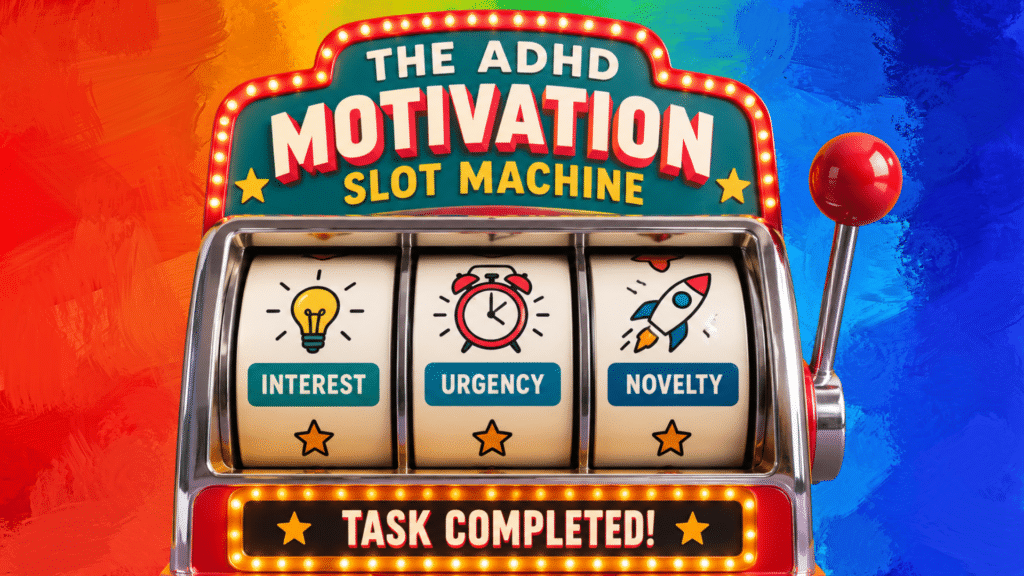
I’ve come to the conclusion that ADHD motivation appears to follow a set of rules that it’s not bothered to explain to the rest of us. And quite frankly, some of them are completely unreasonable. More often than not they appear to make zero sense.
I NEED THINGS TO MAKE SENSE!
Because this is how it rolls for me. I can know something needs doing and genuinely want to do it. I can have the time, tools, ability and absolutely no good reason not to do it. And yet somehow, there I am, three hours later, having achieved the square root of sod all. But if something mildly interesting but totally irrelevant shows up, I’m the most dedicated, focused and determined person you’ve ever met.
It’s a really strange contradiction, particularly when you’ve spent much of your life believing that motivation is something you’re supposed to be able to summon up through sheer willpower. We’re led to believe that ‘wanting it bad enough’ is all you need. God, there are a million motivational straplines backing up that fallacy, and yet it’s a lovely theory that a lot of our brains just didn’t buy in to.
One of the more discombobulating things about ADHD for me is that even when I know something is important, and that I need to get on with it, that doesn’t necessarily make it interesting enough to do!
My magpie brain pays attention if it’s interested, or the task is novel or a bit challenging. Ooh, I love a challenge….until I don’t! Add ‘urgent’ to the mix and it’s properly sitting up paying attention. What is really craves, above everything else, is the shiny new exciting thing. That almost always pushes everything else to the bottom of the stack regardless of priorities.
And don’t get me started (literally) on the familiar mundanity of the regular things I need to do. Regardless of how important they might be. “Eat the frog” was clearly not a strategy built for this magnificent brain. Get the rubbish stuff out of the way first? Erm, nope! In fact, that whole phrase is a nope for me. Far too literal! Imagine how chewy it would be.
Of course, from the outside, it can look as though we’re choosing the things we enjoy and ignoring everything else. But there’s a big old difference between choosing not to do something and struggling to find the motivation to actually do it. It’s not that we’re incapable of doing boring things. If that were true, most of us would have given up hoovering back in the 90s. To be fair, some of us did! It’s just that getting ourselves to crack on with them can be excruciatingly tricky. Which is bloody inconvenient when adulthood consists mostly of doing things that aren’t remotely shiny.
I can spend six hours researching something that started as a random thought. I’ll invest an inordinate amount of time, I more often than not don’t have, investigating every possibility. Following all the interesting tangenty goodness, emerging with the level of information that might earn me a seat opposite Magnus Magnusson, in the giant Mastermind seat….Were that still a thing. (RIP, Magnus). Even when that subject was something I knew nothing about hours earlier. The mating habits of a shrew?…….pro-level knowledge in less than a working day!
But ask me to take a few pictures of my boiler and I’m kicking that ‘bore me’ task down the road until I’ve been chased at least 3 times. And It’s not necessarily the amount of time something takes that determines how difficult it feels. Sometimes I find a complicated project is easier to start than a straightforward email. Because the project has something to explore, problems to solve and decisions that feel interesting. The email has a subject line, three sentences and absolutely no redeeming features.
And this is where, for me, the whole thing makes no logical sense, because I clearly have the ability to concentrate, often to the point where I forget to blink. And I can definitely work hard and follow things through. But those abilities don’t always come when I call them. And that can look like a lack of effort from an onlooker’s point of view. Inside it feels like I have two entirely different parts to my brain, and both of them are ignoring each other.
This is probably the part I find most difficult to explain to someone who hasn’t experienced it. Because, even as I type it, I appreciate it sounds bizarre. And yet it’s my reality nonetheless. There are times when I genuinely want to do something, and I’m definitely not avoiding it. I’m not sitting there enjoying the experience of not doing it. In fact, I might be thinking about it constantly, feeling increasingly frustrated that I haven’t started.
But thinking about doing something and actually doing it are two completely separate departments. It’s like homeware and lingerie… not even on the same floor of the building.
And it turns out there’s actually a reason for this particular bit of madness. It’s called executive dysfunction, and it’s something a lot of us who are ADHD experience. Basically, our brains can struggle with the processes that help us get from wanting to do it, to actually doing it. Stuff like planning, prioritising, organising and, rather importantly, getting started.
So we can know exactly what needs doing, genuinely want to do it, and still find ourselves sitting there waiting for our brain to read the memo.
Which is why being labelled lazy sucks. Because it suggests we can’t be arsed, when that’s not what’s happening here. The willingness is there, hanging out with intention and more often than not a whole load of frustration. It’s like a dysfunctional team meeting where everyone has turned up, but nobody’s actually doing anything.
And telling someone to just get on with it is rarely the revelation people seem to think it is. Believe me, the thought has occurred to us. Hell, we’ve said it to ourselves multiple times.
But along with its second cousin, “calm down”, and its strange aunt, “just don’t think about it”, that particular bit of advice needs to be thrown into the sea. Because the difficulty is rarely not knowing what needs to happen. It’s getting the brain on board with that idea.
And just when you’ve set fire to the idea of productivity, along comes a deadline. It swaggers into view with the arrogance of knowing that suddenly the abandoned task has just become entirely possible. Not only possible, but urgent, absorbing and worthy of every available brain cell.
It’s almost impressive. If it weren’t so exhausting. Urgency can be a powerful source of activation for people with ADHD, as the heat starts to turn up with an approaching deadline. But it’s not toll-free. Yes, it can make a task you’d filed under tedious suddenly wink at you, but it’s often late to the party and comes at a cost.
Because whilst there’s something truly exhilarating about pulling off a last-minute miracle, it’s a bit like a rollercoaster. Stay on it too long and eventually you’re going to feel sick. The stress, adrenaline and disruption to everything else are the price we pay for that buzz of knowing we got there in the end. And as I clamber out of the cave into the light after one of these occasions, I can often be heard muttering to myself, “Next time I will definitely start earlier.” But… spoiler alert… I probably won’t!
Don’t get me wrong, I meant that empty promise when I said it. I had big plans for future Hannah, but awesome as she is, she’s a creature of habit and likes familiarity, even if it raises her blood pressure. It should be noted that this last-minute productivity is not proof that we could have done it sooner but chose not to. The conditions changed, as did the possibility. So I guess the trick is finding ways to create some of those conditions earlier to avoid the blue-light situation every time something needs finishing.
I suspect there are plenty of adults with ADHD who’ve spent years believing their issues around motivation are character flaws. In fact, I know there are as I’ve spoken to plenty. They’ve been told they’re capable but inconsistent, intelligent but disorganised, full of potential but somehow not applying themselves properly. And after hearing versions of that often enough, it’s surprisingly easy to start saying those things to ourselves.
We can become our own worst critics, prioritising perfection in a bid to avoid mistakes, and noticing the mess ups rather than the big wins. Comparing ourselves to those who seem to have everything just right. Of course, no one really does. But it can feel like that. And somewhere along the way, we start feeling ashamed that we can’t just do better.
The trouble is, shame isn’t a reliable solution to executive dysfunction. It can make tasks feel even more stressful, which makes them harder to begin. And before we know it, we’re caught in a guilt loop that’s doing nobody any favours. The less we do, the worse we feel, and the worse we feel, the harder it becomes to do anything about it.
And sometimes we excuse self-criticism as though it’s perfectly acceptable to berate ourselves. Better than someone else doing it, right? WRONG! Being hit with a stick still hurts, even if you’re the one doing it. And feeling bad about something is not going to help.
Of course, accountability matters. Life keeps chucking responsibilities at us, and deadlines won’t sod of, however much we wish they would. So, I’m certainly not suggesting that ADHD provides a lifetime exemption from replying to emails. But there’s a big old difference between taking responsibility for something and repeatedly telling yourself you’re useless because it doesn’t always come easy to you. One might actually help you move forward. The other just gives you another problem to deal with.
So what do we actually do with all of this? Because understanding why motivation behaves like Uncle Tony at your cousin’s wedding is useful, but it doesn’t magically get the invoices sent.
I reckon the starting point is recognising just how unpredictable motivation can be, and that sometimes changing the conditions around a task works better than demanding more effort from ourselves. We know that interest can be a powerful motivator, so why not use that to our advantage?
When I’m doing something particularly brain-numbing but essential (accounts, anyone!?), I sometimes set myself little time challenges. Suddenly, I’m racing against the clock rather than contemplating the misery of bookkeeping.
And if starting it is the difficult part that day, I try and break it into more doable chunks. Even if that first step is ridiculously small just to get our brain out of the cave. So it might be locating my accounts spreadsheet. That can be a whole task in itself, depending on which ‘safe place’ I have stashed it! I digress. Or if I need to write something I break it down into a plan, and that often gets me curious about how it will turn out, which then sparks some motivation.
External accountability can help too, but not in the form of someone a bit scary barking ‘just do it’ at you. Obviously! Working alongside someone, arranging a check-in or setting yourself a realistic interim deadline. None of this is revolutionary, and I’m sure you’ve already developed a few tricks of your own. The point is finding what works for your brain, rather than following someone else’s idea of how productivity is supposed to happen. And yes, what works brilliantly one day might be spectacularly useless the next. Because naturally, ADHD wouldn’t want us getting too comfortable.
But perhaps that’s the bit we need to get our heads around. We can spend an extraordinary amount of time and energy trying to make our brains behave like everyone else’s, rather than accepting that they don’t, and working with that. Not against it.
Because maybe the problem isn’t how we motivate ourselves. Maybe it’s that we’ve spent so long trying to follow rules that weren’t written for us, we’ve forgotten we can make our own.

