
I became self-employed for the freedom to be exactly who I am. Also because I suck at being told what to do, and that’s not ideal when there is someone else in the company whose primary purpose is to pretty much do just that (your boss). So I became my own boss. I get to choose my own hours, lean into my magnificent brain’s natural rhythm, and pick up my phone when I want to. Which is rarely! And I got all of that. But what nobody mentioned in the brochure was that I also became the entire infrastructure. HR, finance, IT, admin, the complaints department, and the person who has to remember all of it.
Needless to say, after subscribing to the third app that promised it would help me sort my shit out, and having had a 1:1 with a particularly enthusiastic (AKA mean) business coach with a limited knowledge of my ND brain and a whole lot of faith in ‘consistency’ I concluded that most business advice assumes a brain that handles the basics automatically.
Here’s what I’ve come to believe. That advice assumes a brain that handles remembering, prioritising, starting, switching and stopping on autopilot. If that’s not how yours works, the advice isn’t wrong exactly, it’s just missing a floor. So I needed to build that floor myself and staff it with all the tools and systems I needed to make my life easy. But after a lot of trial and error I learnt that the quickest way to make your business harder is to spend three days setting up a brilliant new system for a problem you don’t have. So here’s some of my wisdom… so you hopefully go down less rabbit holes.
If there’s one thing I’d recommend first, it’s getting those ‘to do’ lists out of your head and onto something that isn’t your head. Checklists, mainly. Because all the time you are scanning multiple brain ‘to do’ lists, you’re stuck in this ‘WHAT to do’ cycle of chaos. My weapon of choice is a heady mix of Trello for the project headliners, and ‘notes’ on my phone for the day to day ‘don’t forget’ type stuff.
The ultimate goal is to stop storing all this stuff in your brain as it uses up all the RAM and things like the basics of survival, such as eating/drinking/going to the loo can get lost in the wilderness. You may think you have this incredible filing system…you know the one. Beautiful looking cabinets, with neatly labelled folders all colour coded for ease. But, if yours is anything like mine, it’s giving ancient detective movie scene vibes. Piles of manilla folders, pages spilling out, coffee stains everywhere.
And when you master (in the loosest sense – I’m a work in progress) your lists, you can do yourself a solid and start blocking things into your phone calendar. I block pieces of work, and/or tasks into my calendar with the understanding that they are not in concrete, unless they are a meeting, but more so a movable ‘to do’ that can push to another day if needed. It helps me map out my days, whilst also being realistic about my time capacity.
And if you really want to feel smug, then templates are ‘to do lists’ slightly maturer cousin. They’re underrated, but you’re gonna thank them later. Because they are not really about typing less, or producing a whole load of cut/paste generic bullshit. Sure, they can be a time saver when it comes to the obvious, like sales outreach etc. But actually their real value can be getting you off TikTok and moving forwards with the stuff you need to do that day. And if you build a template straight after you’ve done something the hard way, while the steps are still warm it’s there to help you next time. It doesn’t need to be pretty. It just needs to exist.
“But I hate them”….I hear you cry. Even more so because we are told throughout our lives that routines are going to save us. Well….assuming those routines don’t involve living on Cadbury’s fruit & nut. Other chocolate is available!
But seriously, the word can make a lot of us bristle because it might have been sold to us in the guise of a 5am routine. And if you’re someone, like me, who’s still fast asleep at 5am then we can associate routine with shame. But if you think of them as defaults instead, then they are not a rigid schedule, but a few decisions made once so I don’t have to keep remaking them. See? Much more palatable. Things like when admin happens, for example, the first thing I do in my working day is check emails to prioritise anything that needs to be looked at first. Because every decision I don’t have to make ‘in the moment’ saves some energy I can bank for later.
The key is building them so they survive being interrupted. Because a routine that falls apart the first time life gets in the way wasn’t really a routine, it was a dream about how one day you managed to save energy!
Automation is where I get properly excited, which is also where I need to be reined back in. Because the idea I can get something else to ‘do a thing’ for me can quickly turn into me creating things that I don’t need to do just so I can get something else to do them!
A good rule of thumb is automating the things that are boring, repeatable and low-stakes if they go slightly wrong. This could be stuff like invoice reminders, booking confirmations, follow-up emails etc. The stuff that needs doing, but is taking up valuable cognitive load in an already busy brain. I speak for my own brain here. But here’s the catch…an automation you feel the need to check every day isn’t automation. It’s a pet that needs feeding. It makes noises at inconvenient times, and you’re responsible for it. so be aware that if you automate something you are not truly happy to let go of, then at that point you’re babysitting it. You haven’t removed a job, you’ve just created a different but equally annoying one.
AI sits somewhere in this category too, and I think the honest version is more useful than either the hype or the horror. I find it genuinely good at first drafts, at breaking an overwhelming task into steps, at turning a messy brain dump into something with a shape, and at taking an email that’s become my life’s work and making it less rambly. Or, more often than not, less sarcastic or blunt. “I’d like to thank my parents for creating me, my husband for ignoring the meaner parts of me, and AI for softening the edges of my sometimes unintentional bluntness when I am trying to get to a point in an email.”
BUT the caveat for me is remembering that it is not you, however much you fill its memory with reams of your thoughts and dreams. My experience is that there is a direct correlation with the good stuff I put in and the good stuff I get out. It can be a fresh pair of error checking eyes, a formatter, for those moments where you can’t rely on your brain for that consistency, or indeed someone to bounce ideas off. ‘Train ‘it well and it will tell you when you’re talking rubbish, and when you need to “just get on with it”. I think of it as a very keen colleague who’s read everything and been to none of your meetings. And a word of warning to be aware of the ‘shiny-tool trap’. Because if choosing the tool is taking longer than the task, the tool is now the task. Yes, I have spent an entire day creating a Miro board (think digital mood board) for something that didn’t require one because I basically got lost in the ‘pretty’ of it and went on a time stealing tangent. No regrets, it was fun. But sometimes there isn’t time for fun.
This took me way longer to figure out that it was even a thing. Mostly because I’m late diagnosed and didn’t realise how much my environment was either working for, or more often than not against me. Sure, I knew that noisy people when I was trying to work gave me the rage, and sometimes I would try and improve that. Mostly by telling them to shut up. But I’d never really pondered why that might be, or thought much beyond that moment.
But one of my environmental kryptonites is interruptions. They reset your brain and, as you’ve already found out, the result is rage. But the answer isn’t to become more tolerant of interruptions, because that’s a strategy with very mixed results (aka it doesn’t work!). But taking back some control to reduce the interruptions can be a real game changer. Things like noise-cancelling headphones, a closed door, notifications off, an agenda before a meeting so you can prepare rather than improvise. It’s about changing the setting, not your tolerance.
Boundaries belong in this same ‘taking back control’ category, and I’d argue they work best when they’re built in rather than reliant on you feeling brave. Which is not a consistent state for me. Write it down and make it part of the system, like a stated response time, an auto-reply that does the talking, or even a standard ‘no, but here’s what I can do’ so you’re not drafting a defence from scratch every time. As Stu says, “no is a full sentence”. But I’ve never mastered the one-word no. Mine tend to run to about twenty!
And then there’s the boundary with yourself which I have spent 52 years skirting around. But I guess it’s progress that I know it exists at least! It’s the sneakiest one, because sometimes saying no to ourselves if we are driven by perfection, or basically a lack of self discipline, can be really tricky. I’m the queen of ‘just one more thing’ at 9pm. Going to reply to 1 email at the end of the day and then ‘while you’re here’ing the other 20 sitting in your inbox. But at least if you give yourself a boundary of things like when you start/end your day, breaks and rest time, in writing, then there’s a hope that occasionally they will be obeyed.
Yes, I became my own boss because I’m rubbish at being told what to do. But I never really considered that being that boss makes me responsible for my own working conditions. For years I ran this place like a company with no HR, and a management style fuelled by perfectionism, pressure and self criticism. Not very sustainable, I can tell you. I’ve already proved I can run a business on willpower. I’ve got the 9pm emails to show for it. But ‘can’ was never the question. The question is whether I should have to.
I know myself well enough to say that some of the tools in this blog will no doubt change for me. Half of mine will probably be abandoned by spring (hello again, Miro). But what wont is the principle that sits underneath them: a business built around how my brain actually works, not one that depends on my brain rising to whatever gets thrown at it.
So I’ve stopped asking how I keep up with the business, and started asking what the business needs to do to keep up with me. Because if I’m lucky enough to be my own boss, then why wouldn’t I be the best ‘girl boss’ someone can have!

Well…if you ask my mother, I exited the womb wanting things my way. Fiercely independent before I’d even mastered crawling! Apparently, when I was less than a year old, she left me lying on my changing mat while she went off to do something. Only to come back and find that I’d had a pretty impressive attempt at putting my own Babygro on. I know, I know…..child prodigy and all that!
I won’t pretend that I remember that moment, but I can fully attest to the fact that I can imagine it happening. And that moment in time no doubt set the tone for the next 50 or so years! Because I’ve always been someone who likes doing things myself. Am I bossy?……erm….absolutely yes. Maybe less so at this stage of life, but one of my stepbrothers used to call me ‘Queenie’ as a small child, because he said I must have thought I was the queen of the land, I was so bossy.
For the record, I never aspired to rule the country…far from it. Much too much attention to be had in that role! And in fact, I think it’s much more about wanting control and enjoying being independent. I love making my own decisions, figuring things out and generally getting on with whatever needs doing. I’ve never been particularly comfortable relying on other people, and for most of my life I’ve assumed that’s simply because I prefer doing things my way. But recently, I’ve started questioning that assumption.
Because while I need independence, I’ve begun to realise that some of my reluctance to ask for help is less to do with enjoying doing everything myself, and more about how I feel when I don’t. That’s an interesting discovery, not least because I’ve also spent a considerable amount of my adult life getting the rage if it feels like everyone leaves things to me. And I appreciate the contradiction I am creating there, where I find myself both the person who insists on doing everything whilst also complaining that I am doing everything.
At this point I’d like to award the lifetime achievement award for “nodding and smiling whilst not questioning the logic” to my husband of 23 years, Steven. Not all heroes wear capes.
One of the many things I’ve been learning about myself since discovering I’m neurodivergent is that some of the things I’ve always considered personality traits might also be ways I’ve learnt to manage situations that make me uncomfortable. Of course, that’s not just a neurodivergent thing, but taking a deep dive into the inner workings of my brain has made me question what’s really driving some of those behaviours. And my fierce independence is a particularly interesting example.
I’ve always liked being in control of what I’m doing. Not necessarily because I think I’m best at everything, although there may have been times when I’ve behaved as though I do. The truth is if I’m in charge, then I get a front row seat to all the details, and I need that. I want to know what’s happening, and how. What stage it’s at, and what still needs sorting. This info keeps my anxiety in check and allows me to foresee any problems and generally keep a reassuringly close eye on proceedings.
If someone else is in charge then some of that certainty disappears. And I’ve started to recognise that this can make me surprisingly anxious. It’s not control over another human, it’s control over my own emotions, but I can appreciate it can look different on the outside. When you’ve spent years developing your own ways of managing things, handing responsibility to someone else can feel like I’m abandoning a system I really rely on.
Then there’s perfectionism. What’s that saying, “the devil is in the detail”? I’ve always sold my need for detail as a reflection of how thorough I am. A good thing….you’d think. I love things done ‘properly’ and can be pretty specific around what that ‘properly’ looks like. And sadly, for some, I don’t always remember to divulge that info to the other people involved. Which can make the whole business of accepting support somewhat complicated.
But control and perfectionism aren’t the only things that can make asking difficult.
There’s also the vulnerability involved in admitting you need something from somebody else. If you’re someone who is particularly sensitive to rejection, then the possibility that you might be turned down or criticised for needing help can feel much scarier than it needs to be. Even when what you’re asking for isn’t a major deal.
And if you’ve spent years being misunderstood, criticised or feeling that you’re somehow not quite meeting everyone else’s expectations, that can surface some pretty familiar insecurities to boot. So with that in mind, it makes more sense really that doing it ourselves feels easier than asking somebody else. Even if it isn’t actually easier at all.
Here’s where common sense leaves the building though. Because, more often than not I am fully aware that I’m overloaded and am not denying I could really do with some support. I’ve even gone as far as to find somebody perfectly willing to provide it. Excellent. Problem solved.
Except now I have to let them do the thing. Challenge accepted……except most of the time it’s ‘challenge NOT accepted’. Because what if they don’t do it the way I would? If that happens I won’t have predicted the correct outcomes. What if they miss something, or I have to spend loads of time explaining every tiny detail?
Because, side note, for some people the intensity of explaining things is not always easy or comfortable. And yet my need for it to be RIGHT means I feel compelled to provide a comprehensive briefing. Think full guide with images and links to videos! Because I need to cover not just what needs doing, but why, my considerations, and the potential complications. As well as the things they should probably avoid and several additional details that are quite possibly not even remotely relevant.
By the time I’ve finished explaining, I could quite possibly have done the job myself. Which, of course, reinforces my belief that it’s easier to do everything myself. It’s a beautifully inefficient system.
And then there’s the temptation to remain involved. Hell no, on the rare occasion a task can be prised from my reluctant fingers that’s not the end of it. I need to check progress, ask questions, offer unsolicited advice and occasionally hover in the background.
The irony being that even if I’ve handed over the responsibility for something, I’m still carrying the cognitive load to some degree. So, I’m not really getting a break at all.
Now, this is where my lifelong independence also kicks my arse. Because when you’re the ‘yes’ person, always putting your hand up for stuff, making things happen…you become pro-level at making yourself indispensable. Which feels good at first, from a validation point of view. Everyone wants you. But that can get boring pretty quickly, and then you realise you’ve built yourself a cage.
Because you’re pre-empting the things that need doing before others get the chance, sorting problems, organising things, and before long it’s assumed you’ve got this. So everyone becomes accustomed to you being the default for this stuff, including you.
Until one day you find yourself completely overwhelmed, wondering why nobody else seems to be lifting a finger. But no one else can really see it because for years you’ve looked like you’re very happy to be the default ‘doer’…until you’re not.
Now, don’t get me wrong, sometimes people genuinely aren’t pulling their weight, and I’m not suggesting every exhausted person has somehow manufactured their own workload. Because other people have responsibilities too, and it’s really reasonable to expect them to take some initiative. But quite a lot of the time I’ve also played a huge part in creating the situation I’m complaining about. Because I’ve stepped in to do things, even when I’ve not been asked. Or I’ve declined offers of help or been so particular about something that people are reluctant to get involved. Yeah, I know, it’s very hard to believe I’d be anything other than delightful to work with! And then I have become a resentful martyr at the end of it all.
I’ve essentially appointed myself head of every department, refused to recruit any additional staff, and then become enraged about the lack of support from management…who I also self-appointed.
And there’s something fascinating about recognising that pattern. Because being capable and being able to cope with unlimited responsibility are two very different things. And if you’ve been doing it for such a long time, it can be surprisingly difficult to recognise when you’ve reached your capacity. Particularly if you’ve spent years measuring your value through what you can achieve, how useful you are or how little you need from other people. That independence can become so deeply ingrained that asking for help feels like failure somehow. So, you keep going until you’re exhausted, frustrated and often full of a special type of rage that means you’re not particularly delightful company.
I speak entirely hypothetically, obviously.
The difficult part has been acknowledging that if I want things to change, I need to change some of my own behaviour too. But I’m getting better at this. Because I can see that it’s not fair to insist I do everything myself whilst also expecting those around me to read my mind if there are times when that is not the case. Although imagine how convenient that would be if they could!
This is a life skill for sure and it becomes particularly interesting when we’re running a business. Because I’m sure one of the attractions of being self-employed, for those of us who are, is the independence it offers. That autonomy over decisions, choosing how to work and building something that reflects who we are, on our terms. Sounds kinda perfect doesn’t it? That autonomy can be especially valuable if you’re someone for whom conventional working environments didn’t really suit. But like all great things, there’s often a downside too.
Because If you started out being the king of the tasks then that can double down into every aspect of your business. And before you know it you’re the head of every department and forgetting to ask yourself if doing everything yourself is the best use of your time and energy.
But I think it’s important to distinguish between getting help with tasks and also appreciating support. Because support doesn’t necessarily mean handing over responsibility or paying someone else to do something. Sometimes it’s having another person to talk things through with and bounce ideas off. Someone who understands the particular challenges of running a business, or who can offer a different perspective. Because sometimes knowing you’re not the only person finding something difficult is enough.
I think that’s particularly valuable when you’re neurodivergent, because general ‘business advice’ isn’t always perfect for us, and finding people who understand how you work removes the constant need to explain yourself. One of the many things I love about working alongside Stu is that, although we are very different in some ways, he also understands a lot of things about me. Like my need for clarity is not me being difficult, and that I can have different ways of doing things that work better for me.
But there’s one thing finding these magnificent humans, and another thing being willing to let them in. And for me that has definitely involved quite a lot of soul searching and learning how to communicate what support actually looks like for me. Sometimes that is an ear rather than solutions. In fact, I am particularly reluctant if you try and fix a situation for me. Remember the Babygro? Although I admire your optimism in thinking that’s possible!
None of this means accepting support that doesn’t work for us. Nor does it mean abandoning the independence that has helped us build our businesses in the first place. It’s about recognising that independence and connection aren’t opposites. And that you can be perfectly capable of doing something yourself and still feel the benefit from having a wingman too.
Looking back, I can see how much my fierce independence has shaped my life, both in positive ways, and not so much. It’s a huge part of who I am, and also something I really admire in myself. It’s helped me become resourceful, determined and willing to figure things out. And it’s given me confidence to take on challenges and build things that matter to me, and that I am genuinely proud of. And I would never want to lose that.
But after 52 years of insisting on doing things my own way, I’m beginning to appreciate that there’s a difference between being independent because I want to be and feeling that I have to be because the alternative makes me uncomfortable. The first gives me freedom. And the second builds a cage.
I’m also realising asking for support doesn’t mean surrendering control or becoming dependent on somebody else. It can be as simple as trusting another person enough to share the load. And that is the bit I am still working on. Not how to be less independent, but learning to be comfortable enough with support that I can choose when I need it. Because having people around who understand, encourage and support us doesn’t diminish who we are and what we’re capable of. In fact, if anything it can make everything we are trying to achieve more sustainable.
As for that fiercely independent baby who was determined to dress herself? Well, 52 years later, I’m still fairly convinced I can do everything myself, but I now know that I don’t always have to. And that perhaps it’s finally time to let somebody else do up a few of the buttons. Metaphorically speaking, obviously. I’m not quite ready for help getting dressed!

One of the most eye-opening things about discovering I had ADHD so late in life (50!) was realising that apparently not everyone finds being a functioning adult quite so bloody exhausting!
For years, I just assumed everyone was putting in the same amount of effort. That they were all having to consciously remind themselves to pay attention, remember things, organise their thoughts, manage their emotions and generally keep themselves on the rails. I just assumed it was something I wasn’t particularly good at, which made me even more determined to keep trying harder.
But it turns out some of the things I’ve spent decades doing manually are rather more automatic for other people. Which, if I’m honest, is a pretty miserable discovery when you’ve spent most of your life wondering why you haven’t managed to nail this whole ‘life’ business quite as successfully as everyone around you. Particularly those who appear to have the process down to something resembling an effortless art form.
At that point, it feels very much like a ‘you’ problem. And there’s often a considerable amount of shame attached to that.
I think one of the most exhausting things about ADHD, although to be fair it’s pretty tricky to narrow it down, is the sheer amount of mental admin involved in getting through an ordinary day. Stuff like remembering to reply to a message, not forgetting an appointment. Wondering where I put something, and the admonishment in realising I’ve lost something again. Second-guessing things I think I’ve done but am not 100% convinced. God, the number of times I have checked the sent folder to see if I imagined sending the email or not? Better check. Actually, better check again, because I have absolutely no recollection of checking the first time.
It’s like I’ve got an internal PA who’s permanently overwhelmed, off their face on coffee and constantly interrupting me. Their filing system is like a larger version of the kitchen drawer of doom, and there’s a real sense they may have lied on their CV. And the most annoying part?… you’re also that PA.
So, we develop systems. Lists, reminders, calendars, notes, alarms, strategically placed objects that to the untrained eye look abandoned, but we know that they absolutely must not be moved because their entire purpose is to remind us of something. A ‘helpful’ household member thinks they are doing you a favour by transferring your stair-drobe to your bedroom, oblivious to the mental house of cards that just fell down.
Don’t get me wrong, I am sure most people have their own version of a to-do list. But do they have multiple formats, three backup systems and a recurring internal announcement reminding them not to forget the to-do list?
Before I understood my ADHD, I genuinely thought this was just what responsible adulting looked like. That everyone had this background commentary of reminders, checks and contingency plans. That the second-guessing part of the process was a thing we all had to do. That being a responsible adult just sucked a fair bit. But it turns out there’s a difference between being organised and having to work inexplicably hard to stay organised. And it’s the second one that can quietly burn through your energy before you’ve even done any of the things you’re trying to remember.
Here’s another strange thing about spending decades not knowing you have ADHD. I’ve become remarkably good at appearing to have everything under control. And in fact, at this stage of my life, it’s probably fair to say that I often do. Particularly when it’s work-related and being capable, attentive and organised are entry-level requirements. Clients don’t want to hear that your brain wandered off halfway through a Zoom meeting to investigate an entirely unrelated thought. So, I’ve learnt to manage it as well as I can.
But that ‘managing’ involves concentrating on maintaining eye contact while also trying to listen. Reminding myself not to interrupt and mentally rehearsing what I’m going to say, while trying not to lose track of what the other person is saying. And when my attention wanders, which it often does, dragging it back without anyone noticing that it left the building. All while doing my best impression of ‘completely relaxed and professional’.
Sometimes this is masking, where we’re deliberately hiding aspects of how we think or behave. Other times, it’s compensation, where we’ve developed strategies to manage things we find difficult. More often than not, it’s an exhausting combo of both. And if, like me, you’ve been doing it for years, you don’t always acknowledge any of this as extra effort because it’s your default. It’s how you’ve learned to function.
I’ve always found it rather ironic when people describe someone with ADHD as organised or efficient. Because they’ve clearly got no idea how much smoke and mirrors has gone into maintaining that impression. The competence is real. But so is the effort behind it.
Ah yes, the emotional side of ADHD, which for me can either be one of the least visible parts of the whole experience, or front and centre. Depending on the day. Not everyone with ADHD experiences emotional regulation in the same way, but for many of us, managing our emotional responses can be another significant energy burn.
There’s the frustration of finding something straightforward unexpectedly difficult, and the self-flagellation that can often accompany it. “Why can’t I just do it!?!” The overwhelm when too many things are screaming at you at the same time. The impatience when your brain is racing ahead, and it feels like the rest of the world is on another coffee break.
And then there’s criticism. Oh god, do we really have to go there? Yep… yes we do. A passing comment someone else might barely notice can take up residence in my head, leaving me replaying the conversation, analysing what was said, what was meant and what I should have said. Whether I’ve somehow made a complete idiot of myself. Which is quite some airtime for a conversation that lasted about 40 seconds.
Before I knew more about ADHD, it was easy to interpret some of this stuff as personal shortcomings. Being too sensitive, too impatient, too emotional. Too much of something in general. And I’d concluded that dealing with things was simply more of a struggle for me.
Of course, even if you’re the ADHD master, it doesn’t mean every emotional reaction is caused by it. We’re still human beings with personalities, experiences and sometimes perfectly legitimate reasons for getting the rage. But knowing that emotional regulation can be part of ADHD showed me an alternative way of looking at things.
And that’s why I can find this particular part so exhausting. It’s not always the emotion itself, but the ensemble that comes with it. The analysing, second-guessing, trying to make sense of what happened. Even if the moment passed in seconds, the emotional admin around it can take considerably longer.
I wonder what the total would be if I sat down and counted all the decisions I had to make in an average day. A lot… I’m guessing.
It’s a series of things like “what should I do first?” Is this urgent? Should I reply now or later? How long will that take? Do I have enough time to start something else? Which of these seven equally important things is actually the most important? And that can be before I’ve even opened my first email!
For some of us, prioritising, estimating time and weighing up demands that are all vying for attention can require a surprising amount of conscious effort. So, what looks like a fairly straightforward choice from the outside has involved a lengthy internal debate.
I can spend an utterly ridiculous amount of time trying to decide which task deserves my attention first. Not because I don’t understand that things need doing, but because when there are so many variables to consider, choosing one can feel like committing to a major life decision. The indecision is very real for me, and while I’m busy not really deciding what to do, nothing else is getting done either. Which introduces an entirely new layer of frustration. Marvellous.
Individually, none of these decisions seems particularly significant. But when you’re making hundreds of them, often while trying to manage everything else going on in your head, the cumulative effect can be brutal. It’s not necessarily the work itself wearing you out, but the extravagant amount of thinking involved in working out how to do the work.
This is the part where all that invisible effort starts to compound. You’ve done a full working day looking vaguely capable. Attended meetings, replied to people, made decisions, remembered things (mostly), kept your emotions on the down low and generally fulfilled your responsibilities as a functioning member of society.
Congratulations. You have successfully been an adult.
Unfortunately, you now have 2% battery remaining, and there are littler versions of yourself that a younger, more enthusiastic version of you committed to creating years ago, wandering around your house asking what’s for dinner and wanting help with their UCAS form. Arghhhhh!
All of this can be hard for someone who has never experienced it to understand. I get that. Because from the outside, you might not appear to have done anything especially demanding beyond the average person’s working day and family commitments. But here’s the thing… they’ve only seen the activities. They haven’t seen the full-on production that goes on behind them. And there’s a big difference between physical tiredness and what I call ‘brain tired’. The mental energy consumed just trying to remember what you are doing next and stay on task!. But your capacity to concentrate, tolerate interruptions, make decisions or engage with other people has gone.
The good news is that we can find it again, but the route to that is not always socially acceptable to the general population (Gen pop). Because it can mean needing total quiet, withdrawing from conversation, abandoning plans or spending time doing something that requires absolutely nothing from you. Hello Netflix! And it doesn’t always come with a gentle “please can everyone give mummy some space” disclaimer. The urgency of it can look more like “can everyone leave me the hell alone”. Sometimes it means sitting on the sofa staring into space, while somebody points out that you haven’t done much today. Which is helpful.
For years, I interpreted this kind of exhaustion as another sign that I wasn’t ‘doing life’ very well. If other people could get through their day and still have energy left for the evening, why couldn’t I? What I didn’t appreciate back then was that I might have been spending considerably more energy on the same activities. And sometimes what looks like doing nothing is actually recovering from the effort of everything else.
So what do we actually do with all this information? Because while understanding why we’re exhausted is a good start, it doesn’t automatically reduce the workload.
I think the first thing is to stop measuring effort purely by looking at what we’ve achieved. A relatively uneventful day can still be mentally demanding, particularly if you’ve spent most of it managing your attention, emotions and competing priorities. Or simply trying to calm your frustration at not being as productive as you had planned to be.
The next step could be investigating how much of that hidden work is really necessary. A great starting point for this, I’ve found, is getting as many of the things that are residing in my head outside of it. Wherever this is possible, of course. Like using reminders on my calendar rather than relying on an unreliable memory. As Stu says, he’s an “unreliable witness” and I feel similar. Only rely on me to remember something if you witnessed me physically putting it in my phone. Otherwise, it’s ‘reliability roulette’. Less death possibility, but still ultimately disappointing. When there are fewer things squatting in my head, it’s less overcrowded.
Also recognising where I’m making life more complicated than it needs to be is a good thing too. I tend to overcomplicate… because I am ALL about the detail. Good for research, not always good for general conversation! It’s looking at whether I really need to make the same decision every morning. Could I create a routine or default that removes some of the thinking? Not because routines are inherently wonderful, especially to those of us who can struggle to get on board with them. But because sometimes they save energy for things that actually deserve it.
There are also ways to reduce the effort involved in navigating situations that don’t naturally suit how our brains work. For example, if a meeting requires an enormous amount of concentration, then having an agenda beforehand so we can remove that ambiguity and prep if needed can make life nicer. If, like me, interruptions reset your brain and make it difficult to work, then surely the answer isn’t to be more tolerant. Noise-cancelling headphones can be helpful here, assuming your job isn’t reliant on you listening to your environment, of course. And you’ll have heard Stu and I saying this plenty, but preparation time before things and recovery time after are an essential part of the working day, not something that is squished in willy-nilly.
None of this is about creating the perfect ADHD management system. It’s about noticing where we’re leaking energy, and whether there are ways to turn down the volume on everyday life so it’s less demanding. Because the goal is not to convince everyone you’re coping just fine. It’s about reducing that effort and drain on yourself in the first place.
There’s a frequent flyer in the ADHD community known as ‘ADHD tax’. It mostly refers to the additional cost we can end up paying for things we forget. For example, not paying something on time and being penalised for it, forgetting to cancel subscriptions, or overstaying our welcome in a car park because we’ve lost track of time. Buying the same thing more than once. Stu’s got three leather notebook thingys… just saying! Whilst it’s not exclusive to people with ADHD, it’s common enough to have earned its own phrase.
But there’s another part of the ADHD tax that doesn’t get quite so much attention. The time and energy we spend trying to keep everything ticking along. All that invisible work, the wasted time, the things we end up doing twice and the extra effort involved in getting things done. Of course, time is money, particularly when you’re self-employed. So, the cost isn’t just financial. It’s physical, mental and emotional too.
Understanding that this is a thing, and owning it, has been a bit of a game changer for me. Forewarned is forearmed, and all that jazz. There’s also a lot less time wasted feeling ashamed, which is a bonus. Knowing you’re not alone can be huge. When I realised that my brain just has a habit of making my life overly complicated sometimes, I could start looking into ways to make that easier. It’s not a lack of capability on my part. It’s a different way of doing stuff being applied to a generic working system not built for my brain.
Sure, that initial stage of adapting the way I work took some trial and error. But giving myself permission to find ways that complemented my brain rather than fighting it has been huge. Just as importantly, I’ve started being kinder to the version of me that knew no better for so many years.
It’s not an exact science, and no miracle has occurred. But the difference is palpable either way. I understand so much more about why some days squeeze all the juice out of me, and others feel easy. I know the preparation needed for some events, what the recovery might look like, and I can plan my days accordingly. I’m also getting much more comfortable with protecting and respecting my energy and setting boundaries so that others do the same. It’s not always easy when the opposite was my default for 50 or so years.
But I’m a magnificent work in progress, and that’s good enough for me!
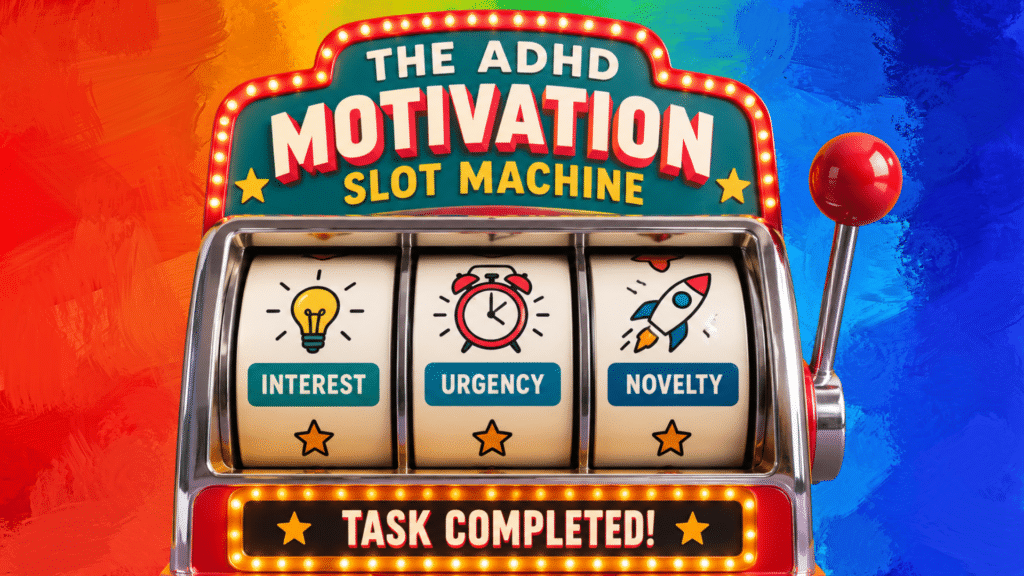
I’ve come to the conclusion that ADHD motivation appears to follow a set of rules that it’s not bothered to explain to the rest of us. And quite frankly, some of them are completely unreasonable. More often than not they appear to make zero sense.
I NEED THINGS TO MAKE SENSE!
Because this is how it rolls for me. I can know something needs doing and genuinely want to do it. I can have the time, tools, ability and absolutely no good reason not to do it. And yet somehow, there I am, three hours later, having achieved the square root of sod all. But if something mildly interesting but totally irrelevant shows up, I’m the most dedicated, focused and determined person you’ve ever met.
It’s a really strange contradiction, particularly when you’ve spent much of your life believing that motivation is something you’re supposed to be able to summon up through sheer willpower. We’re led to believe that ‘wanting it bad enough’ is all you need. God, there are a million motivational straplines backing up that fallacy, and yet it’s a lovely theory that a lot of our brains just didn’t buy in to.
One of the more discombobulating things about ADHD for me is that even when I know something is important, and that I need to get on with it, that doesn’t necessarily make it interesting enough to do!
My magpie brain pays attention if it’s interested, or the task is novel or a bit challenging. Ooh, I love a challenge….until I don’t! Add ‘urgent’ to the mix and it’s properly sitting up paying attention. What is really craves, above everything else, is the shiny new exciting thing. That almost always pushes everything else to the bottom of the stack regardless of priorities.
And don’t get me started (literally) on the familiar mundanity of the regular things I need to do. Regardless of how important they might be. “Eat the frog” was clearly not a strategy built for this magnificent brain. Get the rubbish stuff out of the way first? Erm, nope! In fact, that whole phrase is a nope for me. Far too literal! Imagine how chewy it would be.
Of course, from the outside, it can look as though we’re choosing the things we enjoy and ignoring everything else. But there’s a big old difference between choosing not to do something and struggling to find the motivation to actually do it. It’s not that we’re incapable of doing boring things. If that were true, most of us would have given up hoovering back in the 90s. To be fair, some of us did! It’s just that getting ourselves to crack on with them can be excruciatingly tricky. Which is bloody inconvenient when adulthood consists mostly of doing things that aren’t remotely shiny.
I can spend six hours researching something that started as a random thought. I’ll invest an inordinate amount of time, I more often than not don’t have, investigating every possibility. Following all the interesting tangenty goodness, emerging with the level of information that might earn me a seat opposite Magnus Magnusson, in the giant Mastermind seat….Were that still a thing. (RIP, Magnus). Even when that subject was something I knew nothing about hours earlier. The mating habits of a shrew?…….pro-level knowledge in less than a working day!
But ask me to take a few pictures of my boiler and I’m kicking that ‘bore me’ task down the road until I’ve been chased at least 3 times. And It’s not necessarily the amount of time something takes that determines how difficult it feels. Sometimes I find a complicated project is easier to start than a straightforward email. Because the project has something to explore, problems to solve and decisions that feel interesting. The email has a subject line, three sentences and absolutely no redeeming features.
And this is where, for me, the whole thing makes no logical sense, because I clearly have the ability to concentrate, often to the point where I forget to blink. And I can definitely work hard and follow things through. But those abilities don’t always come when I call them. And that can look like a lack of effort from an onlooker’s point of view. Inside it feels like I have two entirely different parts to my brain, and both of them are ignoring each other.
This is probably the part I find most difficult to explain to someone who hasn’t experienced it. Because, even as I type it, I appreciate it sounds bizarre. And yet it’s my reality nonetheless. There are times when I genuinely want to do something, and I’m definitely not avoiding it. I’m not sitting there enjoying the experience of not doing it. In fact, I might be thinking about it constantly, feeling increasingly frustrated that I haven’t started.
But thinking about doing something and actually doing it are two completely separate departments. It’s like homeware and lingerie… not even on the same floor of the building.
And it turns out there’s actually a reason for this particular bit of madness. It’s called executive dysfunction, and it’s something a lot of us who are ADHD experience. Basically, our brains can struggle with the processes that help us get from wanting to do it, to actually doing it. Stuff like planning, prioritising, organising and, rather importantly, getting started.
So we can know exactly what needs doing, genuinely want to do it, and still find ourselves sitting there waiting for our brain to read the memo.
Which is why being labelled lazy sucks. Because it suggests we can’t be arsed, when that’s not what’s happening here. The willingness is there, hanging out with intention and more often than not a whole load of frustration. It’s like a dysfunctional team meeting where everyone has turned up, but nobody’s actually doing anything.
And telling someone to just get on with it is rarely the revelation people seem to think it is. Believe me, the thought has occurred to us. Hell, we’ve said it to ourselves multiple times.
But along with its second cousin, “calm down”, and its strange aunt, “just don’t think about it”, that particular bit of advice needs to be thrown into the sea. Because the difficulty is rarely not knowing what needs to happen. It’s getting the brain on board with that idea.
And just when you’ve set fire to the idea of productivity, along comes a deadline. It swaggers into view with the arrogance of knowing that suddenly the abandoned task has just become entirely possible. Not only possible, but urgent, absorbing and worthy of every available brain cell.
It’s almost impressive. If it weren’t so exhausting. Urgency can be a powerful source of activation for people with ADHD, as the heat starts to turn up with an approaching deadline. But it’s not toll-free. Yes, it can make a task you’d filed under tedious suddenly wink at you, but it’s often late to the party and comes at a cost.
Because whilst there’s something truly exhilarating about pulling off a last-minute miracle, it’s a bit like a rollercoaster. Stay on it too long and eventually you’re going to feel sick. The stress, adrenaline and disruption to everything else are the price we pay for that buzz of knowing we got there in the end. And as I clamber out of the cave into the light after one of these occasions, I can often be heard muttering to myself, “Next time I will definitely start earlier.” But… spoiler alert… I probably won’t!
Don’t get me wrong, I meant that empty promise when I said it. I had big plans for future Hannah, but awesome as she is, she’s a creature of habit and likes familiarity, even if it raises her blood pressure. It should be noted that this last-minute productivity is not proof that we could have done it sooner but chose not to. The conditions changed, as did the possibility. So I guess the trick is finding ways to create some of those conditions earlier to avoid the blue-light situation every time something needs finishing.
I suspect there are plenty of adults with ADHD who’ve spent years believing their issues around motivation are character flaws. In fact, I know there are as I’ve spoken to plenty. They’ve been told they’re capable but inconsistent, intelligent but disorganised, full of potential but somehow not applying themselves properly. And after hearing versions of that often enough, it’s surprisingly easy to start saying those things to ourselves.
We can become our own worst critics, prioritising perfection in a bid to avoid mistakes, and noticing the mess ups rather than the big wins. Comparing ourselves to those who seem to have everything just right. Of course, no one really does. But it can feel like that. And somewhere along the way, we start feeling ashamed that we can’t just do better.
The trouble is, shame isn’t a reliable solution to executive dysfunction. It can make tasks feel even more stressful, which makes them harder to begin. And before we know it, we’re caught in a guilt loop that’s doing nobody any favours. The less we do, the worse we feel, and the worse we feel, the harder it becomes to do anything about it.
And sometimes we excuse self-criticism as though it’s perfectly acceptable to berate ourselves. Better than someone else doing it, right? WRONG! Being hit with a stick still hurts, even if you’re the one doing it. And feeling bad about something is not going to help.
Of course, accountability matters. Life keeps chucking responsibilities at us, and deadlines won’t sod of, however much we wish they would. So, I’m certainly not suggesting that ADHD provides a lifetime exemption from replying to emails. But there’s a big old difference between taking responsibility for something and repeatedly telling yourself you’re useless because it doesn’t always come easy to you. One might actually help you move forward. The other just gives you another problem to deal with.
So what do we actually do with all of this? Because understanding why motivation behaves like Uncle Tony at your cousin’s wedding is useful, but it doesn’t magically get the invoices sent.
I reckon the starting point is recognising just how unpredictable motivation can be, and that sometimes changing the conditions around a task works better than demanding more effort from ourselves. We know that interest can be a powerful motivator, so why not use that to our advantage?
When I’m doing something particularly brain-numbing but essential (accounts, anyone!?), I sometimes set myself little time challenges. Suddenly, I’m racing against the clock rather than contemplating the misery of bookkeeping.
And if starting it is the difficult part that day, I try and break it into more doable chunks. Even if that first step is ridiculously small just to get our brain out of the cave. So it might be locating my accounts spreadsheet. That can be a whole task in itself, depending on which ‘safe place’ I have stashed it! I digress. Or if I need to write something I break it down into a plan, and that often gets me curious about how it will turn out, which then sparks some motivation.
External accountability can help too, but not in the form of someone a bit scary barking ‘just do it’ at you. Obviously! Working alongside someone, arranging a check-in or setting yourself a realistic interim deadline. None of this is revolutionary, and I’m sure you’ve already developed a few tricks of your own. The point is finding what works for your brain, rather than following someone else’s idea of how productivity is supposed to happen. And yes, what works brilliantly one day might be spectacularly useless the next. Because naturally, ADHD wouldn’t want us getting too comfortable.
But perhaps that’s the bit we need to get our heads around. We can spend an extraordinary amount of time and energy trying to make our brains behave like everyone else’s, rather than accepting that they don’t, and working with that. Not against it.
Because maybe the problem isn’t how we motivate ourselves. Maybe it’s that we’ve spent so long trying to follow rules that weren’t written for us, we’ve forgotten we can make our own.

For this neurodivergent AuDHD brain, time is fungible, and not all measurements of time are equal. A day on my fave projects zips past faster than a bullet train, but a day doing receipts is like wading through an emotionally draining swamp, full of spider webs.
My temporal perspective is often off and not by a little bit, it can be off by a whole universe. So it is time to go travelling in time, and who knows? Even space itself! To a place where nothing is as it seems, and time is both endless and always running out. The ADHD acts like a hall of mirrors, distorting your reflection, enhancing, augmenting, squeezing and outright lying to you about your own morphology.
Let’s take a look at my own specific Spiegelsaal of Temporal Distortion… My Brain.
This particular organic specimen of cognitive compute, eyes a task and thinks, in its best trade’s voice “Yeah, I can probably bang that out in 2 hours, maybe even an hour if I stop thinking about it and actually crack on. So, be a love, pop the kettle on and stand back, things might get a bit messy.“
With the best will in the world that’s magical thinking and downright self-deception at its core. FFW to Stuart 8 hours from now, and the job has gone through a few iterations, several rabbit holes and two unexpected trips to Screwfix. You find a man with a very ruddy complexion, probably tired, almost certainly sweaty, very definitely swearing, depleted in nourishment and with a thirst for the ages and feeling like he’s about to self-combust.
My wife will be nearby, gently chuckling, cheering me up and praising the effort, if not the efficacy and ensuring I am brought back to a baseline by plying me with food and drink, and packing me off to the shower with a cider. Deal with it, Cider Shower, try it, it’s a thing. Obv. only try it if the law allows and you are of legal age, consult an adult, wear PPE, ensure you have done the proper risk assessment and have applied for the correct permits in your jurisdiction, and have the necessary license and training to operate a water powered, domestic cleansing unit, whilst operating a sponge with an open alcoholic beverage in a moving shower spray, whilst wet. Yeah.
EDITOR’S NOTE – yes, I am editing my own blog, this is not the New Yorker – deal with it. (There’s the ADHD right there on the page… The side quest, the double side quest, the over sharing, but the detail though, I mean, c’mon – did it not paint… stobbit Stuart, man get back to the story – Oooh Bakewell tart, and a cuppa, don’t mind if I do! brb)
Lets just say I am not great at getting going, getting to the point or getting past a Bakewell tart and a cuppa. I am also not great at sizing up a task that I have not done before, or one with many variables, or one of those projects which ‘unfurls’ as it goes. They can be tricky. One of my customer’s pays me per piece of artwork. Ten hours or two, same price. There’s a scale too, more complex etc. But the gist is, if it goes over 2 hours, I am on my own time. That does focus you somewhat, but that’s the point.
Somewhat focused.
Not “Completely” focused.
Somewhat – and that is variable depending on which set of circumstances is currently happening…
It’s hard to accurately judge your capacity when your capability is not consistent.
However, if it’s a task I have done before then I am much better at sizing up the time budget and allowing for hiccups one might encounter.
Better… note that. “Better“, not perfect, not consistent, but “better” and that’s better, on some days…
So, lets have a quick review – so far, we have “somewhat capable” and “slightly better”, productivity going great so far in the ADHD Timeline then..
Working knowledge and muscle memory are one of the reasons I like order and routine. The precision of doing something to an agreed cost and hitting your allocated deadline is such a good feeling. But mess up and miss it, and the rage can start to descend, a pitch tar-like substance obscuring your senses, further exacerbating one’s ability to see things as they are, and suddenly the universe is against you and the world needs to shut up and do-one.
Where’s my sonic screw-up driver???
Then lets add in the hyperfocus, it’s a wormhole where hours go to die, you emerge with bladder/thirst/head/posture/cats screaming at you for relief from all their ailments. Side thought – I think first line of defence against Daleks, send in cats. That’ll confuse ‘em…
Anyway… back to the main plot.
It’s disconcerting to awaken from a self-induced miasma to find that the clocks have changed and we have a new Prime Minister but thankfully DFS still has a sale on, phew. I know how a bear feels after hibernating, I too need to eat – a lot.
Hyperfocus may produce a lot of work in short-order but going from 9am to lunch in one task without intermission, distraction or other side-quest is bewildering. I really feel like I “come to” – much like the giddy-fools who give themselves over to stage-hypnosis. I am fine, honka-honka! See? Nothing wrong, honka-honka.
There’s a temporal vertigo to hyperfocus, it can make your schedule as predictable as walking across a bouncy castle, tipsy, in clown shoes, that are, ironically too small. (Honka-honka.)
This means your own sense of time is often off. However, when not strapped into the hyperfocus express, destination; “detailed and done”. I can usually tell the time within 20 mins, sometimes within 5-10mins. Example;Last night, woke, thought It’s about 6am… checked watch 6:10am. Not a useful skill on your CV, but what aspect of neurodivergence is useful on a CV?
But if I am deep into a hyperfocus, or distracted by a myriad of conflicting and context switching tasks? Then, baby, I am more turned around about what time is is than Pete Burns at a hoola-hoop competition, in a maze. (Turned around, right round baby, right round).
This can create issues when pricing work, as I said, pricing comparable jobs is relatively straightforward (taking out the variable capacity), but sometimes you are quoting based solely on the time you’re putting into a project, and that’s where things get quite elastic.
It’s hard to judge how much time to allocate, but anything you plan can be derailed especially when you know that:
A) ADHD Chaos Raccoon could blow up your plan for a day by refusing to do as asked and instead you fix the three noisiest items in your office because they are driving you nuts (CREAKING FROM THE SHADE ATTACHED TO MY StuDio will end me if I do not sort it, GAH!)
B) Your brain decides that it needs the emotional regulation of not doing anything vaguely related to productive work. Instead it wishes to lie down in a spa and be pampered all day. But, as budgets are tight, a packet of GF choc biscuits will suffice and is 100% necessary before we get going. Guess I am off to the shops then…
Oh and a pot noodle if they have it.
Shut up!
No you shut up!!
anyway…
C) DID YOU SEE THAT “SQUIRREL”… and then we’re off to the dopamine mines, and in we plunge, headlong… again… What is it this time? The plural of Octopus is Octopodes you say? Fascinating, tell me more about Greek grammar, go!… A Scottish octopus is known as a Scotopus you say? Uh-hmm, right, right, right… Learning all sorts today.
And that’s every day, all day, and twice on the weekends (matinee shows from 2pm). It is just exhausting, like a wild unicorn on which you ride, off on a whim and a prayer. Yes, I know, it’s “wing and a prayer”, but such is my want that I thought it suitable in this instance to change it, as a literary flourish. And even that sentence shows I cannot be trusted to stay on course for more than five minutes, or a paragraph
That makes planning tasks a complete nightmare, you sit down, to do list in hand and it may as well have been someone else’s tasks because your brain is currently tidying your email inbox as it’s now the noisiest thing in your head. All whilst planning to alphabetise your paint storage, and, therefore, before you get to the list of “to do”, you have to complete the sidequests of doom! Where deadlines go to wither and die.
Plan all you like but as you skate into the day, ass-backwards and three FANTASTIC new ideas boiling your brain good luck on getting any of the items that must be done, done anytime soon.
Just sitting down to write this I’ve
… and made a coffee, which was warm 2 nanoseconds ago, and now is stone cold… why? (ah yes, writing “hyperfocus”, which as we’re discovering is slightly less focused today, the Unicorn is moseying through a pasture, rather than galloping the final furlong in the four-legged cryptid gold cup.) plus answered sundry texts and stared into space contemplating some deals we’re doing right now. NONE of which was on my list of to do.. NONE.
The cognitive load to stay focused is tremendous, even a cluttered desk can add to the overwhelm and I have had a cluttered desk for 5+ years. But no more! I have spent the past three weeks expunging and organising over five years of clutter and chaos in the StuDio. The weight is lifted and all the surfaces are clean and clear. Anything currently residing on my desk is 100% to do with my actions this week. I feel lighter and more focused with a clean and clear workspace, it’s a big accomodation to my own focus & concentration that I needed. And yet.. The above list says otherwise.
How you do one thing, is how you do everything
I’m often heard saying, and it is true of the environment in which you live as much as the work you do. I have struggled with my output for the past few years, several reasons, but mental health has been on a comeback and this is part of the “return to full-strength and focus” plan that I am working on.
But of course all of this can look like being a busy fool, standing still whilst the world spins on, obsessing about the symmetry of your acoustic tiles and adjusting lens stops on your webcam. However it all helps with the emotional regulation if I know my working environment is known, measured, managed and mine to control. From the outside it might seem like folly, but for me it has been about putting out raging fires and ensuring systems are in place to deal with my less regulated moods.
Good luck ignoring it, when the “Do Not Disturb” is on, that’s bad when it’s your own brain!
The Autist requires hyper-regulation, and now it is all tidy it can settle down and stop feeling quite so out-of-control.
So, what about the ADHD? Well a newly tidied space is a novelty, so we get that dopamine dump. The issue is when it no longer seems new and exciting, what then?
Yes, that is an issue, and one to watch for but the excitement of a clean slate and keeping things in order allows for more creativity to come to the fore. Thus I do hope that, for a while at least, the ADHD beast will be satiated. And it really is Dr. Technical and Mr. Hide-and-Seek. One shows up and keeps things in order until you need the services of an unhinged maniac who can conjure chaos into creative genius.
But yet; you want me to be on time for something? Good luck with that! I am either 30 minutes early or ten minutes late with a great story. For some reason I cannot just get somewhere 5 mins before, park and walk in. I’ve even arrived 30 minutes early and sat outside the venue and somehow still managed to be late into the actual meeting. Combination of distractions, phone, thoughts and a sudden urge to use the facilities, with panicked search for suitable arrangements. Gah.
And sometime the brain just will not budge, I can be sat, staring at the clock, and my brain’s both panicking at how close to the start of the meeting it is and why am I still in my PJs, whilst simultaneously thinking “I am sure I could answer that email, and check that stat, and fill in that form”… It’s like you can see the edge of the cliff approaching fast whilst you keep tuning the radio in the hope you’ll hit the “WBRW – the perfect soundtrack for plunging into the void…”
And ever was it so in my head. Time has not diluted the “gift”.
Teachers regularly reported “he seems bright, if only he would apply himself” or “Stuart is constantly distracted” or “Stuart can be a disruptive influence in the class“, of course I was disruptive, I DEMAND CHAOS, the alchemy of the creative process and then I get to impose ORDER plus I was probably bored, which is like kryptonite to my system.
(I’ll overlook the “seems like a bright boy”, SEEMS? Grrrr… heckled by my junior school teacher! Took years to land… ooof. Thx.)
To drag myself back to the throughline of this blog post, there’s also the energy required to wrangle the entire mess of the process to some tangible timeline. Deadlines are amazing at focusing the effort, and I gave myself to the 21st September to finish the tidying and get back on course and ensure it all was done. Is it ALL done, DONE? Lets go with “mostly” and I can upgrade to “yes” as I tick off a few cosmetic tasks.
Things can get into a terrible mess, but it’s my mess and when I am ready to unmess it then I will do and when I am able to spare the energy, but some messes come with emotional baggage, which really craters your capability. All that weight of expectation, your own scathing review or your current performance, and the anger at having to manage all of that and still be unable to do the thing you HAVE to do, which can make any task more slippery than a greased eel.
So what’s the big takeaway Stu?
Don’t store your eels and grease in the same container? Probably?
No!
That’s a terrible ending…
So, err, here it is…
This is not going to work for everyone in all situations but I find that in complex tasks, where the outcomes are unclear and variables may change, then I need to have a system to ensure I stay regulated and don’t spin out, chase rabbits down holes and general end up on a side quest or three.
I have this method where everything is broken into two columns – wish lists and deal breakers.
But this system allows me to choose and prioritise work according to my energy, time and available resources. It allows me to whittle down any complex project or other such multi-layered problem into “the things that HAVE to happen” and “ the things that, if they were to happen, then bonus!” – get the mandatory tough stuff done first, everything else is a bonus!
This can be adapted to suit a lot of situations – a social meet-up that you are obligated to attend? What are the deal breakers? Going is mandatory but staying, not so much… So, lets say 2 hrs is a deal breaker, 1 hr is a wish list item. Anything in between is going to feel like a win!
For me today’s deal breaker? Dealing with the utility company and their toothless threats… today I am Whatevs Kev, and they can swerve off.
Today’s wish list – get this blog finished, and as you can see, we’re smashing it! Yay! Mostly because I am not dealing with said Utility Company. And have the bandwidth and spoons to write the blog. If I did both then
A) Probably be dysregulated, definitely get wound up… and burn through energy…
2) No blog – or poorly thought through blog at the least due to lack of creative spoons
(note from future Stu – I smashed this out in one hyperfocus and day after I am editing this!)
You can use it for specific tasks, or to pick which tasks, I have used it to choose menu items when you get the “BIG BOOK OF ALL THE MEALS”… usually sticky, and then have to triage what you can eat, what’s allowed with what and all the other rules you unconsciously accommodate at home.
It’s a simple tool to help make sense of the complex, and I hope it helps.
There we are, take all that and do with it what you will; I’ve used this wish list/deal breaker process from buying a house, to deciding meals. It’s not foolproof and relies on gathering all the data for making the right decision. It also helps when things go awry, you can review and see if the “unexpected item in the baggage area” was predictable or was new info, and can help for decision making another time.
This process allows you to triage the entire task, project or other life event that you need to make some quick decisions about. It’s not perfect but it helps keep me grounded in my own best outcomes when dealing with any situation. I even used it when looking for a suitable candidate as a spouse. Yeah. Not exactly romantic, but my partner is amazing and ensures my best interests are always met, and I do the same for her, you know. Marriage/partnership/love 🙂
I do hope the above ramble will help, just a few thoughts around the challenges of having a brain that will not wear a saddle, won’t be told what to do and can sometimes take all your plans and decide we’re off to the seaside for lollies and chips.
As this winding narrative shows, sometimes the journey is the lesson, and I am hoping reading this has been a worthwhile journey.
What works for me, may not work for you, so do let us know if there’s anything you do to help retain some semblance of balance, control or regulation, always willing to add tools to the toolbox of life.
Listen to the Business Oddcast for more exciting tips and tales of misadventures in the garden of neurodivergence.
Strap in, we’re off for a wild ride
I would like to dedicate this specific blog to my great friend and co-host/co-producer on the Business Oddcast, Hannah, she’s supported me over the past month and allowed me to wander off and get this tidy up done. Thank you for your msgs and listening to my whingy whiny complaining. Lets now go smash it!

There’s a really uncomfortable problem with talking about neurodivergence when it comes to our work.
Because a lot of the focus is around the things we find difficult: the overwhelm, the executive dysfunction, the sensory stuff, the exhaustion, the communication differences, the fact an unexpected call can make us want to chuck our phone into the sea.
And all of those things matter, so we definitely shouldn’t stop talking about them.
In my last blog, The Performance Never Ends, I wrote about how much energy I can spend monitoring myself during meetings, phone calls, networking and all the other interactions that come with running a business. Understanding that has been massively important for me. But there’s another side to this conversation that I don’t want to lose, because I’m also really bloody good at what I do.
I can read a room. I notice things other people miss. I’m brilliant at joining dots, spotting problems and seeing opportunities. I can become deeply invested in understanding somebody’s business and will happily disappear down whatever rabbit hole is required to find out why something isn’t working. Give me a problem that interests me and I am basically a Labrador who’s just been shown a tennis ball.
None of that disappears because some parts of running a business take more out of me than they might take out of somebody else. And that’s where things get interesting, because what if the question isn’t whether neurodivergent people can thrive in business? Loads of us already are.
What if the better question is: how do we keep all the brilliant bits without sacrificing ourselves in the process?
This is something I wish I’d understood much earlier. For years, I assumed that if something left me exhausted, I must somehow not be very good at it. Surely if I was naturally good with people, meetings wouldn’t tire me out? If I was confident, I wouldn’t need to prepare so much. If I was genuinely capable, work shouldn’t require this much effort.
Except that doesn’t really stand up to scrutiny.
I’m very good with clients. I’ve spent most of my working life in roles involving people, communication, sales, strategy and relationships. I’ve presented, pitched, negotiated, managed teams and walked into rooms full of people I’d never met before and somehow managed to convince them I knew what I was doing. Most of the time, I did know what I was doing!
But some of the things that made me good at those jobs were also costing me energy. I prepared thoroughly. I watched people closely. I noticed changes in tone and body language. I thought about what somebody might need before they asked for it. I could adapt my communication depending on who was sitting in front of me.
Those are skills, and the fact that they sometimes come with an enormous energy bill doesn’t make them less valuable. That’s been quite a shift for me, because it means I’ve stopped using exhaustion as evidence that I’m somehow failing. Sometimes I’m tired because something was difficult. Sometimes I’m tired because I’ve been doing something incredibly well and my brain has been working its little socks off behind the scenes.
The outcome might look effortless. That doesn’t mean the process was.
The awkward part is that some of the habits that helped me succeed were probably never particularly sustainable.
Over-preparing is a great example. If you’re worried about getting something wrong, one fairly effective solution is to prepare for absolutely every possible eventuality. Research everything. Think through every question. Make notes. Make notes about the notes. Mentally rehearse the conversation several times and, as we’ve already established, prepare the other person’s lines for them too.
Does it work? Often, yes. You walk into the meeting incredibly prepared and do a fantastic job. Everyone is impressed. Lovely. Unfortunately, you’ve already used half a day’s energy preparing for a one-hour conversation.
The same can happen with over-delivering, being incredibly responsive, saying yes because you don’t want to disappoint somebody, working late because you lost several hours earlier trying to get your brain into gear, or taking on more than you really have capacity for and then somehow pulling it off anyway. From the outside, all anyone sees is the result, and when the result is good, it’s remarkably easy to keep doing the thing that produced it.
I think I’ve spent chunks of my career running on a highly sophisticated business system consisting largely of anxiety, adrenaline and sugary snacks. To be fair, it got quite a lot done. But there’s a difference between something being effective and something being sustainable, and I don’t think I understood that distinction for a very long time.
I think many of us have inherited some fairly peculiar ideas about what being professional is supposed to look like. Professional people are always available. They respond quickly. They don’t need much downtime. They can go from meeting to meeting without needing to stare at a wall for twenty minutes in between. They answer the phone when it rings rather than looking at it suspiciously until it stops. They also apparently enjoy networking breakfasts, although I remain unconvinced by this.
The trouble is that when you’ve spent years trying to fit that model, making things easier for yourself can feel like cheating. If I choose email instead of a phone call, am I avoiding something? If I don’t put meetings back-to-back, am I being less productive? If I decide that a huge networking event isn’t the best way for me to build relationships, am I missing opportunities? If I need time to think before answering a question, does that make me look less competent?
Increasingly, my answer to all of those questions is: who cares, if the end result is good?
My clients don’t benefit from me having three meetings back-to-back if I’m running on fumes by the third one. They don’t get a better strategy because I answered their email within seven minutes. Nobody receives bonus points because I made the process unnecessarily difficult for myself. Professionalism, to me, looks much simpler these days: do good work, communicate clearly, do what you say you’re going to do, and treat people well. Everything else is negotiable.
This is the bit I’ve become much more interested in since understanding my neurodivergence. I don’t want to make myself less ambitious. I don’t want to stop getting ridiculously excited about ideas, caring deeply about my clients or disappearing into a problem until I’ve worked out what’s going on. Those are some of my favourite things about the way my brain works.
I just don’t want to keep borrowing energy from myself to do them.
So I’ve started looking at the bits around the work. I never book days full of meetings anymore. I leave gaps because I know my brain needs them. I work from different rooms when I need a change of environment. I choose written communication when it makes more sense. If somebody asks me something and I need time to think, I’m comfortable saying exactly that rather than producing an answer on the spot because Professional Hannah apparently has all the answers immediately.
I’ve also become much more protective of the conditions in which I do my best work. I know that there are times when my brain is brilliant and times when asking it to produce anything useful is like repeatedly pressing the button on a remote control when you know perfectly well the batteries are dead. Past me would probably have kept pressing the button harder. Current me is much more likely to change the batteries. Or, depending on the day, abandon the television entirely and go and have a cup of tea.
None of these things makes me less serious about my business. If anything, the opposite is true. I’m finally treating my capacity as something the business depends upon rather than an inconvenient obstacle I need to overcome.
For years, I think I measured whether work was going well almost entirely by the external result. Was the client happy? Did I deliver what I promised? Did the meeting go well? Did we win the work? Did the business grow? If the answer was yes, then whatever I’d done to get there was obviously working.
Except I was leaving one fairly important question off the list: what did it cost me?
Not financially. Personally.
Did that piece of work require me to push through exhaustion for three days? Did I spend the whole weekend recovering from a week I’d apparently “managed” perfectly well? Was I constantly anxious? Had I agreed to something I knew I didn’t really have capacity for? Was the business succeeding because I’d become the resource it was consuming?
That’s a much less comfortable measure of success, but I think it’s an important one. Because a business can look successful from the outside whilst being completely unsustainable for the person running it. You can have happy clients, money coming in and a diary full of work and still have built yourself a job that requires more of you than you can keep giving. That’s not success I particularly want anymore.
For me, this is where the conversation about neurodivergent business owners sometimes goes wrong. We talk about adjustments, boundaries, energy management and doing things differently, and somewhere along the way it can start to sound as though we’re designing smaller lives because we can’t cope with the big ones.
That’s not how I see it at all.
I don’t protect my energy because I have less to offer. I protect it because I know how much I can do with it when it’s available, and there’s a huge difference between those two things.
Building a business around the way my brain works doesn’t mean lowering my expectations. It means creating the conditions in which I’m much more likely to meet them without flattening myself in the process. And yes, sometimes that means doing less. It might mean saying no to something, moving a deadline, leaving space between commitments or accepting that there are only so many people I can deal with in one day before my brain puts up the CLOSED sign.
But it also means that when I am working, I have far more of myself available for the things I’m genuinely brilliant at. That feels like a pretty sensible business strategy to me.
I spent a lot of years assuming that being good at something meant being able to keep doing it regardless of what it cost me. I don’t believe that anymore.
I’m still ambitious. I’m still fascinated by business. I still get overexcited about ideas, care far too much about solving problems and occasionally find myself doing considerably more research than any reasonable person could argue was necessary. I’m not trying to remove any of that.
What I’m removing is the belief that exhaustion somehow proves I’ve worked hard enough, that pushing through is evidence of commitment, or that if I make something easier for myself it somehow makes the result less impressive.
Because my business doesn’t need the version of me who can keep going until there’s absolutely nothing left. It needs the version of me who can still be here doing work I love in five, ten or twenty years.
The goal isn’t to become less brilliant at what we do. It’s to stop sacrificing ourselves in order to prove how brilliant we are.

An average working day in the life of a neurospicy business owner (specifically THIS neurospicy business owner!)
10am – I’ve got an online client meeting, which is always a bit of a struggle as I find meetings much easier in person. Without really thinking about it, ‘Client Meeting Hannah’ (CMH) has entered the virtual building.
She’s warm, interested, confident and hopefully making the ‘right amount’ (AKA ‘normal’ amount) of eye contact. Too much and she risks looking overly intense/creepy. Not enough and she looks disengaged. Ironically, my best engaged self is when I am not making any eye contact. That’s when my ears and brain concentrate best.
CMH knows what she’s talking about, but she’s also keeping half an eye on whether she’s talking too much about what she knows. There is, apparently, a very fine line between demonstrating expertise and accidentally delivering an unsolicited TED Talk.
The meeting goes well, but CMH feels wrung out like a sponge and needs to regroup her headspace before the next thing on the workday list. A cup of tea and CMH is ‘back in the room’, ready to make a phone call that she has been putting off. This requires a slightly different version of me, so in comes ‘Phone Hannah’ (PH).
PH likes to know what she’s going to say before she says it, ideally with several possible conversational routes planned in advance. This works beautifully until the other person completely ignores the script that PH has thoughtfully prepared for both of us and asks an unexpected question. Frankly, PH thinks that’s quite rude, as it throws her off her game and invites ‘Tangent Hannah’ (TH) into the mix.
We’ve met TH before, so no need for more intros. But needless to say, TH has inspired comments such as ‘let’s wrap this up’ and ‘I’ve got to jump’ from fellow workday interactors. So we try to keep TH in her box during a workday.
Then perhaps there’s networking, a presentation or a podcast recording. I don’t consciously decide to switch between these modes, and until I understood more about my neurodivergence, I didn’t even realise how much switching I was doing. I just thought this was what everyone did when they went to work.
And to an extent, it is. We all behave differently depending on who we’re with and what we’re doing. I don’t talk to a new client in exactly the same way I talk to my husband on the sofa, and I suspect the client is extremely grateful for that. But I’ve started to realise there’s a difference between adapting naturally to a situation and spending an enormous amount of energy monitoring yourself within it.
Because none of these versions of me are fake. They’re all me. But when you’re constantly checking which version of yourself the room requires, being “professional” can start to feel surprisingly like performing. And some days, it feels as though the performance never ends.
One of the strangest things about discovering I was neurodivergent later in life was realising how many things I’d been doing for decades without knowing why. I didn’t walk into meetings consciously thinking, Right, time to mask my autism, and yet I was aware that I had different ‘modes’ for different situations. I just assumed everyone was switching.
I’d spent years watching and learning what made interactions go more smoothly and implementing that into my own life. Sometimes that involved mimicking what others did, and other times it was a case of getting it wrong the first time around, licking my wounds and trying again.
I still have an inner monologue reminding me to:
Think what you’re going to say
Try not to interrupt
Don’t talk for too long
Look the ‘right’ amount of interested
Look relaxed, but not too much
Try not to look like you’re concentrating quite so hard on looking relaxed.
Can you imagine a world where you have to think about all this stuff, to this degree? To be fair, if you are reading this then it is more than likely your reality too.
Phone calls are a particularly good example. I’ve always liked knowing roughly what I’m going to say before I make one, and it’s pretty common for me to rehearse the conversation in my head first. Not just my part, obviously, as that would be amateur level. I prepare the other person’s responses too, which makes it particularly irritating when they decide to improvise.
Spoiler: They NEVER say what I had planned for them!
For years, I didn’t think any of this was unusual. I assumed everybody was doing roughly the same amount of preparation and monitoring underneath the surface, and perhaps some people are. The difference was that I couldn’t see what was happening inside anybody else’s head. I could only see how effortless they made it look. So, I learnt to make it look effortless too.
That’s the difficult thing about masking. It doesn’t always feel like putting on a disguise. Sometimes it’s simply a collection of tiny adjustments you’ve made over such a long period of time that you stop noticing you’re making them.
Business gives us an impressive (AKA overwhelming!) number of opportunities to practise this. There are client meetings, sales conversations, networking events, presentations, phone calls and those unexpected encounters where somebody asks what you do for a living and you suddenly forget every job you’ve ever had.
Networking Hannah (NH) needs to be sociable and interested without trapping somebody beside the coffees for forty-five minutes. Presentation Hannah (PH) needs to sound confident even if part of her brain is wondering whether everyone can see that she’s forgotten how arms work. Sales Hannah (SH) needs to talk about what she does without either massively underselling herself or sounding like she’s about to launch a twelve-week mastermind from a Lamborghini. Then there’s Unexpected Phone Call Hannah (UPCH), who has been given absolutely no rehearsal time whatsoever and more often than not just doesn’t answer the phone.
Being able to adapt to different people and situations is useful, particularly when you’ve spent much of your career working with clients. I’m very good at reading people, understanding what they need and changing the way I communicate accordingly. The problem comes when adapting stops being something you’re doing alongside the interaction and starts becoming another entire layer of work underneath it. Because it’s so blooming exhausting!
Imagine the cognitive load of listening to what somebody is saying whilst running some sort of quality control program in the background. Scanning the conversation, monitoring whether the talking has morphed into a rabid squirrel and suddenly becoming acutely aware of where your hands are. And now I’m thinking about where my hands are, I have absolutely no idea what the person just said.
It’s essentially a second job called Managing How Everybody Experiences Me (MHEEM), and annoyingly the overtime is self-funded!
The really exhausting bit, though, isn’t necessarily what happens while you’re in the room. A meeting might only be an hour long, but the mental work surrounding it can take up considerably more space than the innocent little square in your calendar would suggest.
There can be preparation beforehand, particularly if it’s somebody I haven’t met before or the meeting feels important. I’ll think about what I need to say, what they might ask and how the conversation might go. Sometimes that’s just sensible preparation. Sometimes I’ve mentally attended the meeting three times before the other person has even joined Zoom.
Then there’s the meeting itself, with all the listening, processing, responding and monitoring going on at once. And when it’s finally finished, you’d think my brain might congratulate itself on a job well done and move on with its day. Absolutely not.
Now we begin the post-match analysis. Back to the ‘talking too much’ paranoia. Did I explain that properly? Why did they make that face when I said that thing? Should I have asked another question? Did I promise to send them something? And what exactly did that slightly raised eyebrow at 10.43am mean? Meanwhile, the owner of the eyebrow has probably forgotten the entire interaction and is standing in their kitchen deciding what to have for lunch.
This is the bit I understand much better now. The performance doesn’t necessarily finish when the meeting does. Sometimes you’re still mentally standing on the stage hours later, checking the reviews.
Before I understood any of this, there were plenty of days when I’d get to the end of a working day completely wiped out and wonder what on earth was wrong with me. I’d look back at what I’d done and think, But I haven’t even done that much. A couple of meetings. Some phone calls. Maybe a networking event or presentation. Hardly an expedition up Everest.
What I couldn’t see was all the invisible work happening alongside those things. Understanding that has changed the way I treat myself enormously. These days, if I’ve had a day full of people and my brain has decided it’s finished by 4pm, I’m much less likely to start lecturing myself about resilience, productivity or why I should be able to squeeze another couple of hours out of it. I have a much better understanding of what I’ve been asking it to do.
In fact, it’s fairer to say that these days I try not to have a day full of people or back-to-back work commitments in the first place. I know that doesn’t make for the best use of my brain. It needs room to breathe and decompress, and I know that goes against everything we are taught in the ‘be consistent’ work mantra. But when I work with my brain rather than setting it up for failure, life is much nicer, and my work is both more enjoyable and more productive.
And there’s another thing I’ve had to learn: enjoying something doesn’t mean it isn’t tiring. I love recording the podcast. I enjoy good client meetings. I can have a brilliant time at an event and genuinely love talking to the people there, then come home and want nobody to speak to me for several hours. Both things can be true.
For a long time, I think I assumed exhaustion meant something had gone badly. Now I understand that sometimes it simply means something took a lot of energy.
Discovering I’d been masking for years made me seriously question myself. If I’d spent so much of my life adjusting myself depending on the people around me, then which version is actually me? The ‘real’ Hannah. And I don’t think there is a definitive answer to that. In fact, I am increasingly suspicious of anyone who claims there is.
Because I don’t believe that there is a real Hannah hidden underneath all of these other versions, peeling away the layers like an emotionally complicated pass-the-parcel and stepping into the light in a ‘dada!’ moment.
Client Meeting Hannah is me. Podcast Hannah is me. Networking Hannah is me. The version of me sitting at home in comfy clothes who would strongly prefer not to answer the phone is also very much me.
We all have different sides to ourselves, and behaving differently in different situations doesn’t automatically mean we’re pretending. I don’t need to speak to a client exactly as I speak to my closest friends in order to prove I’m authentic. There are some conversations that would probably become considerably more interesting if I did, but I’m not sure it would be a sound business strategy.
So I’ve stopped worrying quite so much about which version is the “real” one. I’m more interested in noticing where I have to edit myself the least. Who are the people I don’t rehearse around? Which environments allow me to say I don’t understand something without worrying how it’ll be received? Where can I admit that I need time to think, move around if I need to, or get ridiculously enthusiastic about something without simultaneously monitoring whether I’m being Too Much?
Those are much more useful questions for me than trying to uncover one definitive authentic self.
There’s a version of this conversation about unmasking that can make it sound as though the ultimate goal is to stop adapting altogether. Just say whatever you’re thinking! Reject all social expectations! Be completely yourself at all times! But I’m not sure that’s either realistic or particularly desirable.
Understanding masking hasn’t made me want to abandon professionalism, and I’m not about to start turning up to client meetings in my pyjamas in the name of authenticity. Although I work from home, so statistically speaking there’s a reasonable chance I’ve already attended meetings wearing something questionable below the camera line. What happens off Zoom stays off Zoom.
What has changed is that I’m much more interested in noticing where I’m performing unnecessarily. Do I really need to go to networking events that leave me wiped out when I build much better relationships one-to-one? Does that conversation genuinely need to be a phone call, or could we deal with it perfectly well over email? Do I need to produce an immediate answer, or can I just say, “I need to think about that and come back to you”?
I’ve also started questioning whether some of the things I spent years trying to edit out of myself were ever unprofessional in the first place. Being enthusiastic isn’t unprofessional. Needing time to process something isn’t unprofessional. Communicating clearly about what you need isn’t unprofessional. Neither is working in a way that allows you to do your best work rather than one that looks the way you’ve been taught work is supposed to look.
I still adapt. Of course I do. The difference is that these days I have much more choice about when that adaptation is useful and when I’m only doing it because I’ve spent most of my life believing that’s the price of fitting in.
I’ve grown rather fond of all these different versions of me. They’re not characters I’ve invented; they’re different parts of me that help me navigate different situations. And a few probably deserve a BAFTA for services to getting through networking breakfasts while appearing completely comfortable with the concept of making small talk over rubbish coffee and a pastry.
I don’t think the answer to years of masking is another set of rules about how we’re supposed to unmask correctly. That feels suspiciously like replacing one performance with another, and I think we’ve all got enough to be getting on with.
For me, it’s much simpler than that. It’s having more places, more people and more parts of my working life where I don’t have to think quite so hard about how I’m being perceived. Where I can use the energy I once spent managing everybody’s experience of me on actually experiencing my own life.
Perhaps the goal isn’t to work out who you are when the mask comes off. It’s to build a life where you don’t have to wear it quite so often.

So… blog on procrastination, flow state and hyperfocus… AND GO!
Just start Stuart…
Yep, it’s not that simple though is it brain?
No but you gotta do it, the deadline and all… Hannah will be disappointed.
Yeah, I know, exactly, so why won’t you just get started then, BRAIN?
Brain will not be told what to do, brain is brain, brain decides what brain does. You shut up ego. Brain in charge.
Arghhh. Just get on with it, I have consumed enough caffeine to power a 90s rave, just get the frig on with wording and typing.
::silence::
::silence continues::
::more silence::
::except it’s not ‘silence’ though is it?::
::It’s the bin lorry reversing, it’s the birds outside the door, it’s the couple screeching their true love vows at ear piercing volume, it’s the twat of a dog that just will not stop asking where the owner is because object permanence is not a thing for it, BARK BARK BARK… BLEEP FUCKING BLEEP. YEELL YELL YELL.::
And breathe….
When your brain decides that leaves rustling in the breeze is reason enough to stop focusing and forget what it was thinking about one minute and then three hours later we arise from our miasma and realise that hyperfocus got us again.
We’re gonna take a look at procrastination, flow and hyperfocus, maybe. If this brain cooperates and gets going. It’s been a hard three weeks recently and the heat has not played well with my productivity.
It’s not an unreasonable ask, one might think, to say to another functional grown adult, “Hey, could you take this task and do it?”
And, that other functional grown adult says “Yeah. I can do it. I will do it tomorrow.”
24hrs later…
“That thing you wanted me to do. I did it. Here.”
“Thank you functional grown adult, I truly appreciate you doing what you said you would do when you said you would do it.”
“That’s OK. Would you like to get coffee sometime? Just two professionals interested in the thing we did…”
“No.”
::awkward silence::
End scene.
Just because you have a deep wellspring of ideas, ready to give you all the good stuff, doesn’t mean it turns up when YOU want it to. We’ve documented this throughout the Oddcast, energy is patchy and can be unreliable, which translates to a lot of panic when deadlines loom. Like this blog!
But what does any of that actually mean Stuart?
Good question, thanks brain!
Well it makes for focusing on a topic quite challenging; when you’re an intellectual omnivore you feast on all the trivia, nommity nom. You want, no sorry, you NEED all of the details and have questions. And this is for EVERYTHING!
Not only is your brain coming up with all its own stuff, it also has millions of questions at any time, it is truly exhausting. So getting started is more like whack-a-mole, where you hope that one of the moles turns out to be the blog you wanted to write.
So you have all that just to get going and then you have to shut all the noise out, quieten it all down, and focus like a “LAY-ZERRR” (10 points if you did the Dr. Evil voice in your head 100 points if you did the little finger too).
Getting started might be a whole load of circling the landing strip before you tentatively try to touch down and get the work started. Procrastination can look like many things, but for ND brains it can be procrastination against your will. Your brain just refuses to settle down and get on with it, a myriad of competing actions, thoughts and demands all crashing in and demanding attention.
If you’re lucky you have a series of cues and triggers which help you forget the world at large and get into the work you want to start.
Ideally, as all the “one size fits all” self-help and business literature holds up the ideal productivity goal is to get into “flow state”, or “flow”, which the dictionary describes as:
A mental condition of complete absorption in an activity, marked by focused attention, diminished self-consciousness, and an altered sense of time,
Flow is often held up as the perfect state for achieving productivity, where you are “in the zone” or “locked in” and you are attuned to the work. First coined by the Hungarian-American psychologist Mihály Csíkszentmihályi, in his 1975 book ‘Beyond Boredom and Anxiety’
The concept has been widely adopted across a variety of fields and denotes absorption in one’s work. Named because, during Csíkszentmihályi’s interviews with chess players, dancers, artists, and athletes, the metaphor of a water current carrying them along, or flow of thoughts was used by several people to describe a state of function with moderate levels of psychological arousal, where you are unlikely to be overwhelmed by the work, but also not understimulated and bored.
But do not confuse flow with hyperfocus, they are not the same.
To use the water metaphor, flow is like being in a rubber ring, floating down a lazy river, maybe with a cool beverage in one hand and chilled vibes floating on the breeze.
And if that were possible in your ND brain then life would be all cake and candles, kumbiyah at sunset and a never ending hugathon (unlikely!). But here’s the inside skinny…
It’s a raging chaos, fire hydrant of ideas, with thoughts and actions cascading over each other. If flow is a day out to “Float Town”, hyperfocus is a ride down a white water rapids of ideas propelling you towards the waterfall of desperation and deadlines. A mind full of synaptic murmurations, diving and veering off, tangents meeting side quests, which in a Newton’s Cradle of ideas thwacks the next shiny ball into view for you to chase in a dopamine, sensory rush that never wants to end.
All of this is pointed at the object of your obsession, your hobby, or current special interest, a deep dive that seems to be endless, and the deeper you go the more you need to know, do or see. It can span multiple sessions too, where you snap out. Maybe you finally listen to your bladder, or your hunger. You peel your eyes off the object of your desire at that time but the itch is not scratched.
And that’s where flow state stops being flow state and starts to develop into something a little more hard-core-you-know-the-score. Where your flow state focus alights on a sweet spot, something you are really feeling, and then brain bends time and warps space and you are in a hyper-bubble.
You may even sleep, awake and find yourself unable to think about anything other than what it is you are focusing on. Eventually it ends, or diminishes enough for real-life to crash in and the light that burns twice as bright, lasts half as long.
And the neurodivergent brain burns so very, very brightly at times, which comes at a cognitive cost, well, at least for me. And that’s an issue, if your available cognitive bandwidth is an all or nothing full-fibre firehose at the all-you-can-eat data buffet then it can be overwhelming. It can take days to recover from a 2 or 3 day hyperfocus, where you have smashed out 30+ hours of work, often to a very high quality. But with every high, comes the lows…
You also have to live with your focus being fungible, it can be with you and then slip away just when you need it because you notice some small detail on a business card on your desk and your brain decIdes that’s the off ramp and away it is gone. If you’re lucky, it’s a pretty easy detour to navigate and you can get back on the freeway to hyperfocus town.
Literally time stops and others cease to be, you cease to be, you are nothing but the task in hand and the moment you are in, this is what buddhists train for their whole lives, it’s less about achieving and more about sustaining this beautiful feeling of freedom.
Your focus is narrowed to a sharp and very clear point, you’re aware of everything but nothing matters as your hearing, and eyes, brain and self melds into this one creature just doing their thing.
It’s a beautiful thing, right up until it’s not, and then you start to realise that things might be not right in the “body” department, and you snap out of the hyperfocus, like you de-warp and suddenly realise the control bridge is on fire and all the red shirts are dead. Plus if you do not pee like NOW… then… ooops…
Plus, call the Dr. and ask him why is my ankle in a weird position. Also, why are you pressing your foot into the floor so hard? Ouch it hurts, that’s gonna take days to stop aching.
All this because your body decides to ignore the Geneva Convention rules on interrogations and puts you into tortuous stress position for hours whilst your brain folds in on itself over and over like so much dough in an orgiastic release of dopamine and need for more. Forget you body… Brain be braining…. Nawwmmm, nawwnnnn… ahhhh it tastes really dopaminey.
Think of it like itching a particularly compelling scratch over and over and over and over and over and over and over and over until both the patch is red raw and so is your finger from all the scratching.
It’s a FIREHOSE. Absolute ruddy non-stop and you have to wrestle it to point in the right direction and hold it there for however long it is needed. It can be exhausting.
The hyperfocus is not something that can be summoned, it’s a flighty creature, some might call it by the familiar, “muse”, or the more prosaic “inspiration”. But it is attracted by certain rituals and spaces, provokers of state, and suggestors of the possible. Also the hyperfocus may literally have zero to do with the work you HAVE to do. Your brain bolts and you’re on a wild ride until it stops. Destination unknown.
There are definitely factors that will prevent a hyperfocus, tiredness, hunger, illness, cold, distractions, both physical and emotional, but it’s not guaranteed. All of this can mean that simply being hungry and a bit tired, maybe even a bit dehydrated, can prevent you hitting the big red hyper-warp access button. But may also contribute to the after effects, if you go in unrested, out of sorts or mentally already a bit spent, the end result can be very exhausting.
Hyperfocus is a superpower, like King Midas’ golden touch, sounds great until you realise the implications of such abilities, gives a whole new meaning to “polishing your (k)nob”. Two major hyperfocus sessions back to back is brutal, and I want to just lie down all the time.
Do not read this and think you can summon focus at will, you can’t, but you might plant some seeds and see early signs, and then get going and hope it all falls into place. The getting going is the hard bit, like the start of this entire piece. You might find a few sparks and fan them into a roaring flame. Your hope is the flame doesn’t turn into a forest fire that wipes out large swathes of your cognitive landscape.
It is a balancing act, can be dictated by circumstances beyond your control and when it hits you can be all consuming, but it is certainly not delivered at will. You have no control over it, or at least I have no control over it, when it lands, like an unwelcome visitor you have no idea when that will be or what time, including the 3am waking and need to write down the ideas.
However, there’s been lots of thinky on this piece, which means I have to go eaty/drinky and brain has to go rest.
If any of this has felt familiar then why not listen to an episode?
Or take our NeuroInclusive Workplace audit, to see how neuroinclusive your workplace is. You can then see how to make your environment more productive whether you are a solo-preneur or multi person team.
If you have any questions get in touch!