






Have you ever had one of those mornings where you sit down to work, read the same sentence on repeat, and somehow still have absolutely no idea what it says?
So, you make a cup of coffee, come back, read it again and discover that the words have not become any more meaningful since your attempt a few minutes ago. Annoying. At this point, you’re starting to think it’s a ‘you’ problem. Perhaps you’re tired or distracted. Or maybe it’s just another example of your brain refusing to cooperate on demand. You’ve decided to be productive, and it’s decided it’s not getting onboard with that idea. Thanks brain!
After about half an hour, you notice that the neighbour has been pressure washing their patio since they got up, the label in your jumper is sanding off a layer of skin from the back of your neck, and every device you own has apparently formed a small committee dedicated to sending you notifications. Suddenly, the problem looks slightly different. Perhaps you’re not struggling to concentrate.
Perhaps this room is just awful?
For years, this question never would have occurred to me. Like a lot of people, I assumed productivity was mostly about discipline. If I couldn’t focus, I just wasn’t trying hard enough. I needed a better system. A better routine. Maybe buy a nicer notebook. Because obviously this notebook was the issue. (Let’s be honest though… I was probably going to buy the notebook anyway. I do love a nice notebook.)
It never really crossed my mind that my environment might have used up half my brain before I’d even thought about turning on my laptop.
One of the strange things about productivity advice is that it tends to treat the environment like some sort of irrelevant wallpaper. It’s simply there while you sit at your desk, get your head down and crack on with your day. If you’re distracted, the assumption is usually that your mindset needs adjusting rather than your surroundings.
That has never really been my experience.
For many neurodivergent people, the environment isn’t something that quietly hangs out in the background, minding its own business. It’s often the very first thing our brain notices. Before we’ve even ventured into our inbox, our attention has already wandered around the room taking inventory. The lighting feels a bit harsh. Someone’s having a conversation in another room that we absolutely don’t want to listen to, but our ears have other ideas. There’s a smell we can’t quite identify but now can’t stop noticing. The heating has somehow managed to recreate both summer and winter within the space of ten minutes. The sleeve of our jumper keeps catching on our watch in a way that suddenly feels deeply unreasonable.
None of these are particularly dramatic on their own. They’re just little pieces of information. Tiny details. Background noise. Except they aren’t really background at all. They’re all asking our brain to process something before we’ve even started the job we came here to do. I wonder whether this is one of the biggest differences between how neurodivergent and neurotypical people experience exactly the same workspace. We can both walk into the same room, sit at the same desk and technically be doing the same job, yet our brains are processing completely different amounts of information before we’ve even opened the first email.
When you look at it like that, it’s perhaps not all that surprising that one person reaches elevenses feeling ready for another coffee, whilst the other feels like they’ve already done a full day’s work.
I’ve started thinking about this as a kind of sensory tax. We all understand spending time, and we’re painfully aware of spending money because they’re things we consciously budget for. But I don’t think we spend nearly enough time talking about spending sensory energy.
Every little irritation feels too small to matter. It’s a bit like having a toddler follow you around all morning asking, “Can I just ask you one quick question?” Individually they’re perfectly manageable. By question number forty-three you’re considering moving to a cave.
A flickering light isn’t exactly a crisis. Neither is an uncomfortable chair, a humming projector, someone chewing loudly (actually… that is a crisis), or the air conditioning making that strange rattling noise that apparently nobody else can hear. On their own they’re just mildly annoying. The sort of stuff most of us shrug off.
Collectively though, they feel like a personal attack on our nervous system. Each one withdraws a little more from the same energy account you’re trying to use for concentrating, making decisions, solving problems and remembering why you walked into the kitchen. By lunchtime you’ve spent half your cognitive budget without ever agreeing to it.
It’s a bit like discovering your bank account has been steadily charging you £1.50 every few minutes all morning. You probably wouldn’t notice the first few payments. Or even the tenth. But by lunchtime you’d definitely be wondering where all your money had gone. Our brains can function in much the same way.
The frustrating part is that none of these little things are usually enough to stop us working altogether. They simply make everything trickier. Thinking takes longer. Making decisions become almost impossible. Don’t even get me started on trying to hold a conversation whilst simultaneously pretending the humming light above your head isn’t slowly consuming your last remaining ounce of patience.
By mid-afternoon we’re exhausted, pondering why we’ve achieved so little, when our brain feels like it’s completed an ultra-marathon. It’s just that most of the miles were spent processing everything except the work we sat down to do.
For ages I didn’t see any of this. I simply assumed I needed to become more disciplined. More organised. More resilient. Looking back now, I realise my brain wasn’t refusing to cooperate at all. It had simply been working incredibly hard on things I’d never even counted as work.
Of course, it isn’t just physical spaces that do this. When most people think about sensory overload, they picture noisy offices, bright lights or packed trains. And yes, those absolutely can be brutally exhausting. But some of the noisiest environments I spend time in don’t make any noise at all.
They’re on my laptop.
I’ll open it on a mission to do one specific thing, and before I know it my desktop is itching my brain with all the bizarre screenshots I’ll never use, whilst the little red circle of doom on Outlook reminds me I have emails I haven’t opened.
WhatsApp is flashing away in the corner, and there are too many browser tabs open to reasonably justify. I can only assume a younger version of me thought they were all absolutely essential because I certainly can’t explain them now. I’m also fairly sure there are at least three open because I didn’t want to lose something interesting, despite not looking at them since approximately February. Somewhere underneath all of that is the piece of work I intended to do, still waving at me from behind everything else that’s competing for my attention.
Nothing feels particularly urgent on its own, but together it’s like a smoke alarm in my brain. We tend to think of interruptions as big, obvious events. A phone call. Someone walking into the room. A colleague asking a question. In reality, some of the biggest interruptions are tiny. A notification you don’t even open. A quick glance at your inbox. Deciding whether you should just check your calendar before you forget.
Each one only steals a few seconds, but before you know it you’ve spent the entire morning switching between those few seconds. By lunchtime it feels like you’ve been busy all morning yet somehow haven’t actually done anything.
One of the biggest changes I’ve made over the last couple of years has been changing the question I ask myself. Not because I’ve finally become brilliantly self-aware. I haven’t. My default setting is still to assume I’m the problem, and I suspect that’s true for quite a few neurodivergent people. We’ve had lots of practice.
But every now and then I catch myself halfway through telling myself I’m distracted, lazy or not concentrating properly and I stop. Instead of asking, “Why can’t I focus today?” I’ve started asking, “What’s competing for my attention?”
the answer genuinely is me. I’ve slept badly or my head is full of other things. But surprisingly often, the answer is sitting all around me. The room’s too hot. My phone won’t stop lighting up. Somebody’s mowing their lawn with the sort of enthusiasm normally reserved for international sporting events. You almost have to admire the commitment. I just wish it wasn’t always at precisely the moment my brain had finally decided to play ball. I’ve been interrupted so many times that my brain has given up trying to remember what it was doing in the first place.
I’m certainly not suggesting the environment is always to blame. Sometimes my brain has simply decided today isn’t going to be its finest performance. But I’d spent years assuming I was always the problem, and that’s a very different thing. Realising there might be other things competing for my attention turned out to be a surprisingly big shift.
I also find it fascinating how guilty we can feel about making tiny adjustments that help us. I’ll happily sit in a chair that’s making my back ache, in a room that’s too warm, whilst trying to ignore a conversation happening three metres away and pretending the constant stream of notifications isn’t bothering me. Suggest I put on some noise-cancelling headphones, though, and it feels like I’m somehow cheating.
It’s such an odd thing when you think about it. As though productivity only counts if it’s achieved under unnecessarily difficult conditions. As though struggling is somehow proof that we’re working hard enough. I have absolutely no idea where we learnt that.
These days I’m much more interested in reducing unnecessary friction than proving I can tolerate it. If moving to another room helps, I move. If softer lighting helps, I change it. If switching notifications off means I can finish what I started, that’s exactly what I do.
My husband can usually tell when I’ve reached my sensory limit because I start wandering around the house looking for somewhere my brain is prepared to cooperate. I’ll work in the office for a bit, then the kitchen, then the dining room, before eventually returning to the office like I’m presenting a particularly underwhelming episode of Location, Location, Location. Sometimes the room really was the problem. Sometimes I just needed a change of scenery. Either way, I’ve learnt to stop feeling guilty about going looking for somewhere my brain feels a little more at home.
None of those things miraculously make me brilliant at concentrating. They don’t magically transform me into one of those people who answers every email before breakfast and has a colour-coded to-do list. What they do is stop my brain wasting energy on battles it never needed to be fighting in the first place. And that’s a very different thing.
If you’d asked me a few years ago why I was struggling to concentrate, I’d almost certainly have come up with a list of things I needed to fix about myself. I needed to be more disciplined. More organised. Better at managing distractions. More resilient. There was always another way I thought I ought to improve.
What never crossed my mind was that my brain might already be doing an extraordinary amount of work before I’d even started.
One of the biggest gifts of understanding my neurodivergence hasn’t been discovering some magical productivity system or becoming one of those effortlessly organised people whose desk always looks immaculate and whose inbox contains fewer than ten emails. (I’m fairly convinced those people only exist in stationery catalogues.)
Instead, it’s changed the relationship I have with my own brain.
I still have days where I can’t concentrate. I still get overwhelmed. I still read the same sentence six times and somehow retain absolutely none of it. None of that has changed. What has changed is that I don’t immediately assume it’s because I’m failing.
These days I pause for a moment and look around instead.
Have I accidentally recreated Piccadilly Circus on my laptop? Has the pressure washer returned? Is my jumper slowly trying to remove the skin from the back of my neck? Has my brain simply been filtering and adapting for so long that it’s run out of steam?
Sometimes the answer really is that I’m tired. That I just need a break. But surprisingly often, the answer is wonderfully ordinary. Turn off the notifications. Close a few tabs. Move to another room. Put the headphones on. Take the jumper off.
They’re hardly revolutionary. They don’t magically transform me into someone who colour-codes everything and always knows where they’ve left their phone. What they do is leave my brain with a little more breathing space for the things that truly matter.
It isn’t about creating the perfect environment. I don’t think such a thing exists. Life will always be noisy, unpredictable and occasionally accompanied by somebody pressure washing a patio with Olympic-level commitment. But I’ve stopped believing there’s some sort of prize for making life harder than it needs to be.
These days, whenever I find myself reading the same sentence for the sixth time, I still ask myself the question that never used to occur to me. Is it me… or is this room just awful?
More often than not, the answer is a little bit of both. The difference is that I don’t automatically assume I’m the problem anymore. Instead of trying to become tougher, I’ve become kinder. And if understanding my neurodivergence has taught me one thing, it’s this:
making life easier for yourself isn’t giving in. Sometimes it’s simply understanding yourself well enough to stop making life harder than it needs to be.

We’re currently writing a “Handbook for the Recently Diagnosed” – a sort of primer, provided day one, that explains the practical, lived realities of neurodivergence.
A lot of commentary, narrative thrust and general focus in neurodivergence and particularly autism circles, is to define, delineate and describe what‘s going on, we do like definitives after all. But, and I must admit my research is probably flawed, but, there’s little I have read, seen or gleaned online that looks at the practical realities of living, learning, earning and, well, life in general getting by with a brain that is a wild stallion at a petting zoo on good days. On bad ones, that beast has broken out the paddock and is doing doughnuts in an Asda car park at 2am… Story for another time perhaps.
There’s various testimonies and lived experiences but mostly it’s a lot of frustrations, venting, self-therapising, and lived experience, but not a comprehensive “if this, try this” a kinda Sam Costa’s top tips for living day-to-day with a recalcitrant and magnificent brain.
The thing is, that however you arrive at “Destination Diagnosis”, either self-realisation or formal assessment, the lived reality of what your brain and nervous system IS, allows you to start building a better life. HOW you arrive is of no importance, THAT you realise who and what you are, that’s massive.
Once you’re dropped off at “Destination Diagnosis” that’s it, there’s no one to meet you at the pick up point, yer on yer own, make us proud kid! There’s no courtesy bus, no welcome wagon, no taxi. There’s not even a signal, wifi or vandalised phone box to sob in.
The support post diagnosis is, at best, woeful. You may get some links and a leaflet, I share exactly what I got later in this post. Whatever your thoughts on support, just think about the lived experience of the person living for 30+ years and then getting told; yeah, all those “things”, yeah, you’re Autistic. That part in the movie where the plot twist gets revealed and just like that, ::insert wind blowing noise:: Keyser Söze has left the building, and you no longer know who you are.
Once passed the initial head trip “If I am not who I thought I am, then is anything real?”
You then turn to “What’s me? What’s the autism?” Erm… So if you are not who you thought you are why continue doing all the things you do? Are those things things YOU really like, or were they performative and for show, just to “fit in”? You do this high wire act alone, thankfully I had a very supportive partner and family, mostly because I HAD built a life the way that worked for “me”, and in fact “US”!
So, you may find yourself behind the wheel of a large automobile thinking, this is not my beautiful house, this is not my beautiful wife. HOW DID I GET HERE? And suddenly those lyrics take on a whole new dimension. Hat-Tip to awesome autist David Byrne and further extended hat tip to Tina Weymouth bass boss, and the rest of Talking Heads for that matter.
As Hughie Green might say, “and I mean that most sincerely folks!”
Who’s Hughie Green? Then you have clearly never seen the magnificent TV series Opportunity Knocks, a proto BGT where Hughie held court and I thrilled at the chance to one day be on the tellybox with my impersonations.
The child who would mimic everyone, spend hours walking round the garden having conversations, making up all the voices from the faces on the telly. A rich inner world that span on an axis that I controlled, much better than the world I saw outside my head.
That world proved to me over and over, from school, clubs, training and workplaces that if you do not fit the model of human they expect, you’re instantly the issue, the weirdo, the “difficult one”. Or the medical establishment tries to “fix” you, or at the very least ensure you’re not a problem for the rest of gen. pop.
This is why, now more than ever, we need to build a neuroinclusive workplace, in fact we need a neuroinclusive society. The benefits would be to EVERYONE not just the NDs suffering daily to be heard, seen and taken seriously. Ease of communication, understanding of different styles and approaches would help all of us, whatever our neurotype.
::Stuart steps off ADHD Tangent Soapbox::
When we last check in our hero was raging at the lack of support post-diagnosis…
Let me share with you the full extent of the support that you get once you have a formal diagnosis.
At the point of formal diagnosis, a process which, for many people is both frustratingly long, offering you a lengthy wait or a big bill as your choice, before sitting in front of assessors and finally getting granted a certificate to put on your wall. (Spoiler Alert: there’s no certificate!)
Before you get that “prize” there’s a tortuous and exhausting process to go through, with questionnaires, appointment chasing and interviews all whilst hoping your executive function does all the right things at the right time – I nearly blew it because I missed a crucial step in one email and failed to fill one part of a form.
This process comes after many months/years of research into every aspect of neurodivergence as you wait, the doubt gnawing at you. The entire process is not built with ND brains in mind. The energy required, the executive functioning required, the focus and the FORMS! DAMN YOU FORMS!!! ::runs outside, shakes fist at sky::
The endless, frustrating questions, where you mostly want to answer “IT FRICKIN’ DEPENDS!”… Can I wear socks, well, yes, I CAN wear them. Do I want to wear them? IT DEPENDS? Also, what sort of socks are we talking about? My socks, socks that I have been handed that are warm/wet/white? A lengthy woollen hose or a short sports sock? C’MON PEOPLE, I NEED DETAILS!
Whilst you wait for this process to reach destination diagnosis, you deep dive into the entire back history of, and any topic associated or tangentially related to, neurodiversity and consider possibly doing a PHD in it. (deep breath)
after doubting yourself and thinking you will be charged with wasting the NHS’s time, you get formally diagnosed. Apparently no, it is not normal for people who are not “on the spectrum” to spend 2 years and countless hours and money on trying to disprove that you are indeed “a bit special”. But at age 56 I was running out of things that it might be!
I once even considered the notion I was a psychopath – just because it might then offer me some respite to this one question “WHY AM I SO DIFFERENT?”
But whatever your pathway to finding out the reality of the situation, as a late diagnosed adult I want to share everything you get given and all of the facilities, funding and general underlying support you get at the point of diagnosis.
So… Are you Ready? Are you Steady? Is your name Eddie? (My Mum said this all the time… Hello if you ARE indeed an Eddie, welcome!)
Here’s the full package of support that you get…
DRUM ROLL…. brbrbrbrbrbrbrbrbrbrbrbrbrbrbrbrbr
You get an email with your full written report, which contains an assessment of every dimension in which your brain is broken, different and generally odd, all couched in medical terms that make you sound unhinged.
BUT WAIT… YOU ALSO GET…
AND THE CROWD GOES WILD…
“I’d like to thank my wife, my children, my good friend Hannah Logan…”
That’s it. You get a list of all the ways you are broken, deficient, and different, and some “Post-assessment resources“. The biggest of big woops.
“We’ve prepared some helpful guides to support you following your assessment.” enthuses the email…
NOTE - Hi - Editor Stu here it's 10 July 2026, just checked the diagnosis notification email received Sept 2025, 312 days and the link to those resources is broken, not even a full year. No post-diagnosis follow up, no counselling, or trauma support, pushed in the deep end, good luck. Well, I guess up to now I’ve survived, oh well keep treading water Stu.
…there’s absolutely no support directly after diagnosis. You’re just left to figure it out, and as someone very late diagnosed, I kinda been doing that since I was born, so, well I guess I just push on with the “cope and hope” strategy, seems to have worked (mostly) thus far.
You are right Sandra*, there is Access to Work – https://www.gov.uk/access-to-work – this is what the Gov. says about eligibility, “You must have a disability, illness or health condition that means you need support to do your job.” – Which is helpful, and genuinely could be of use if you need it, but I was not told about this and found out whilst doing some additional research for an Oddcast. But that’s the point, no one told me about it, I stumbled on it when looking for something else entirely!
*humble apologies to anyone with that moniker, including the lovely people I actually know, but it made me laff, I always hear it in a Birmingham, Midland, Black Country accent…
Yes, thank you Sandra, (you heard it in that accent then too, right?) you could also apply for a “Personal Independence Payment” (PIP) https://www.gov.uk/pip – but after two years waiting for diagnosis and having every part of your life poked and reviewed to see if, yes, he’s an “odd ‘un“, last thing you want is to dive into a whole other world of form filling and further means tested scrutiny.
And the horror stories I have heard first hand from friends who’ve applied and have been through, and still enduring, the process. It doesn’t sound like a fun time. I am not good with this type of bureaucracy, so best for them I do not go anywhere near it.
But that got me thinking… and one thing my brain does do well is solve problems, often at 3am, but timing is not my strong suit.
The movie with Michael Keaton, a young Winona Ryder, Alec Baldwin, Geena Davies, Catherine O’Hara – loved it since I saw it back in the eighties. My kids introduced me to the musical, which has recently landed in London and a family trip is planned. My daughter’s already seen it 4 times, it’s only been open for about a month! SPECIAL INTEREST much?
If you have yet to witness this marvellous film/musical, there’s a guide given to the newly-dead titled “Handbook for the Recently Deceased“, and so we arrive at the “Handbook for the Recently Diagnosed“, a not altogether original title as a quick Google will reveal, and it’s just the working title – more a sub-header, title page kinda thing.
Because, quite frankly, there needs to be something more concrete than “here’s a few links and some government support, that we won’t tell you about”, because quite frankly it’s disorientating to be told you’re not who you think you are. I spent so much time at odds with the world, out of step, misunderstood and struggling and now you tell me why!
It’s all a bit of a confusing time, and you have to start to reconsider so, so much about every aspect of your life. Having lived my own life since my mid twenties, and just got on with ploughing my own furrow, I had fewer barriers to employment than most, but it is still a disorientating time.
Aged 25 suffering a major burnout/breakdown/life flatline I just decided that I was going to stop listening to everyone else, they just seemed to not get, understand or otherwise process that my experience of the world was not the same as theirs. Their advice and guidance, may have been well meaning, and with a genuine interest in my best interest and good outcomes, but that didn’t make it any less wrong.
I’d spent 2.5 decades on the planet without knowing the reason, or having a “label” to help shape my perception and give me language to help me gain a full understanding of why I seemed to be out of step with everyone around me.
So I just opted out and started to forgive myself for being “odd” and not really being able to explain it. Various Dr’s attempted, psychotherapist, sleep experts, cognitive assessments and diagnosis from bipolar, and hypermania, via insomnia, and OCD and a whole cast and crew of ideas, symptoms and pharmacology all with added migraines! Which keeps you eternally hopeful that at some point you might find some semblance of “nOrMaL“. Whatever that might look like, but like most things in life you’d know what works for you when you see it.
and I have realised that the decision I made aged 25 was the start of it all. The self-acceptance that I was not broken, just different, magnificently fanatabulously awesome. I often thought I was an alien on a mission to gather as much knowledge as I could about humans, and studied them intently, fascinating creatures.
Hence my childhood mimicry mentioned at the start, which led to a career in stand-up and lookalike/impersonations because I followed my own intuition and backed myself. Everyone else’s feedback was along the lines of “REALLY? An Ali G lookalike? Nah.“, but I just knew I could do it, it wasn’t something scary to run away from, but something big and shiny to run towards.
I remember one specific gig, where I was a surprise guest, to give my wife a toast for her birthday, as Ali. The host/main act was sceptical, and openly so, when I told him what I was going to do. Anyway, afterwards he stated “you were amazing” and enthused that I was so much better than he’d thought I might be. And that’s the whole point, that you get underestimated, second-guessed and otherwise diminished. Yet, here we are 32 yrs later and I am still pursuing my shiny, sparkly, rainbow interests, dancing like everyone’s looking and knowing I make a positive difference to my community.
Deciding that rather than going to beg, like Oliver for a second bowl of gruel to fill me up, that I’d just start building a life that required nothing from anyone and I could make all the accommodations myself.
Why wait for permission to be magnificent?
Remarkable and extraordinary doesn’t look at the clock and wait until 9am on Monday to turn up in a suit. If my energy and passion arrive in a shipping container at 3am, then you betcha bippy I am going to be working, living and loving the project whenever my energy arrives.
In some regards it was a selfish decision (Insert Hannah – “a Necessary one!“), but I decided to put on my own oxygen mask first, you cannot do your best if you do not give yourself the best.
As a policy it only gets you so far, but I needed to withdraw from the toxic people around me to gain some perspective. I saw that actually, you need a community around you, you need others to help you see things you can’t and help you with the things you need help with. A family (whoever you call family!) is the first layer, then good friends who really understand you and have your best interests at heart also adds further protection. Expect false starts, and family members it’s best not to mingle with. Then you find your “community” or “tribe”, which adds strength in numbers, and validation.
This gives you space to figure out who you are and be accepted, and that’s all any of us are trying to do, get through a day, be understood, accepted for who we are and be valued for our whole self, not just the convenient bits, or the socially acceptable bits, but the whole of you.
It’ll share a lot of what we’re delivering with the Neuroinclusive Workplace giving practical steps you can take at work, home and everywhere you go, once you know what is actually going on in that amazing brain and nervous system of yours, an Owners Manual. It’s some thoughts, ideas and suggestions, allowing you to kind to yourself. Not a proscriptive list of tasks or must-dos, frankly that kind of book gives me the right itch.
This is more a pick it up and flick to the section that you most need to read at that time. Bit like a car maintenance manual, it’s the engineer in me, I do like a manual, the oilier the better!
There’s a long way to go, and we have yet to complete the first draft, or collate the research, but the plan is in place and like any worthwhile journey it’s going to take some time to get it completed.
But once it is ready – we’ll share it!
If you have any specific topic or other question that arose once you found out or were diagnosed as being neurodivergent, get in touch.
We would love to hear any insights or thoughts you had, or areas that you still are not sure about. We would love to hear from you and include your questions, or suggestions in the book.
Get in touch hosts@businessoddcast.com and keep your eye out for Neuroinclusive Workplace resources being added to the site. Sign up using the form below and join the mailing list for notification of everything Oddcast!
The funny thing about disability… actually no, sorry. That’s an appalling way to start a blog about disability. Let’s try that again. The strange thing about disability is that I thought I understood it. Not perfectly, obviously. But well enough to be able to join in a conversation about it.
If somebody had asked me a few years ago what disability looked like, I’d have given a pretty confident answer. I’d have talked about wheelchairs, white sticks and accessible parking spaces. The things most of us instinctively picture because they’re the examples we see most often. If somebody had handed me a piece of paper and said, “Quick, draw a disabled person,” I’d probably have reached for exactly the same mental image as a lot of people do. But I’m confident I wouldn’t have drawn someone without any visible signs of what we have come to understand disability to be.
And that wouldn’t have been through any lack of caring or need to be dismissive. Well… not consciously anyway. I just wouldn’t, at that point, have questioned what I thought I knew. And if we’re honest, that’s probably true of most of us. We tend not to examine our understanding of something until life gives us a reason to. And that’s exactly what happened to me.
Three years ago, or there abouts, was the beginning of my health starting to change rather dramatically. And I found myself having to navigate a world I hadn’t expected to become part of. Around the same time, I also started learning more about neurodivergence, accessibility and inclusion, and suddenly conversations I’d never really paid much attention to started making an awful lot more sense.
As my knowledge grew, and my thoughts evolved around this stuff, I realised it wasn’t that I’d been completely wrong. It was more that I’d only been looking at a really teeny part of a much bigger picture. Once I had realised that I couldn’t stop seeing all the bits I had been missing.
One of the things I found myself doing after my health changed was reading. A lot. Like a ‘forget to eat whilst you go down a long and winding rabbit hole of obsessive deep research until your eyeballs start to twitch’ level of reading.
I’d been dropped, Alice in Wonderland style, into a world I hadn’t expected to inhabit, and my instinct was to get ‘pro-level expert’ at understanding it all. So, I found myself reading about invisible disability, neurodivergence, accessibility, the Equality Act…amongst other things. Basically, ANYTHING that helped me make sense of what was happening.
At one point I stumbled across the legal definition of disability in the Equality Act. It describes disability as an impairment that has a substantial and long-term adverse effect on your ability to carry out “normal day-to-day activities.”
It’s a perfectly sensible legal definition. But WTAF is normal day-to-day activities. The more I’ve learnt about disability, the more suspicious I’ve become of the word normal.
There are common experiences and shared expectations, for sure. But normal? That feels rather dependent on whose life you’re looking at. For one person, a normal day might involve commuting into London, spending eight hours in a busy office, going to the gym afterwards and meeting friends for dinner. For somebody else, a normal day might involve pacing themselves carefully enough to get dressed, make lunch and still have enough energy left to enjoy an hour in the garden. Neither of those lives is more normal than the other. They’re just different.
That overly generic definition gave me the rage which fuelled a shift in my thinking. Instead of wondering whether people could do what society considered “normal”, I questioned why we’re asking everybody to experience the same world in exactly the same way. By doing that we’re creating unnecessary barriers, and the last thing disabled people need is that extra layer of bullshit. Once I’d seen that, I couldn’t stop seeing examples of those barriers everywhere.
Another thing the previous version of myself had been missing was invisible disability. I realise I’d been making exactly the same assumptions that many people still make now with me. Not because I was stupid, but because invisible disabilities are, rather inconveniently, invisible. By their very nature they are going out of their way to not be found.
Add the invisible element to something you’ve never had to think about before, and your brain quietly fills in the blanks. In the absence of there being nothing obviously visually to latch on to. If somebody sees a wheelchair, a pair of crutches or another visible physical impairment, most people instinctively understand that there will be barriers for that person. They might not know exactly what those barriers are, but they recognise that adjustments could be needed.
Invisible disability doesn’t come with the same advantage. If somebody sees me walking into a meeting, smiling, holding a conversation and clutching a cup of coffee like it’s life support (it is!), they more often than not assume they’ve seen the full picture. That’s how all of our brains work. We gather information from what we can see and then build a story around it.
The trouble is that we’re remarkably confident in those stories, even when we’ve only been given about twenty percent of the information. It’s a bit like watching the first ten minutes of a film and deciding you already know exactly how it ends. Occasionally you’ll get lucky. Most of the time you’ll be completely wrong.
What people don’t see is the constant mental arithmetic happening quietly in the background. I’m wondering how far I’ll need to walk, whether there will be somewhere to sit, how much energy something is likely to require, whether I’ll still be paying for it three days later, and whether saying yes to this means saying no to something else tomorrow.
And to be fair… why would they? Most of us don’t walk around giving strangers a running commentary on our nervous system. Imagine that conversation.
“Morning! Lovely weather. By the way, my nerve pain is on fire, my brain has decided today isn’t the day for processing information properly, and there’s a reasonable chance I’ll need a lie down in the imminent future.”
We don’t all do that. Partly because it’s personal. Partly because it would make for some fairly unusual small talk (and no one likes small talk at the best of times!). But also, because there can be a surprising amount of shame attached to admitting that you’re finding everyday things difficult. So, we become incredibly good at looking okay. Sometimes so good that people forget there was ever anything to manage in the first place.
I think that’s one of the reasons invisible disabilities can feel so complicated. Not because they are somehow less real, but because there is often an unspoken assumption that if people can’t see the struggle, then perhaps it isn’t really there.
Nobody says it quite so bluntly, of course. Instead, it appears disguised as comments like:
“But you don’t look disabled.”
“Well, you managed it last time.”
“You seem fine.”
The first time somebody said something along those lines to me, I remember thinking how strange it was. I also remember briefly wanting to throw them into the sea before immediately recognising that this was probably a slight overreaction. They weren’t trying to be cruel. They were simply working with the information they had and didn’t know they needed to look deeper.
But it did make me wonder what they expected disability to look like. Was I supposed to arrive with a warning light on my head? Wear a ‘special’ badge, or maybe some sort of high-vis vest that reads: “Warning: appearances may be wildly misleading.”
The reality is that pain doesn’t have a particular look. Fatigue doesn’t. Brain fog certainly doesn’t. Neither does sensory overwhelm, and any of the other things that are very real, but not visually obvious. Yet we’d somehow come to expect disability to announce itself before we’d believe it existed.
Incoming analogy — It’s a bit like watching somebody carry an incredibly heavy suitcase up a flight of stairs and deciding it obviously can’t have been that heavy because they managed it. You’ve seen the outcome, but you’ve completely missed the effort it took to get there.
It was whilst trying to make sense of all of this stuff that I stumbled across something that completely changed the way I understood disability. For the first time, I came across the Social Model of Disability. Giant lightbulb moment!
The first time I read about the Social Model of Disability it unsettled me. Not because I disagreed with it. Quite the opposite in fact. I was annoyed because it had taken me this long to find out about it. Why had nobody explained it to me three years earlier!?
It’s one of those ideas that, once it’s pointed out, it’s ridiculously obvious. And you feel stupid for not working it out already. Like one of those annoying 3D puzzle pictures that made all of our eyeballs and brains hurt in the 90’s. Where you’ve been staring at the same image for ages, pretending to know what it is, but refusing to share it with anyone else. As you have no clue. Then suddenly your older brother blurts out “it’s a rabbit” and suddenly it’s all you can see. From that moment on, your brain simply refuses to unsee it.
That was exactly what happened to me with the Social Model. Up until then, I’d always assumed disability was largely about the individual. If somebody was struggling, then surely the answer sat somewhere within them. Their condition. Their diagnosis. Their symptoms. Their ability to cope. It wasn’t a belief I’d consciously chosen. I’d simply absorbed it over the years because often that’s how disability is talked about.
The Social Model flips that whole idea upside down. Instead of immediately asking what’s wrong with the person, it asks “what barriers are getting in their way?”
That shift in language changes absolutely everything. At the beginning of my disability journey (that sounds like a trip you wouldn’t want to go on!) I’d been trying to solve the wrong problem. I’d spent too long assuming the environment was fixed and I was the variable. It hadn’t really occurred to me at all that the environment deserved a little scrutiny too. Once the switch was flicked in my brain, disability felt less like a conversation just about limitations, and more about accessibility.
It wasn’t just about what somebody could or couldn’t do. It was also about whether the world around them had been designed with them in mind in the first place. They’re two very different ways of looking at exactly the same situation. And once I’d seen the difference, I noticed it everywhere.
One of the examples that’s often used to explain the Social Model is a ‘staircase’. It’s brilliantly simple, because it’s so visual. Which is one of the reasons it has stuck with me.
Imagine two people arriving at the same building. A building that has a large flight of stairs into it. One walks straight up the stairs without giving the entrance a second thought. The other can’t get in because stairs simply aren’t an option for them.
For years, I suspect I’d have instinctively focused on the individual in this scenario. How do we help them? What support do they need? What adjustments can we make for them?
But the Social Model asks a completely different and much better question. Why is there only one way into the building? Why wasn’t accessibility considered when the building was designed? Why are we automatically treating the person as the problem when the entrance itself is creating the barrier?
The more I thought about it, the more I realised that this wasn’t really a story about staircases at all. Sometimes the barrier genuinely is a staircase. Sometimes it can be a workplace designed around the assumption that everybody thrives in a noisy open-plan office. Sometimes it’s harsh lighting, inaccessible transport, rigid working hours or communication styles that only work well for one type of brain. In every example, the condition is exactly the same. The person is exactly the same. The thing that’s changed is the environment around them.
That simple shift in thinking also helped me understand something else: the difference between equality and equity. I appreciate this feels a little like I’m schooling my readers at this point, but when I find out useful stuff there is no option in my brain to do anything but share it. Helpful in this case…hopefully. But less so the time I went on a deep dive about crocheting.
Sorry, I digress. Back to the subject in hand. Focus Hannah..
Equality says everybody gets exactly the same staircase. Which sucks if you can’t do stairs. But Equity stops to ask whether everybody can actually get into the building.
They sound remarkably similar (literally 2 extra letters. Who thought that was a good idea?), which meant that my brain confused them both for quite some time. But they’re very different ideas. One treats everybody identically. The other recognises that different people sometimes need different things to reach exactly the same goal.
I’d heard those words countless times before, but suddenly they stopped being abstract concepts and started making perfect sense. And, inconveniently, once I’d understood that, I started seeing metaphorical staircases absolutely everywhere.
I think this is one of the reasons the Social Model is so relatable to me. After spending years thinking accessibility was largely about ramps, lifts and accessible parking spaces. All of which are incredibly important, by the way. I started examining my own needs and saw how accessibility is also about lighting, noise, communication, flexibility, predictability and all the invisible things that make one person’s day perfectly manageable and another person’s feel like they’ve accidentally entered the Hunger Games.
And it’s easier to miss those invisible things (I’m not doing that joke twice), because they are harder for the majority of people to relate to. So, accessibility conversations centre more around the more physically obvious adaptations. They’re visible. They’re tangible. They make sense to us. We don’t often hear people talking about sensory environments, communication styles or the mental effort involved in constantly adapting yourself to systems that were designed with somebody else in mind.
As somebody who lives with both invisible health conditions and a neurodivergent brain, I really get how important the conversations are around the invisible barriers too. Because they are still very real, and equally debilitating.
There have been countless situations throughout my life where the challenge wasn’t actually the task itself. It was everything surrounding it. The noise. The sensory input. The expectations. The lack of flexibility. The assumption that everybody should be able to do things in exactly the same way, at exactly the same speed, with exactly the same resources available to them. For years, I simply assumed I needed to try harder.
Looking back, I can now see how many of those situations were made more difficult than they ever needed to be because nobody stopped to ask whether the environment was actually working for me. The onus was very much on me. It was a “me” problem.
That’s the bit that really sticks with me. It isn’t pretending that impairments, illnesses or disabilities don’t exist. Of course they do. My health hasn’t magically improved simply because I understand disability differently. What has changed is the way I understand the relationship between my body and the world around it. And the extra kindness I afford myself based on that knowledge.
I completely understand that sometimes the biggest barrier genuinely is our health. Sometimes it’s the environment. More often than not, it’s a complicated combination of both. The difference is that the Social Model doesn’t automatically place all of the responsibility on the individual to somehow overcome every barrier they encounter. It asks whether there are things society, workplaces, organisations and communities could do differently too. And that’s a much kinder place to begin than automatically assuming the problem always sits with the person.
I’ll admit the first time I heard the phrase Disability Pride, I wasn’t entirely sure how I felt about it. I think, like a lot of people, I misunderstood what it meant.
The word pride sounded oddly celebratory. Like “hurray, we can’t do stuff”, which felt really weird when there are many aspects of disability I wouldn’t choose to celebrate. Chronic pain isn’t exactly on my list of hobbies. Fatigue isn’t something I’m hoping to collect more of. Likewise, there are parts of being neurodivergent that can be exhausting, frustrating and genuinely difficult to manage.
So, the phrase made me pause, and pull a deep thinking confused face. A slightly disapproving visual ‘harumph’. But the more I listened to disabled people talking about Disability Pride, the more I realised I’d misunderstood it. Because It wasn’t about celebrating disability. It was about refusing to be ashamed of it.
Disabled people spend a ridiculous amount of time trying to become the least inconvenient version of themselves. Trying not to ask for too much. Trying not to need too much. Trying not to take up too much space. Trying not to make anybody else feel awkward or uncomfortable.
That ‘trying’ is something I recognise from so many conversations around neurodivergence. Around chronic illness. Around mental health. Around almost anything that makes somebody feel like they don’t quite fit the mould. There’s often an unspoken pressure to become easier. To accommodate, to understand, to ignore. And when I considered that I realised that pride isn’t really the opposite of struggle. It’s the opposite of shame.
If somebody has spent years being made to feel like they’re too much, too complicated or too inconvenient simply because the world wasn’t built with them in mind, then perhaps pride isn’t such a strange word after all. It feels like exactly the right one to me.
One of the biggest surprises over the last few years hasn’t been learning more about my own health but realising just how much my understanding of disability has changed.
Like many people, I started with a fairly simple picture of what disability was because I’d never really had reason to question it. Then life came along, added a few unexpected plot twists, and suddenly I found myself looking at the whole subject through a completely different lens.
The Social Model didn’t magically make my health conditions disappear, but it changed the questions I started asking. I became more interested in what barriers might be getting in the way, and whether the biggest barrier was my health or the world around me. Sometimes the answer was my health. Sometimes it was an expectation, an environment or a system that simply hadn’t been designed with me in mind. And often it was a mixture of things.
Knowing what I know now, I think we’d all benefit from asking those questions more often. Because, as a society, we’ve become surprisingly comfortable defining people by the things they find difficult.
We’d never introduce somebody by saying,
“This is Sarah. She’s terrible at parallel parking.”
Or,
“This is Dave. He can’t cook to save his life, and he’ll bore you to death on the topic of angle grinders, given half the chance.”
Those things might be true, but they tell us almost nothing about who those people actually are. Yet somehow, when it comes to disability, we can end up doing exactly that. We reduce wonderfully complicated human beings to the list of things they struggle with, rather than seeing the whole person standing in front of us.
I don’t want people to pretend my disabilities don’t exist. They’re part of my life, and sometimes they’re incredibly difficult. But they’re also only one part of my life.
I’m also a business owner.
A podcast host.
A wife.
A mum.
A daughter
A friend.
A woman who’s slightly too enthusiastic about analogies and will almost certainly buy another item of clothing she doesn’t need on Vinted before you’ve finished reading this blog.
Disability is part of who I am. It just isn’t the whole story. And perhaps that’s what Disability Pride Month is really inviting us to remember. Not that disability should be ignored. Not that struggle doesn’t exist. But that people have always been so much bigger than the labels we give them.
So perhaps the question isn’t, “What’s wrong with this person?” but “What barriers are we asking them to navigate that we haven’t even noticed?”. Because once you start asking that question….you stop seeing disability. And you start seeing people.
The funny thing about disability… actually no, sorry. That’s an appalling way to start a blog about disability. Let’s try that again. The strange thing about disability is that I thought I understood it. Not perfectly, obviously. But well enough to be able to join in a conversation about it.
If somebody had asked me a few years ago what disability looked like, I’d have given a pretty confident answer. I’d have talked about wheelchairs, white sticks and accessible parking spaces. The things most of us instinctively picture because they’re the examples we see most often. If somebody had handed me a piece of paper and said, “Quick, draw a disabled person,” I’d probably have reached for exactly the same mental image as a lot of people do. But I’m confident I wouldn’t have drawn someone without any visible signs of what we have come to understand disability to be.
And that wouldn’t have been through any lack of caring or need to be dismissive. Well… not consciously anyway. I just wouldn’t, at that point, have questioned what I thought I knew. And if we’re honest, that’s probably true of most of us. We tend not to examine our understanding of something until life gives us a reason to. And that’s exactly what happened to me.
Three years ago, or there abouts, was the beginning of my health starting to change rather dramatically. And I found myself having to navigate a world I hadn’t expected to become part of. Around the same time, I also started learning more about neurodivergence, accessibility and inclusion, and suddenly conversations I’d never really paid much attention to started making an awful lot more sense.
As my knowledge grew, and my thoughts evolved around this stuff, I realised it wasn’t that I’d been completely wrong. It was more that I’d only been looking at a really teeny part of a much bigger picture. Once I had realised that I couldn’t stop seeing all the bits I had been missing.
Who gets to decide what’s normal?
One of the things I found myself doing after my health changed was reading. A lot. Like a ‘forget to eat whilst you go down a long and winding rabbit hole of obsessive deep research until your eyeballs start to twitch’ level of reading.
I’d been dropped, Alice in Wonderland style, into a world I hadn’t expected to inhabit, and my instinct was to get ‘pro-level expert’ at understanding it all. So, I found myself reading about invisible disability, neurodivergence, accessibility, the Equality Act…amongst other things. Basically, ANYTHING that helped me make sense of what was happening.
At one point I stumbled across the legal definition of disability in the Equality Act. It describes disability as an impairment that has a substantial and long-term adverse effect on your ability to carry out “normal day-to-day activities.”
It’s a perfectly sensible legal definition. But WTAF is normal day-to-day activities. The more I’ve learnt about disability, the more suspicious I’ve become of the word normal.
There are common experiences and shared expectations, for sure. But normal? That feels rather dependent on whose life you’re looking at. For one person, a normal day might involve commuting into London, spending eight hours in a busy office, going to the gym afterwards and meeting friends for dinner. For somebody else, a normal day might involve pacing themselves carefully enough to get dressed, make lunch and still have enough energy left to enjoy an hour in the garden. Neither of those lives is more normal than the other. They’re just different.
That overly generic definition gave me the rage which fuelled a shift in my thinking. Instead of wondering whether people could do what society considered “normal”, I questioned why we’re asking everybody to experience the same world in exactly the same way. By doing that we’re creating unnecessary barriers, and the last thing disabled people need is that extra layer of bullshit. Once I’d seen that, I couldn’t stop seeing examples of those barriers everywhere.
The exhausting business of looking fine
Another thing the previous version of myself had been missing was invisible disability. I realise I’d been making exactly the same assumptions that many people still make now with me. Not because I was stupid, but because invisible disabilities are, rather inconveniently, invisible. By their very nature they are going out of their way to not be found.
Add the invisible element to something you’ve never had to think about before, and your brain quietly fills in the blanks. In the absence of there being nothing obviously visually to latch on to. If somebody sees a wheelchair, a pair of crutches or another visible physical impairment, most people instinctively understand that there will be barriers for that person. They might not know exactly what those barriers are, but they recognise that adjustments could be needed.
Invisible disability doesn’t come with the same advantage. If somebody sees me walking into a meeting, smiling, holding a conversation and clutching a cup of coffee like it’s life support (it is!), they more often than not assume they’ve seen the full picture. That’s how all of our brains work. We gather information from what we can see and then build a story around it.
The trouble is that we’re remarkably confident in those stories, even when we’ve only been given about twenty percent of the information. It’s a bit like watching the first ten minutes of a film and deciding you already know exactly how it ends. Occasionally you’ll get lucky. Most of the time you’ll be completely wrong.
What people don’t see is the constant mental arithmetic happening quietly in the background. I’m wondering how far I’ll need to walk, whether there will be somewhere to sit, how much energy something is likely to require, whether I’ll still be paying for it three days later, and whether saying yes to this means saying no to something else tomorrow.
And to be fair… why would they? Most of us don’t walk around giving strangers a running commentary on our nervous system. Imagine that conversation.
“Morning! Lovely weather. By the way, my nerve pain is on fire, my brain has decided today isn’t the day for processing information properly, and there’s a reasonable chance I’ll need a lie down in the imminent future.”
We don’t all do that. Partly because it’s personal. Partly because it would make for some fairly unusual small talk (and no one likes small talk at the best of times!). But also, because there can be a surprising amount of shame attached to admitting that you’re finding everyday things difficult. So, we become incredibly good at looking okay. Sometimes so good that people forget there was ever anything to manage in the first place.
I think that’s one of the reasons invisible disabilities can feel so complicated. Not because they are somehow less real, but because there is often an unspoken assumption that if people can’t see the struggle, then perhaps it isn’t really there.
Nobody says it quite so bluntly, of course. Instead, it appears disguised as comments like:
“But you don’t look disabled.”
“Well, you managed it last time.”
“You seem fine.”
The first time somebody said something along those lines to me, I remember thinking how strange it was. I also remember briefly wanting to throw them into the sea before immediately recognising that this was probably a slight overreaction. They weren’t trying to be cruel. They were simply working with the information they had and didn’t know they needed to look deeper.
But it did make me wonder what they expected disability to look like. Was I supposed to arrive with a warning light on my head? Wear a ‘special’ badge, or maybe some sort of high-vis vest that reads: “Warning: appearances may be wildly misleading.”
The reality is that pain doesn’t have a particular look. Fatigue doesn’t. Brain fog certainly doesn’t. Neither does sensory overwhelm, and any of the other things that are very real, but not visually obvious. Yet we’d somehow come to expect disability to announce itself before we’d believe it existed.
Incoming analogy — It’s a bit like watching somebody carry an incredibly heavy suitcase up a flight of stairs and deciding it obviously can’t have been that heavy because they managed it. You’ve seen the outcome, but you’ve completely missed the effort it took to get there.
It was whilst trying to make sense of all of this stuff that I stumbled across something that completely changed the way I understood disability. For the first time, I came across the Social Model of Disability. Giant lightbulb moment!
It’s one of those ideas that, once it’s pointed out, it’s ridiculously obvious. And you feel stupid for not working it out already. Like one of those annoying 3D puzzle pictures that made all of our eyeballs and brains hurt in the 90’s. Where you’ve been staring at the same image for ages, pretending to know what it is, but refusing to share it with anyone else. As you have no clue. Then suddenly your older brother blurts out “it’s a rabbit” and suddenly it’s all you can see. From that moment on, your brain simply refuses to unsee it.
That was exactly what happened to me with the Social Model. Up until then, I’d always assumed disability was largely about the individual. If somebody was struggling, then surely the answer sat somewhere within them. Their condition. Their diagnosis. Their symptoms. Their ability to cope. It wasn’t a belief I’d consciously chosen. I’d simply absorbed it over the years because often that’s how disability is talked about.
The Social Model flips that whole idea upside down. Instead of immediately asking what’s wrong with the person, it asks “what barriers are getting in their way?”
That shift in language changes absolutely everything. At the beginning of my disability journey (that sounds like a trip you wouldn’t want to go on!) I’d been trying to solve the wrong problem. I’d spent too long assuming the environment was fixed and I was the variable. It hadn’t really occurred to me at all that the environment deserved a little scrutiny too. Once the switch was flicked in my brain, disability felt less like a conversation just about limitations, and more about accessibility.
It wasn’t just about what somebody could or couldn’t do. It was also about whether the world around them had been designed with them in mind in the first place. They’re two very different ways of looking at exactly the same situation. And once I’d seen the difference, I noticed it everywhere.
The staircase that changed everything
One of the examples that’s often used to explain the Social Model is a ‘staircase’. It’s brilliantly simple, because it’s so visual. Which is one of the reasons it has stuck with me.
Imagine two people arriving at the same building. A building that has a large flight of stairs into it. One walks straight up the stairs without giving the entrance a second thought. The other can’t get in because stairs simply aren’t an option for them.
For years, I suspect I’d have instinctively focused on the individual in this scenario. How do we help them? What support do they need? What adjustments can we make for them?
But the Social Model asks a completely different and much better question. Why is there only one way into the building? Why wasn’t accessibility considered when the building was designed? Why are we automatically treating the person as the problem when the entrance itself is creating the barrier?
The more I thought about it, the more I realised that this wasn’t really a story about staircases at all. Sometimes the barrier genuinely is a staircase. Sometimes it can be a workplace designed around the assumption that everybody thrives in a noisy open-plan office. Sometimes it’s harsh lighting, inaccessible transport, rigid working hours or communication styles that only work well for one type of brain. In every example, the condition is exactly the same. The person is exactly the same. The thing that’s changed is the environment around them.
That simple shift in thinking also helped me understand something else: the difference between equality and equity. I appreciate this feels a little like I’m schooling my readers at this point, but when I find out useful stuff there is no option in my brain to do anything but share it. Helpful in this case…hopefully. But less so the time I went on a deep dive about crocheting.
Sorry, I digress. Back to the subject in hand. Focus Hannah..
Equality says everybody gets exactly the same staircase. Which sucks if you can’t do stairs. But Equity stops to ask whether everybody can actually get into the building.
They sound remarkably similar (literally 2 extra letters. Who thought that was a good idea?), which meant that my brain confused them both for quite some time. But they’re very different ideas. One treats everybody identically. The other recognises that different people sometimes need different things to reach exactly the same goal.
I’d heard those words countless times before, but suddenly they stopped being abstract concepts and started making perfect sense. And, inconveniently, once I’d understood that, I started seeing metaphorical staircases absolutely everywhere.
Invisible barriers are still barriers
I think this is one of the reasons the Social Model is so relatable to me. After spending years thinking accessibility was largely about ramps, lifts and accessible parking spaces. All of which are incredibly important, by the way. I started examining my own needs and saw how accessibility is also about lighting, noise, communication, flexibility, predictability and all the invisible things that make one person’s day perfectly manageable and another person’s feel like they’ve accidentally entered the Hunger Games.
And it’s easier to miss those invisible things (I’m not doing that joke twice), because they are harder for the majority of people to relate to. So, accessibility conversations centre more around the more physically obvious adaptations. They’re visible. They’re tangible. They make sense to us. We don’t often hear people talking about sensory environments, communication styles or the mental effort involved in constantly adapting yourself to systems that were designed with somebody else in mind.
As somebody who lives with both invisible health conditions and a neurodivergent brain, I really get how important the conversations are around the invisible barriers too. Because they are still very real, and equally debilitating.
There have been countless situations throughout my life where the challenge wasn’t actually the task itself. It was everything surrounding it. The noise. The sensory input. The expectations. The lack of flexibility. The assumption that everybody should be able to do things in exactly the same way, at exactly the same speed, with exactly the same resources available to them. For years, I simply assumed I needed to try harder.
Looking back, I can now see how many of those situations were made more difficult than they ever needed to be because nobody stopped to ask whether the environment was actually working for me. The onus was very much on me. It was a “me” problem.
That’s the bit that really sticks with me. It isn’t pretending that impairments, illnesses or disabilities don’t exist. Of course they do. My health hasn’t magically improved simply because I understand disability differently. What has changed is the way I understand the relationship between my body and the world around it. And the extra kindness I afford myself based on that knowledge.
I completely understand that sometimes the biggest barrier genuinely is our health. Sometimes it’s the environment. More often than not, it’s a complicated combination of both. The difference is that the Social Model doesn’t automatically place all of the responsibility on the individual to somehow overcome every barrier they encounter. It asks whether there are things society, workplaces, organisations and communities could do differently too. And that’s a much kinder place to begin than automatically assuming the problem always sits with the person.
Why Disability Pride Month matters
I’ll admit the first time I heard the phrase Disability Pride, I wasn’t entirely sure how I felt about it. I think, like a lot of people, I misunderstood what it meant.
The word pride sounded oddly celebratory. Like “hurray, we can’t do stuff”, which felt really weird when there are many aspects of disability I wouldn’t choose to celebrate. Chronic pain isn’t exactly on my list of hobbies. Fatigue isn’t something I’m hoping to collect more of. Likewise, there are parts of being neurodivergent that can be exhausting, frustrating and genuinely difficult to manage.
So, the phrase made me pause, and pull a deep thinking confused face. A slightly disapproving visual ‘harumph’. But the more I listened to disabled people talking about Disability Pride, the more I realised I’d misunderstood it. Because It wasn’t about celebrating disability. It was about refusing to be ashamed of it.
Disabled people spend a ridiculous amount of time trying to become the least inconvenient version of themselves. Trying not to ask for too much. Trying not to need too much. Trying not to take up too much space. Trying not to make anybody else feel awkward or uncomfortable.
That ‘trying’ is something I recognise from so many conversations around neurodivergence. Around chronic illness. Around mental health. Around almost anything that makes somebody feel like they don’t quite fit the mould. There’s often an unspoken pressure to become easier. To accommodate, to understand, to ignore. And when I considered that I realised that pride isn’t really the opposite of struggle. It’s the opposite of shame.
If somebody has spent years being made to feel like they’re too much, too complicated or too inconvenient simply because the world wasn’t built with them in mind, then perhaps pride isn’t such a strange word after all. It feels like exactly the right one to me.
Like many people, I started with a fairly simple picture of what disability was because I’d never really had reason to question it. Then life came along, added a few unexpected plot twists, and suddenly I found myself looking at the whole subject through a completely different lens.
The Social Model didn’t magically make my health conditions disappear, but it changed the questions I started asking. I became more interested in what barriers might be getting in the way, and whether the biggest barrier was my health or the world around me. Sometimes the answer was my health. Sometimes it was an expectation, an environment or a system that simply hadn’t been designed with me in mind. And often it was a mixture of things.
Knowing what I know now, I think we’d all benefit from asking those questions more often. Because, as a society, we’ve become surprisingly comfortable defining people by the things they find difficult.
We’d never introduce somebody by saying,
“This is Sarah. She’s terrible at parallel parking.”
Or,
“This is Dave. He can’t cook to save his life, and he’ll bore you to death on the topic of angle grinders, given half the chance.”
Those things might be true, but they tell us almost nothing about who those people actually are. Yet somehow, when it comes to disability, we can end up doing exactly that. We reduce wonderfully complicated human beings to the list of things they struggle with, rather than seeing the whole person standing in front of us.
I don’t want people to pretend my disabilities don’t exist. They’re part of my life, and sometimes they’re incredibly difficult. But they’re also only one part of my life.
I’m also a business owner.
A podcast host.
A wife.
A mum.
A daughter
A friend.
A woman who’s slightly too enthusiastic about analogies and will almost certainly buy another item of clothing she doesn’t need on Vinted before you’ve finished reading this blog.
Disability is part of who I am. It just isn’t the whole story. And perhaps that’s what Disability Pride Month is really inviting us to remember. Not that disability should be ignored. Not that struggle doesn’t exist. But that people have always been so much bigger than the labels we give them.
So perhaps the question isn’t, “What’s wrong with this person?” but “What barriers are we asking them to navigate that we haven’t even noticed?”. Because once you start asking that question….you stop seeing disability. And you start seeing people.
There is a very specific way to make me not want to do something.
Tell me I have to. That’s it. That’s the kryptonite!
It doesn’t matter whether it was already on my to-do list. It doesn’t matter if it was my idea. It doesn’t even matter if it’s something I genuinely want to do. The moment it starts feeling compulsory, some deeply stubborn part of my brain folds its arms, narrows its eyes and mutters “NOPE”.
I’ve had entire conversations with myself that go something like this:
“Right, today we’re finally going to finish that blog.”
“No, we’re not.”
“What do you mean, no?”
“We just aren’t.”
“But it was literally our idea.”
“Still no.”
At this point, I’m essentially arguing with myself like both parts of me are not, in fact, on the same team! If this sounds familiar, then welcome. Pull up a chair. This one’s for you.
Instead, I found myself in a bizarre stand-off with perfectly reasonable activities. The strange thing is that the task itself often wasn’t the problem. In fact, I was frequently interested in the task. I’d chosen it. Planned it. Sometimes I’d even been excited about it. Then I’d write it on a list. And suddenly it felt completely different.
For years, I thought there was something wrong with me. Surely if I wanted to do something, I should just be able to do it? It seemed logical enough. If I needed to send an email, send the email. If I wanted to write a blog, write the blog. If there was a task on my to-do list, complete the task and move on with my life like a sensible adult. (although, I have always felt that ‘sensible’ was overrated. But I digress)
The blog that had seemed exciting now felt oppressive. The email that would take three minutes somehow became a major life event. The phone call I’d intended to make all week was a weighted chain around my neck. It’s a weird experience trying to explain to people, particularly when the person creating the pressure is also you.
I once spent three hours avoiding a task that would have taken ten minutes. During those three hours, I managed to reorganise my desktop, research something completely unrelated, make two cups of tea, and stare out of the window. The original task remained exactly where I’d left it. Waiting patiently…mocking me with its judgy face.
I’ve come to realise that one of the most dangerous words in my vocabulary is “should”. I should post more consistently. I should be further ahead. I should have finished this by now. I should really sort that out.
The funny thing is that “should” sounds incredibly responsible. Like the sort of word used by people who always know where their car keys are and have a bottle of water on them at all times.
But for me, “should” always comes with some creepy companions. Like guilt, pressure, unrealistic expectations and a small suitcase full of shame. Before I know it, a perfectly manageable task has transformed into a judgement on my entire character.
And then the resistance arrives. The more pressure I apply, the more resistance I create. The more resistance I create, the more guilty I feel. Which makes me apply more pressure. It’s an impressively terrible system.
One of the reasons self-employment suited me so well was the autonomy. No manager. No clocking in. No annual appraisal where someone asks where I see myself in five years’ time. (Surviving. Ideally in stretchy trousers.)
For many neurodivergent people, self-employment can be genuinely life-changing. It gives us the freedom to work around our energy, our focus and our lives, rather than trying to squeeze ourselves into systems that were never really designed for us in the first place.
The autonomy is glorious. There is, however, one slight complication.
Whilst we’ve escaped other people telling us what to do, we’re now responsible for setting our own deadlines, creating our own structure and deciding what happens next. And if your brain is demand-sensitive, it turns out it doesn’t particularly care who created the demand.
The number of productivity systems I’ve lovingly created and then immediately rebelled against is frankly embarrassing. I’ve colour-coded calendars. Built project plans. Created beautifully organised task lists. Then looked at them the next day and thought, “Hell no.”
It’s a very strange experience setting your own rules and then immediately looking for loopholes.
At some point I realised that I spend a surprising amount of time negotiating with myself. Not motivating myself. Not inspiring myself. Negotiating.
“What if we just do ten minutes?”
“You don’t have to finish it.”
“Let’s just open the document.”
“Would a biscuit help?” (FYI – they ALWAYS help)
The thing is, choice changes everything. There is a huge difference between telling myself “You have to finish this today” and “It would be useful to make some progress on this today.” The task hasn’t changed. The outcome hasn’t changed. But the emotional response is completely different. One feels like being backed into a corner. The other feels like an invitation.
Over time, I’ve realised that my nervous system cares far less about the task than it does about how trapped it feels. The more choice I have, the easier things become. Which is deeply inconvenient for all the productivity gurus trying to convince me that discipline is the answer to everything.
For years I bought into the lie that I needed more motivation. More discipline. More grit. What even is grit!?! The internet certainly seemed convinced that was the solution. If you couldn’t do the thing, you simply needed to try harder. Push harder. Want it more. Whatever the latest advice happened to be.
The trouble is that pressure can absolutely produce results. For a while. Many of us become experts in last-minute heroics. We pull things together at the final hour. We work ridiculous hours. We create miracles under pressure and then wonder why we’re exhausted afterwards.
For years I thought this meant I worked well under pressure. I don’t. I work well under urgency. There’s a difference. One feels energising. The other feels like being chased by an angry badger. Or rather, what I imagine that would feel like. I’ve not actually lived that badger experience, thank god.
Eventually, constantly relying on urgency becomes exhausting. It’s like powering your business with emergency generators. It works, but it’s noisy, stressful and not particularly sustainable.
One of the biggest shifts for me has been replacing judgement with curiosity. Instead of asking, “Why can’t I just do the thing?” I’ve started asking, “What is making this feel difficult?” The answers are often surprisingly useful. Sometimes the task is too big. Sometimes I’m overwhelmed. Sometimes I’m exhausted. Sometimes I’ve accidentally convinced myself that a perfectly ordinary piece of work will determine the entire course of my future.
Sometimes the resistance is trying to tell me that I’ve taken on too much. Sometimes it’s warning me that I’m running on empty. And sometimes it’s simply because I’ve turned a minor admin task into a dramatic theatrical production inside my own head.
The point is that resistance usually contains information. Not always accurate information, admittedly. But information nonetheless. And understanding what’s underneath the resistance is almost always more helpful than shouting at myself for having it.
I think this is the bit that often gets missed. For some people, autonomy is a nice bonus. For others, it’s regulation. It’s the difference between feeling trapped and feeling capable. The difference between pressure and choice. The difference between fighting your nervous system and working alongside it.
Which is why so many neurodivergent people thrive when they can build flexibility into their lives and businesses. Flexible schedules. Choice-based planning. Working with their energy instead of constantly battling against it. Designing systems that support them rather than punish them.
Not because they’re lazy. Not because they lack discipline. But because autonomy changes how the whole system responds. Once you understand that, a lot of things suddenly start making sense.
For a long time, I thought the answer was becoming stricter with myself. More disciplined. More productive. More organised. Because I was the one to blame… I was letting the side down.
What I’ve slowly realised is that my nervous system was never asking for more pressure. It was asking for more autonomy.
The goal isn’t becoming somebody who never experiences resistance. The goal is building a life where you’re not constantly having to fight yourself.
Because if your brain experiences pressure as threat, then pushing harder isn’t always the solution. Sometimes the solution is creating enough choice, flexibility and autonomy that moving forwards feels safe again.
That’s why self-employment works so well for so many neurodivergent people. Not because we’re incapable of working hard, but because we’re finally able to build environments that work with our brains instead of constantly fighting against them.
And that’s a much better use of your energy than spending your life arguing with your own to-do list.

I have been described as many things over the years.
Scattered. Distracted. A bit random. “Can you just get to the point?” remains a personal favourite, usually delivered by someone whose patience ran out somewhere around the third tangent.
And, in fairness, I can kinda see their point.
If you ask me a simple question, you’d better have a cup of tea prepped and be ready to pull up a chair. Because there is every chance I’ll start in Hampshire, take a brief detour through a childhood memory from 1987, somehow involve a conversation I had with a client last week, and then arrive triumphantly at the answer twenty minutes later as though anything less than that level of detail would be a crime. And I make no apology for that, as to me it makes perfect sense.
It might look chaotic from the outside, but my brain isn’t randomly pin-balling off the bumpers, for the sheer sake of it. It’s connecting things. Following threads. Spotting patterns. Making links. The route may be unconventional, but I usually arrive exactly where I intended to go. It just doesn’t always travel by the roads other people were expecting.
This is the thing I wish more people understood about neurodivergent thinking. What can get labelled as scattered, unfocused or chaotic isn’t a dysfunction. It’s a completely different but magnificent operating system doing its thing. One that happens to be running several tabs, three side quests, a background process and an entirely separate investigation at the same time. Which sounds ridiculous until that same brain solves a problem everyone else has been staring at for three weeks.
Most people are taught that thinking should (don’t we hate that word?) be linear. Step one. Step two. Step three. Nice and neat. Predictable. Reassuring. The sort of thinking that owns a sensible filing cabinet and knows exactly where its passport is.
Unfortunately, many ND brains did not receive that particular software patch.
Our thoughts tend to arrive more like a spider’s web than a straight line. One idea triggers another. A conversation about marketing reminds us of a documentary we watched three years ago, which somehow links to a client problem, which unexpectedly sparks a completely different business idea. From the outside, it can look like we’ve wandered off topic entirely. Internally, however, there is usually a very logical chain of connections taking place at alarming speed.
The challenge is that we forget to explain the twenty-seven invisible steps in the middle. Or maybe we don’t feel the need to.
So whilst everyone else is wondering how we got from A to M, we’re already halfway to T. Then we become mildly frustrated because nobody else seems to be keeping up. Which is deeply unfair, given that we’ve shared approximately 3% of our working out.
The irony is that many of the same people who find this style of thinking confusing are also the people who later marvel at the solution it produces.
Who ever thought that ‘creative’ should be organised? Surely by its very definition it needs to be full of tangents, and ‘emergency stop’ moments?
As Stu says,”creativity is the sat nav of the brain. Truly creative thinking never welds itself to the ego or the concept of “right”. It takes various things “on advice” but it is free to fly to wherever it needs to and then backwards engineering the through line.”
Brilliant ideas are brilliant because they more often than not are non-conformist. They aren’t sitting in their sensible armchair, smoothing out their beige suit trousers, whilst pondering whether to opt for a plain digestive, or a custard cream.
No. They’re the sort of ideas that screech into your brain at 3am, and have you frantically reaching for a notebook before they eject themselves from your brain forever. The ‘thought magicians’ of the idea world, that make you both flinch and laugh at the same time.
Personally, my best ideas have arrived in the oddest of moments. In the shower, whilst driving, halfway through another task, and occasionally whilst trying very hard to think about something else entirely. My phone ‘notes’ app is a smorgasbord of wild brain dumps, including linkedin post ideas, future hobby goals and random numbers that seemed vital at the time, but now read like coded messages from a previous version of myself. I found one the other day that simply read 4690. Is that the code to my eternal happiness? Who knows…
And yet, hidden amongst the chaos, there is always something inspiring.
The problem is that we’ve spent years being told that good thinking should look tidy. So when our process looks sprawling and slightly feral, we assume we’re doing it wrong. But creativity has never really cared about being neat. It wanders. It explores. It takes the scenic route. And more often than not, that’s where the interesting stuff lives.
One of the things I’ve noticed about many neurodivergent people is how quickly their brains can move. Especially if they are sponsored by ADHD. And I say this with no judgement, being the proud owner of one of these magnificent brain beasts myself!
This all sounds wonderful until you’re trying to sleep. Or relax. Or watch a film without simultaneously redesigning your website, solving a client problem, planning next year’s content calendar and wondering whether penguins have knees.
But that same speed can be incredibly useful.
The ability to connect ideas rapidly means we often spot opportunities early. We notice risks before they become obvious. We see patterns emerging before everyone else has even realised there’s a pattern to look for.
I’ve lost count of the number of times I’ve had a strong feeling that something wasn’t quite right, only to discover a few weeks later that my brain had already spotted something my conscious mind hadn’t fully processed yet.
What often gets dismissed as overthinking is sometimes pattern recognition running ahead of the pack. Not always, of course. Sometimes it’s just anxiety wearing a fake moustache and pretending to be intuition. But not always.
I have never really understood why “having too many ideas” gets treated like a character flaw. Admittedly, it can make life slightly chaotic. But I’d still rather have too many ideas than none at all.
The problem seems to be more that these ideas all arrive with the confidence of drunk Ron at your local boozer, 5 pints of Stella in and telling you how he’d sort out the economy.
These over enthusiastic ideas are why some of us end up with six unfinished projects, three domain names, a half-written book, a business idea involving crochet, and a cupboard full of craft supplies we were definitely going to use.
Eventually, I realised the problem wasn’t having too many ideas. It was trying to store all of them in my head at the same time. But if you are able to create a home for these magnificent specimens. Somewhere safe where they could exist without demanding immediate action, like a notebook (do not take inspo from my notebook app!) Then the chaos just becomes a list of cool things you can come back to.
Because not every idea needs doing today.Some ideas just need somewhere to wait.
One of the biggest shifts in my own thinking came when I stopped viewing this style of thinking as something I needed to fix. Because in business, it’s often incredibly valuable.
Many ND business owners are exceptional pattern spotters. We notice tiny shifts in behaviour. Small inconsistencies. Things that don’t quite add up. We connect information from completely different places and somehow arrive at useful conclusions before we’ve fully worked out how we got there.
The funny thing is that these strengths rarely feel impressive from the inside. They just feel normal. Like surely everyone else is seeing the same thing.
They’re not.
What feels obvious to you is often the result of hundreds of tiny observations being quietly filed away in the background. Your brain has been collecting clues long before you’ve consciously realised it was solving a problem.
Then everyone acts surprised when you’re right…..Again.
When the chaos starts driving the bus
Now, before we all disappear into a dopamine-fuelled celebration of creative brilliance, there is a small caveat.
Chaos is wonderful right up until it isn’t.
Because whilst creative thinking creates possibilities, it can also create overwhelm. Every idea feels exciting. Every opportunity feels interesting. Every project feels like it could be the thing.
And before you know it, you’ve agreed to launch something new, redesign your website, start a newsletter, learn crochet, volunteer for a committee and somehow become responsible for organising the Christmas party.
The truth is that brilliance still needs boundaries.Not because there’s anything wrong with having lots of ideas, but because attention remains a finite resource. At some point, every opportunity cannot be the priority. Every exciting possibility cannot happen simultaneously. Trust me. I’ve checked.
I think structure gets terrible press in neurodivergent circles.The moment someone mentions planning, systems or organisation, half the room starts looking for the nearest exit (usually the ADHD half). But good structure isn’t there to suppress creativity. It’s there to protect it.
The right amount of structure creates a container. It gives your ideas somewhere to land. It stops your best thinking disappearing into the void because something newer and shinier turned up five minutes later.
It doesn’t have to be rigid or complicated. But some boundaries around things such as how many projects you can have on the go can be a real gamechanger. Because structure isn’t meant as a cage. It’s the thing that stops all your brilliant ideas escaping before they’ve had a chance to become something useful.
The older I get, the more I believe that half the things we were criticised for as children were actually strengths that nobody knew what to do with.
Too many questions.
Too many ideas.
Talking too much.
Daydreaming. (actually it’s blue sky thinking!)
Being “easily distracted”.
And yet they’re some of the same traits that show up again and again in entrepreneurs, creatives, innovators and problem-solvers. The people who challenge assumptions and constraints. Spot opportunities, test what’s needed and what’s excess baggage. Connect dots that everyone else missed.
I think the issue was never that our brains worked differently, but that we spent years comparing them to systems that were designed for a completely different style of thinking.
The challenge isn’t becoming less chaotic. It’s learning how to build a life that gives that chaos somewhere useful to go. Because the people changing things have rarely been the people thinking exactly like everybody else.
Perhaps the problem was never the chaos.
Perhaps the problem was being taught to see it as one.
AMEN!

One of the biggest mistakes local small business owners make is undercharging for their services. The price sort of being an apology for having to charge something, a fiscal acknowledgement you exist.
Hello, I’m Stuart and I’m a reformed undercharger. I have seen the light and thankfully I have been charging my value for almost 15 years now.
Phew, there, said it, feel like I have cleansed my soul. The awful truth is that at some level you KNOW you are undercharging, but seem unable to put the price you want. Probably due to a version of this conversation with yourself… (For this example I am going to use a product, but the same rationale goes for a service business.)
”OK, I’ve seen other businesses selling these for £X – so I will charge £X minus desperation tax.”
And the “desperation tax” part is the discount you make to the price to just get the ball-rolling, and “get some sales”. Because, if no one buys, well there goes your self-worth, your dignity, the world hates you and your RSD flares hotter than the Sun burping after a comet vindaloo.
Because price is not just what you charge, it’s how you get seen in the marketplace. It’s your self-worth. Price is as important as branding and what value you provide to your customers. Simply believing that:
“If what I make/do is good enough then it should sell”.
Right?
Wrong!!!
Take a look at something you own. Why did you buy it? Myriad reasons, wasn’t JUST price alone, right. Colour, size, cool-factor, you had one before, never had one before, you were lucky and it was just “there”.
Whatever your rationale, price is not the sole consideration in ANY transaction. You can get a Lidl instant noodle pot for £0.69p but if I fancy the same thing in a Motorway Service station, well… nothing says “I’m minted with money to burn” than buying a family meal at a Motorway Services in the UK. I once paid £3.50 for a pot of noodles. Granted it was a branded “Chonky Wide-Boy” size instant noodle, but still, a cup of coffee and a filthy pot of noodles shouldn’t cost you nearly a tenner!
Rant for another day… But the point is; £3.50 vs £0.69p – both the same experience (give or take) but wildly different pricing.
What you charge is not just the price tag but also understanding and having a rationale for your pricing policy and how you are arriving at that price is probably the problem. And there’s a large dollop of self-worth stirred in for good measure.
Let’s take a look at the rationale and pick it apart and rebuild it so you never have to worry about over or undercharging again.
The rationale for a service business is usually along the lines of:
Costs + (Time x Hourly Rate) + Taxes = KACHING
You then work on the costs bit, because you cannot do much about the taxes bit, and your “Hourly Rate” is what the market will stand, which you don’t determine.
Except!
You are missing the important bit, the “Hourly Rate” is not determined entirely by raw market forces alone, there’s also perceived value, and branding both help boost your bottom line as does supportive local word of mouth (You cannot sell a bad reputation). Also, what does your diary look like? If all the hours in your week are worth the same you may wish to reconsider that.
There’s nothing I like more than to hear the magic words “We have an emergency” or “We need this asap” to change the pricing conversation. I don’t charge people more because of the short deadline, I charge them more because the short deadline means additional time I will need to spend in the office. I’m effectively opening another till and creating more hours for them in my day, so their work can “jump the queue”.
Just like Disney and all the other “fun park*” operators do, you can pay to jump the queue or otherwise avoid the 2 hr wait to see your lunch again. The point is, not all hours are created equal, and as such your pricing policy needs to reflect that. I don’t work Fridays (or rather, I work exclusively on my own projects). You should think about using that red rope around your time to make sure you carve our business development time.
Also, seniority is a huge factor. If you’ve ever had your barnet, sorry, “hair” styled at a salon then you know junior stylists are cheaper than Miguel the “Salon Director” and if you choose a trainee, they will give you a haircut free!
Do not underestimate the years of experience you have, that counts for a lot and you should reflect that in your pricing as a differentiator. Highlight it, share your experience, prove the gap between you and the competitor with only a few years under their belts. Explain the dead-ends avoided, the speed of progress and other benefits of working with a highly experienced practitioner or provider.
Let’s talk about energy, you have finite energy, whether ND or not, there’s only so many hours in a working week. I know this because I found out the hard way, willing yourself to plough on despite pneumonia, 80 hour weeks and a young family is unsustainable and you will end up in hospital, at Christmas.
Let me counter these unhelpful intrusive thoughts and feelings and offer you some tough love, which I learned the hard way…
Failing to charge what you are worth is unprofessional and devalues your entire sector, industry and skill set and does not serve your customers.
Because you, your customers, and the world needs you to be here next year and your profit allows you to do this.
(Pssst: If you have not lifted your rates in the past 12 months you are likely to be undercharging by 10-20% – So… maybe take a look at that?)
I totally understand the, “but Stu, we do not charge by the hour…” argument and let me share some industry experience and knowledge of retail sales and manufacturing products.
Many moons ago I designed and had manufactured novelty products with my production partners at Paladone (hi Paul, Lawrence, Dominic!) – I came up with the ideas, they turned them into stock on shelves of retailers across the globe.
That item that cost 50 cents, ends up on the shelf at 10X that cost. At each stage the margin added inflates the cost.
That’s why you can find end of line products in shops going for stupidly low, below cost prices, the retailer just wants it gone, it is taking up warehouse and shelf space and they need to liquidate their cash quickly. They are looking at the overall profit, and if they made a decent avg. margin letting a few end-of-line items go at cost (or below) just lifts the cashflow.
Different industries have different pricing structures, plus also bulk ordering changes things, as does longer lead times. So the above is just my experience, and that was a couple of decades back, but the principles still apply.
So if you are a small batch, or local producer then pay close attention to your costs, and time you put into the product. You need to ensure you have sufficient margin to withstand pressure of business, downturn in sales, uptick in costs. Keep an eye on cashflow – think about margin on the entire line, not just the single product. Making your pricing more elastic can help during slow or busy times.
You don’t do yourself, your business or your customers any favours by undervaluing your products or services. You just give yourself one more thing to stress about, and you got out of employment to reduce the stress, anxiety and general low mood, right?
Charging the right price is a little bit of alchemy, but undercharging is a crime against yourself, you are picking your own pocket.
You get 40 hours in a working week, except, you don’t, you have as many hours as you feel like or are capable of working. But, we all know when the brain says “no”, good luck getting it to do what you need to do. Your productive hours are fewer, plus adding in the admin and all the work just getting the work, you may be down to 3 or even 2 days of productive work, so; 24-16 hrs needs to make enough to cover your nut every month.
What does 16x Your £hourly rate = for you?
Dare you do the maths?
Remember, whatever your income is, you still need to divide it by ALL the hours your work, not just the billable hours, so you need to divide the total income for the week by ALL your hours worked and it starts to look less than ideal. I know that many self employed business owners earn less than minimum wage.
That just kills your business over time – the erosion of energy and lack of progress, of not generating sufficient income to have money to save towards retirement or whatever goal the business is helping fund. PLUS, you gotta take time out for yourself, and another tip I would suggest is to base your annual income on 10 months productivity. 10 months?
Yep – you have fewer weeks of work in a year than you might imagine… in the UK we usually have EIGHT bank Holidays per year – there’s eight Mondays off right there. You may decide to work, but your employees and suppliers probably won’t. Bank Holidays can be soul destroying, whilst everyone else is off and you’re grinding. Oof. (note: full transparency, I am editing this on a BH Monday…)
Whilst you might not think about “sick leave”, as an ND you know – 100% that you’re going to have days at a time where you are flattened, usually accompanied by a side-order of cold or other ailment. A cold and stress can see you on the sofa, doom scrolling Netflix and sob-eat all of your emotions for days.
That’s another week. According to AYE-EYE from The Googs…
“The statutory minimum paid holiday for a full-time employee in the UK is 28 days a year (equivalent to 5.6 weeks). However, the actual average allowance typically ranges between 33 to 34 days (including bank holidays)“ – Goolge AI May 2026.
Any decent employer is going to give you circa 26 days on top of your Bank Hols, that’s business days remember. That’s another 5 weeks of time off.
Employees therefore probably get somewhere around 7 or 8 weeks of time off their job every year that’s circa 1 day off for every 6 days work. As a self-employed business owner, when was the last time you had a full, uninterrupted week off?
You HAVE to factor in time out of the business or at the very least, unproductive time to be kind to yourself and treat yourself like the valuable employee that you are.
That means basing your income on 10 months a year, which gives you some margin of error when it comes to the hours you can put into income generation.
Let’s say you need 1k per week to survive as a family of four in modern UK, depending on where you live and your lifestyle that may just be enough to keep your head above the water or you may be thinking I would LOVE that level of income, but lets just do the sums based on this number.
That’s 52K pa. Now you have to earn that over ten months – that’s 5.2K per month, or £1300 per week-ish.
Divide by your 16 productive hours gives an hourly rate of around £81.25
Now your wages come out of profit, and I would argue that you also need to retain at least as much again in the business to ensure you can cover the various tax liabilities and unforeseen “financial shitstorms“. This pushes your hourly rate up even higher to circa £150+ an hour.
Soooo… Can I ask…
How does that look against what you are charging currently?
I accept there’s a local max for pricing, and you will need to adjust but it shows you how pricing impacts your ability to sustain a living wage. Many of the small business owners I see who fail do so because there’s simply not enough reward for the effort and risk, stress, anxiety etc. That’s demoralising and you cannot sustain your motivation in the face of starvation.
As ND business owners or self-employed there’s a price to pay for undervaluing your time and that drains you to just survive. You are worth more than scraps off the table. Just because your energy is variable doesn’t mean it is worth less and should be sold cheap. If anything it’s a rare commodity and people who get it are lucky to have your skill, focus and eye for detail.
Plus the world demands you extract maximum value from your time, and charging a premium is your way of marking yourself as offering a superior product or service. Of course you have to live up to that promise, and that’s a topic for another day! None of this is intended to shame you or make you feel bad, it’s just the stark reality of running a small business and remaining self-employed.
If you want to explore this topic, or get involved directly with us and amplify the voices of ND business owners then email us here: hosts@businessoddcast.com
For a limited time only if you are a small business in Hampshire you can get FREE fully funded business development training and support from Hampshire County Council Business Growth Hub via SiGNAL BIZHUB – and that means you get access to our advanced training materials for business for free and gratis.
You need to join the waiting list and be signed up to the SiGNAL BiZHUB members platform. All of the info is at the link, and join our “Circle”, The Neuroinclusive Workplace – where you can directly ask us questions. As well as using the SiGNAL Business Growth Tracker to see where you need to focus to grow, and access to experts in each area of improvement, all for free.
It’s a truly unique programme and we are really made up to be involved. Ask us questions or go to the link below and sign up…
Visit: https://signalbizhub.com/what-we-offer/funded-business-support/
*Fun Park – Obviously going to a “crowded, over stimulating, hell-hole where the rules of human behavior seem to no longer apply“, is fun for some and not others. You do you.
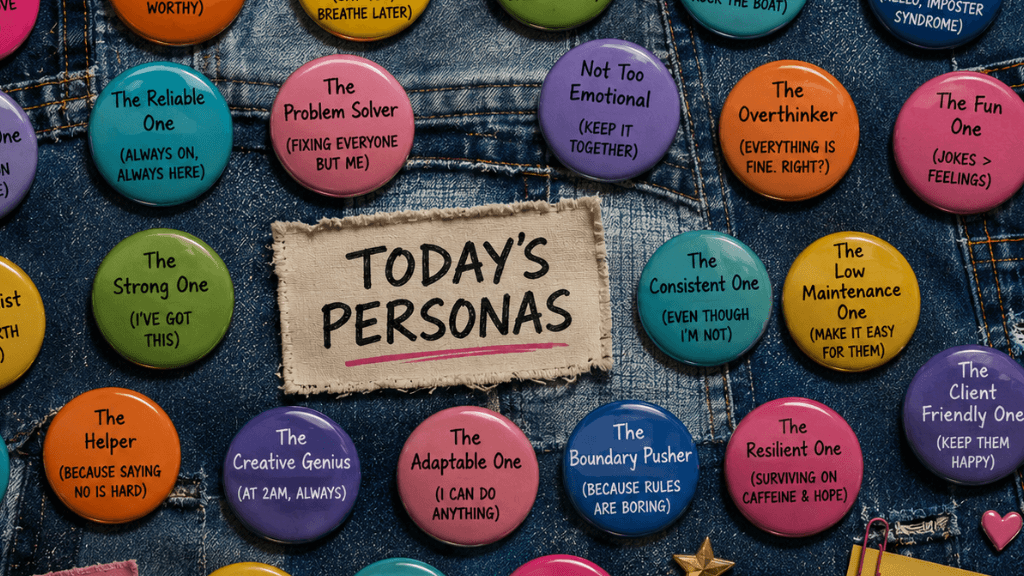
What if you could just show up as yourself, in your natural slightly chaotic form, knowing that you were already enough exactly as you are? Damn… that would change things up a bit, huh!?
The other day I sat down for a ‘quick rest’ (apparently they are a good idea, along with regular water and snacks. Who knew!?). Just twenty peaceful minutes with a cup of tea, biscuits and absolutely no expectations of myself whatsoever. Other than to breathe, drink and consume said biscuits.
Unfortunately, within minutes my brain had munched all the biscuits and wandered off into the ‘thoughts wilderness’, creating a long list of things it would prefer me to be doing instead. Tidy desk, answer all those emails I’ve been ignoring, plan next week’s content… you know, relaxing things.
Because relaxing, for many of us, doesn’t actually feel relaxing at all. It feels vaguely irresponsible. Like there’s something important we should be doing instead. Our brain is on high alert, like a dog when you’ve stupidly uttered the W word (walk) 15 minutes before you are planning to take them out. So, they get their ball, then follow you around with a “is it now” look in their enthusiastic eyes, until you finally put your shoes on and fulfil the promise you accidentally made fifteen minutes earlier. Exhausting!
I think a lot of neurodivergent people carry around this belief that our value is directly linked to how useful, productive, capable, helpful or exhausted we are. Which becomes a bit of a problem when your nervous system is already twitchy and operating at max capacity.
Most of us don’t consciously decide this. It develops slowly over years of trying to compensate for feeling different. You become the person who works harder, pushes through, overdelivers, stays late, always says yes, helps everyone else, and somehow keeps functioning long after your body is googling retreats.
Eventually, proving yourself stops being something you do occasionally and becomes your entire operating system.
This stuff doesn’t appear out of nowhere. A lot of us grew up receiving very mixed messages about ourselves. We were intelligent but inconsistent, creative but chaotic, capable but somehow still “hard work.” It’s a very strange experience being told you have loads of potential while simultaneously feeling like you are constantly disappointing people in tiny invisible ways. Like you’re somehow being tolerated rather than fully accepted.
I had an English teacher who once told me that 50% of my essay was “incredible” and the other 50% was irrelevant. How can someone be incredible and irrelevant at the same time? (thanks Mrs Levay… this still haunts me, ha ha!)
So many of us learned to compensate. It just slowly becomes part of who you are. You become hyper-useful. Hyper-reliable. The person who cracks on with it, figures it out, replies quickly and somehow keeps functioning long after your body has filed a complaint.
If you’re forgetful, you become overprepared. If you struggle with consistency, you overcompensate with effort. If you’re worried about letting people down, you become the person who says yes far too often and then burns yourself out trying to keep everybody happy.
Because after a while, productivity stops being something you do and slowly becomes part of who you are. Being useful earns praise, approval and acceptance, so your brain starts treating rest like a slightly suspicious activity that needs justifying.
I figure that’s why so many of us struggle to rest properly. Not because we physically can’t stop moving, but because stopping can trigger guilt. The second things become quiet, our brains start scanning the horizon for ways to justify our existence again. You finish one task and immediately look for another. You clear your inbox and instead of feeling calm you think, “Right… what catastrophic thing have I forgotten now?”
It’s like our nervous systems are permanently waiting for Ofsted to arrive and inspect our worthiness as humans.
That level of pressure is exhausting. Not just physically, but emotionally too. Because when your self-worth becomes tangled up with output, slowing down can start to feel less like rest and more like failure.
But productivity isn’t the only place this shows up. I think for many neurodivergent people, the need to prove ourselves spills into almost every social interaction too.
You start noticing which parts of you seem welcome and which parts seem to make people uncomfortable. And you adapt.
Not necessarily in huge dramatic ways at first. Sometimes it’s tiny things. You speak less. Tone yourself down. Rehearse conversations before you have them. Think carefully about how you come across. Become easier to manage, easier to understand, easier for other people to sit comfortably beside without feeling unsettled by your intensity, emotions or honesty. You become the “good” person.
Because when you spend enough years feeling slightly “wrong,” safety can start to feel connected to how successfully you make yourself fit around everyone else.
That’s why so many neurodivergent people become absolute experts at reading rooms, reading moods and monitoring themselves constantly. You become hyper-aware of people’s reactions, expressions, pauses and tone changes. I can tell people how they are feeling before they have worked it out for themselves. Often to their annoyance!
Because I’ve got an entire emotional detective agency running in the background while I’m trying to hold a completely normal conversation with someone.
Eventually, all that self-editing becomes so automatic that you barely notice you’re doing it anymore. You become so focused on being accepted that you rarely stop to ask whether constantly reshaping yourself might actually be exhausting you.
Spoiler alert: it is!
Self-employment can make all of this even worse because business gives us endless opportunities to measure our worth against output. Hustle culture is constantly telling us that there is always more we could be doing. More visibility, more networking, more strategy, more content, more learning, more optimisation, more growth. There is no natural stopping point.
If your self-worth is even slightly tangled up with achievement, business can become one long audition for your right to exist comfortably in the world.
That’s when you start undercharging because you feel lucky someone picked you. Or overdelivering because you’re terrified of disappointing people. Or replying to emails at ridiculous hours because you don’t want anyone thinking you’re lazy, flaky, disorganised or “not committed enough.”
Meanwhile your body is sending increasingly aggressive warning signals that you continue to describe as “just being a bit tired.”
I also think hustle culture absolutely loves people like us. People who already feel they need to earn rest are basically productivity culture’s dream audience. There’s always a tiny part of us wondering whether maybe we just need to try a bit harder. Wake up earlier. Push more. Achieve more. Become a shinier, more efficient human being.
Honestly, I can barely remember why I walked into a room half the time. I do not need a man with a standing desk shouting about “6 figure salaries” and telling me to start every morning by plunging myself into an ice bath.
What I find really interesting is that I don’t actually think many of us are frightened of hard work anymore. We know how to work hard. Most neurodivergent people I know could probably organise an evacuation plan during a nervous breakdown while simultaneously apologising for being emotional.
No, I think what frightens many of us more is slowing down.
Because if you’ve spent years defining yourself through resilience, capability, productivity or usefulness, stopping can feel oddly exposing. Who are you when you’re not fixing, helping, striving, producing or proving?
What’s left when the performance ends? And I don’t mean “performance” in a fake sense. I mean the constant internal pressure to justify your existence through effort.
I think this is why so many of us struggle during quieter periods in business. We tell ourselves we wanted more balance, more breathing room and more calm. Then it finally arrives and suddenly we’re emotionally pacing around the house because our nervous systems don’t entirely trust it.
We’re so used to operating in urgency that calm can actually feel unfamiliar.
Even rest becomes productive somehow. We’re not relaxing, we’re “recovering efficiently.” We’re not watching television because we’re tired, we’re “regulating our nervous system.” Which sounds significantly healthier than admitting you’ve just binge watched an entire series of a new crime drama while emotionally dissolving into a family-sized packet of digestives.
Don’t get me wrong, I’m not saying ambition is bad. I love ambitious people. I am ambitious. I enjoy creating things, building things, helping people and earning money. But I would quite like my future to involve slightly fewer panic-Googles about tax and a refillable coffee cup. But I digress.
This isn’t about pretending none of that matters.
I often wonder what life would feel like if we stopped treating exhaustion like evidence of worthiness. What if rest didn’t need to be justified first? What if boundaries weren’t something we only attempted once we were already completely burnt out? What if slowing down wasn’t failure, but actually the first sign that we’d finally stopped treating ourselves like machines?
Because a lot of neurodivergent people have spent years unknowingly building lives around compensation, proving themselves and trying to become useful enough, successful enough, productive enough or easy enough to finally feel safe, accepted or “good”.
And the problem is, when you build your whole identity around proving yourself, you can end up trapped in relationships, businesses and patterns that reinforce the belief that you are only valuable when you are performing.
So you tolerate things you shouldn’t tolerate. You over-explain, over-give and overwork. You say yes, and even manage to sound enthusiastic, when you desperately want to say “hell no”. You take on clients you don’t even like because being chosen feels safer than having standards. You keep pushing yourself long past the point of exhaustion because some part of you still believes rest has to be earned first.
Eventually, life starts to feel less like something you’re living and more like one long attempt to justify your existence.
That’s the bit that has to change.
Because the goal was never to become endlessly efficient, endlessly useful or endlessly accommodating in order to finally deserve your place in the world. You were never supposed to spend your whole life reshaping yourself into somebody more manageable, more productive or more convenient just to feel accepted by the people around you.
At some point, the proving has to stop. Not because you’ve finally become good enough. But because you always were.
Someone I met recently at a business networking event emailed me asking me some questions about business, specifically business partners. They recently had a bad first-business experience and major financial reversal and wanted some guidance about shared business ownership.
Speaking to the person I could tell that their enthusiasm and energy would not be down for long, and they already had Plan B in the bag and ready to launch.
They stayed in touch and wanted some guidance as to “what next”… and as their next venture was very firmly in my “wheelhouse” we got along like pyromaniacs at an open house.
My initial advice was “”get a job”, might as well be earning whilst the flywheel of business spins up to speed. In my early years temping and ad-hoc jobs kept me in pasta and baked beans and very much got me through the economic choppy waters of a new business venture.
Before we get to the specific email in question here’s the three bits of advice I shared and it is broadly speaking the three things I suggest to anyone thinking of becoming self-employed or launching a new venture:
1) What’s Plan B if it goes wrong? Even if you do not have Plan B fully plotted, know what the signs are that you need to stop Plan A. What’s the cut off?
2) Do you have savings? Start today. Even if in debt, savings are a habit, even if it is a fiver a week, start today. If you are in debt, pay down the highest interest stuff first, and once that is paid, go to the next highest and so on. At the end, start saving the exact amount you were paying a month in debt as a reminder of what you have achieved. Well done you!
3) Is your lifestyle that of a monk in a cave? Get rid of every subscription, or payment you absolutely can and focus your attention on the basics and build from there. You will need every ounce of focus, attention and desire to grow your business. Financial jeopardy is always going to be a distraction, so reduce your outgoings as much as you possibly can.
These three points were the main area of our conversation, we exchanged pleasant series of emails and I thought no more of it… Leaving the door open to further correspone in future, because in business, you never know…
After a few weeks with no contact, I received this email, BOOM:
“Hi Stuart
Just on my morning commute to work (yep back to the 9-5!) and in the middle of the next business planning cycle.
I made friends with this girl who is an absolute fire cracker. She works in a high end clothes store in [UK TOWN] and is a demon seller. So I have been trying to convince her to start a side hustle with me.
I sent you the google drive link to the business idea. [REDACTED] sales training.
I think it’s time to give up on her. She has that employee mindset and is just full of ideas why not to do it.
I really don’t want to go into business on my own again. Where’s the best place to find co-founders who are super talented and available. I talk to so many people and it’s so rare to find people I would go into business with.
I’m really not fussed what it is at this point. Just want to make some proper money.
Any advice would be appreciated“
Wow… That’s quite a chunky chew…
So I replied… and with their permission, here is the reply.
This is business advice about business partners learned the hard way, over 30 years. If you are going into business with someone else, take INDEPENDENT LEGAL ADVICE. Do not use BizWoo sourced from a spicy on the Interwebs, do your own due diligence! USE YOUR OWN JUDGEMENT!
enjoy…
TO: Business Contact
FROM: Stu Morrison
SUBJECT: Business Partner Hell – Eye Witness Report
[NAME]
Well done on getting a job – they are useful for regular money whilst you figure out how to earn “f@ck you” money. But bosses suck, so get with the getting…
With regards to your email…
WOOOOAHHHHHHHHHHHHHHHHHHHHHHHHHHHHHHHHH…
Stop…
Take a moment, few deep breaths, box breath… in to a count of 4, hold (count 4) out (count 4), rest (count 4) do that a few times before reading the rest of my reply.
::BREATHE::
::PAUSE::
::EXHALE::
::PAUSE::
DISCLAIMER
I am not a lawyer, advisor or coach, I am, at best, an unreliable witness and your mileage may vary… that said… Here’s some direct, and unfluffy insight from someone who has spaffed so much money up the wall chasing pipe-dreams that I eventually had to build another wall, french drain, and sewer system…
You have an inner fire that is not going to be contained by a 9-5, you know that, I see that, but you need discipline to focus that into a laser. I’m not talking about “gym bro” type discipline, I am talking about the ability to remain on task, on mission and dialled in. Whatever the distraction, and there’s always a distraction, you keep showing up and doing the do.
Now, sure, that sort of grit, the get-it-done mentality is a given, right? Yeah, but here’s the point to it, no matter how much you THINK you have it, until the rubber hits the road, you may never find out if you ACTUALLY have it.
But like any “fucking hard” thing, you do it BECAUSE it IS hard. What’s the point otherwise? Right?? So if we know that the way to reach our goals is going to be one long hard slog, we better have a pretty frickin’ amazing reason for doing it.
And that’s what you’re missing. You’re missing a “why”.
So, why do I do what I do? My why is – 2 reasons…
1) I NEVER EVER EVER EV.AH. E.V.E.R. have to have a boss. Because bosses suck the joy out of life, and are usually wrong about everything and I never had a boss who didn’t think his position didn’t afford him some sort of grace and favour with the staff. We should all somehow bow and scrape… which I am never going to do, king or pauper, we’re all born with an arsehole and I am too fond of pointing that out for that employer/employee relationship to ever last long. Four jobs before the age of 23 and one of them was a five-year apprenticeship started at 16. So, yeah, bosses can do one. As you see, I REALLY do not want to have a boss ever again.
2) To keep my family from starving. Initially it was to keep myself from starving, and to be frank, I was doing a piss-poor job of that before I met my wife. Now, not saying “go get wifed up“, but sometimes you need to be fighting for more than just money and fame for yourself.
I’m better at fighting someone else’s corner than my own, or I used to be. Now I am a diamond-tipped, Teflon-coated mutha-fucker if pushed. Wasn’t always like that, but as that famous business philosopher Al Capone said: “You need two things in life, a smile and a baseball bat. 99 out of a hundred you just need a smile…” What people also don’t appreciate was the bit most people fail to quote: “the other guy also needs to know you have a bigger bat than him“.
Don’t go and buy a bat. This is not bat advice 101. This is:
YOU NEED A MISSION ADVICE.
A reason why. Beyond the fiscal reward, because earning money is straightforward, most people complicate it. Here’s my formula:
Find something you can replicate over and over, that’s not too complicated and is already in demand. One of the hardest things to do in business is change someone’s habit. Designing products, creating new systems and offering new ways of doing something is always, hands down, the hardest thing to sell.
Why?
Changing behaviour is hard; as a business or salesperson it’s the single hardest thing you can accomplish.
You ever try stopping a habit? Now you’ve got to convince someone else to do that, with words and pictures only… Good luck. It’s quicker to stand in your garden and burn tenners.
So. Don’t go and try to create a whole new marketplace – find a marketplace with money in it, and find a reason that you want to get into that market. You can sell anything, you know that – so why not sell something you love, have a passion for or otherwise just want to be involved with?
I found posters, novelties, and writing. I used websites and business to build out my wealth but remain passionate about communicating in the written form, as well as having fun and enjoying life. You also need an economic engine to provide for your lifestyle. Lesson for another day.
OK… Lecture over…
… to your actual email…
“I made friends with this girl who is an absolute fire cracker. She works in a high end clothes store in Guildford and is a demon seller. So I have been trying to convince her to start a side hustle with me.“
This sentence has one of the highest red flag counts for a potential business partner I think I have ever read.
Let me break it down.
“I made friends with this girl“
Exactly how, how did you make friends? Party? Queue for self-checkouts? I am going with ‘chance encounter’. So you have no idea about her values, what she’s made of under pressure. How will she react when you’ve got 14 days until payroll of £300K and only got £200K in the bank and a customer who’s just filed for bankruptcy owing you £200K…
You know how you do when in a “burning building“, how will SHE do? You have started to build your armour, how’s hers? Nothing will save your business if two business partners are not aligned, in sync, and fully understand where their respective strengths and weaknesses lie and are absolutely rock solid in their conviction for the business.
“who is an absolute fire cracker.”
Run, run fast, don’t look back. These people are absolutely essential, but make for terrible business partners. If she has dyed hair, then “AWOOOOGA!”…
Now, speaking as a fully-fledged and diagnosed member of the ‘Spectrum Gang’ and having had varying shades of bright hair colours, this is why I say run.
I know, I’m a fucking nightmare to be in business with.
Two reasons;
How you do one thing, is how you do everything, and if they are always coming up with GREAT IDEAS be careful, because that energy can be very hard to pin down to the grind of making it happen once the great ideas have been had. ::stuart skips away to his next project::
Some businesses thrive on that relationship, but for that to work the partnership understands the dynamic and is self-aware enough to ensure it never becomes a problem. Jobs & Wozniak spring to mind. But for that to work, you both need to know each other and have a “in the trenches” bond to make it through the tougher times.
“She works in a high end clothes store in [REDACTED] and is a demon seller.”
Says who? Never believe a salesperson when they say they are the best… THEY ARE SALES PEOPLE, THEY LIE FOR A LIVING! I know… I am one.
And when I say “lie” I mean bend the truth to the letter of the law and not beyond, whilst also showing the biggest upside to the customer.
“Oh, you look amazing in that, pair it with these shoes…“
See, you’re thinking about new shoes… and… Who owns the business? Family member? I’m going to say an aunt? Pure guess, but I know the store type and have done websites for a few in the past. I no longer do retail store websites because this type of owner broke me. 🙂
“So I have been trying to convince her to start a side hustle with me.” – AWOOOOOOOGA! Red flag trifecta. Cue the confetti canons, dancing girls and frustrating days ahead.
Business partners do not need convincing, it should be a mutual agreement, you’re dancing not wrestling. Plus, what happens if it goes wrong?
Let’s say, one year from now, everything’s proper fucked, people owe you money, cashflow is tight and their rent is due and you cannot, absolutely CAN-NOT, afford both of your wages. Who gets paid?
Do you do 50/50? How will they react knowing they cannot pay rent? And, with that domestic stress, how will they be performing? How quickly does it become “I was doing OK until you roped me into this bad idea, my aunt was right about you all along“?
You see when it is all cake and candles, running a business is a joy and, to be honest, a piece of piss once you get the hang of the cycles and master the mindset. But when it goes wrong, yeah, it will blow up like a Council JCB hitting WW2 ordnance. It’ll make quite the mess of your life. I know. Been there, got the drunk festival tattoo.
“I really don’t want to go into business on my own again. Where’s the best place to find co-founders who are super talented and available. I talk to so many people and it’s so rare to find people I would go into business with.”
Good idea, spread the risk, but that also comes with risk as you identified; how do you find reliable business partners?
By showing up and being reliable! You don’t find your tribe, they find you. If you want to be considered a proper business owner by other’proper’ business owners, then you have to walk the walk, a real chicken & egg scenario.
Having a side hustle is a great way to begin. You met me networking, and that’s where you find the gold — the people who show up, and where you find the people you want to work with.
You can also obsess about a specific business, contact the owner, ask for some advice, but they’re busy, they don’t know you and are likely to be dismissive. Unless you do something for them first.
A website audit was my way in. A piece of work with absolute business value, offered without any strings. Do business, don’t do business – here you go. That sort of thing gets remembered and remarked upon. And that’s when I did the hard yards – nowadays I rarely get asked to “audition”. That’s a privilege of rank and seniority, but you can achieve that in a short time with the right focus and of course product or service.
I would suggest you disconnect “time for money” as soon as possible, finding a way to have some income without having to work for it. A Stocks and Shares ISA with dividend stocks is a good shout. It’s going to take a while to get any meaningful income, but it’s the practice, the dedication, the life skill of saving, and getting some income.
Get proper financial advice — don’t listen to a weird rando on the emails.
So, to your final line…
“I’m really not fussed what it is at this point. Just want to make some proper money.”
Danger, and biggest red flag – you have ambition burning a hole in your pocket, and nothing the market likes better than someone keen to “NOT MISS OUT“… oof, I have been taken a few times because I naively fell for someone’s promises and wasted time, money and sometimes a lot of both at once. Be careful, tread softly and be strategic. Sure, AI is everywhere, but soon it’ll be a commodity like the “internet” . Plus, I got really lucky and ‘timed‘ the early internet wave right (right time/place) and AI is already starting to lose its lustre and small businesses are wary of new tech.
I often suggest “toilet paper and teabags” as my strategy. I offer businesses something they can’t do without, or will buy no matter what. Hosting, websites.
Also have other interests too: diversify from your main business to protect income sources. It’s more than just one thing, you’ve got to take a step back and do all the things at the right time and for the right reasons. Going out and shouting “I WANNA DO BUSINESS” is likely to end badly, desperation is never attractive in business or dating, again, red flags.
Your best strategy: find something you can get passionate about. Is that [REDACTED] sales training? Maybe? But ask yourself these questions before proceeding:
Is there a big market for this [INSERT BUSINESS IDEA]?
Are there businesses with budgets to spend on [INSERT BUSINESS IDEA]?
How many people do you have to convince in an organisation before you get an invoice paid?
Do you have a list of those people right now?
How long to get to those people?
3/6/12 months?
Can you fund the business until you are positive cashflow?
Plus what about the current competition? Are there already businesses doing this? Are you simply treading on their toes and inviting a costly legal battle? Even if unfounded, if they’re established their pockets will be deeper…
See how it starts to unravel. So, find something you can scale – that you have a ‘moat’ around, something you can protect. Forget Intellectual Property (IP) – that’s a moat but requires deep pockets to truly defend.
So what’s the best approach?
Find something you can get passionate about, go digging, get into an industry that you like, and do a deep dive. Spend 6 months REALLY understanding the numbers, the logistics, or the capacity. Find something that’s a broken pain point (oh, they’re everywhere). Something that causes genuine costs to a business. Next, find something, or someone, that plugs that gap, fixes that issue, bridges the problem.
Introduce Player A to Player B – with you taking a cut of whatever the outcome. Low risk for you, easy sell for each potential player. Eventually you get good at sniffing out where there’s opportunity, and that 6 months becomes 90 days, becomes a month, a week… you sniff out the deals quickly. If there’s no way for me to make a cut, then I introduce them anyway — then that’s two people who owe me 🙂 (or at the very least will remember me!).
Then you find something that is such a good fit between the two players that you buy into one or other, or both sides of the sale, and then you own a piece of the businesses. That takes longer, requires more stamina and insight, but here’s the thing, you have learned to manage your risks at every stage. You own the pie, as well as the tray it’s baked in! You might eat the pie, but you have the tray left to bake another, and it’s the recipe and ingredients that are just a cost of business.
You have to do the hard yards to get to eat the pie. It’s just how it is.
Well… Now I want pie and have to go eat.
Here endeth whatever this is/was…
Go get stuck in…
EPILOGUE
You might ask “What gives you the right to pontificate and opine on such matters, Treacle?” and, from the safety of the visitors side of the bullet proof glass, I would confess I’ve had some business “break ups” over the years, including a few “sub-optimal” endings. So I feel 100% qualified to share the lessons learned from being there when trust, money, and lack of principles play out.
Business partners can be very financially beneficial, or a lifestyle wrecking ball. Choose carefully because one type lifts you up, challenges you and always has your back. You remain equals and if the project ends, you have a useful business ally to call on in future.
The other type throws a strop, ignores the Share Holders Agreement (your business ‘Bible’ when it comes to partners), and demands unfair compensatation in a two week window, or they’ll close operations until compliance. This is all without seeing the most recent accounts. Before Christmas. Whilst you’re dealing with a friend’s funeral.
Yeah…
::deep breath::
Sometimes in business, it takes the best of you to make it past the worst of someone else and that’s why I feel very qualified to share my thoughts.

There is a very specific brand of frustration that comes with knowing exactly what you need to do… and still not being able to do it!
It’s not because you don’t care. Not because you don’t understand it. Not even because you’re particularly busy. You can be sitting right in front of the task, fully aware that it would take about twenty minutes if you just cracked on with it, and yet your brain is skipping around a field, picking daisies. Not a care in the world!
For most of my life, I didn’t have any language for this. I was late diagnosed, which means I spent 51 years assuming that this was just how I was. Inconsistent, easily distracted, a bit unreliable when it came to getting shit done. I had zero idea my brain was neurodivergent, which is laughable really now I know that it clearly is.(Narrator: the signs were always there!)
I just thought it was ‘special’ and not in a good way. And that conclusion didn’t come out of nowhere either. It was born for a million moments where I was quietly made to feel like I was buffering ‘normal’.
I still remember an English teacher telling me “80% of this essay is brilliant, and the rest is pure fairy land,”. Now I’m proud of that part of me that wanders off on fabulous tangents, mid sentence. It’s a hugely important part of who I am. But back then I was filed under “lovely, but a bit strange”. And it left me pondering whether it was a world problem, or my brain. I had no idea that my magnificent brain just needed the right conditions.
So I did what most of us do. I tried to fix it.
For years, I assumed this was a discipline problem. That if I could just be a bit more consistent, a bit more focused, a bit less prone to wandering off mid-task, everything would finally get in line. Then when it came to work I bought into the idea that the ‘winners’ were the ones who showed up the same way every day and just got on with things, regardless of how they felt. It never crossed my mind that I might be aspiring to a rulebook my brain missed the memo for.
The majority of business advice isn’t neutral. It’s built for a very specific type of brain. And that brain is not mine. Which kinda sucks really.
It’s built for people who can decide to do something and then… just do it. No internal negotiation. No sudden urge to make a cup of tea, scroll something deeply irrelevant, and then question all of your life choices halfway through opening a document. No weird moment where your brain nopes, and disappears off to learn something fascinating but entirely unhelpful. (I once lost a solid hour researching what to do if you’re stuck in a lift. Do I need that information? No. Do I now avoid lifts? Absolutely yes!.)
And the thing is, this generic advice is given like it’s universal. Which means that when your brain bumps into it, it feels like a ‘you’ problem. You’re inconsistent, you need more self discipline. You haven’t found the right system. You’re just not good enough. (Spoiler alert: you absolutely are.)
But what if it’s not that you haven’t found the right system — it’s that you’ve been trying to force yourself into ones that were never built for your brain in the first place? Read that again. Because once you understand that, things start to make a lot more sense. Not in a dramatic “everything is fixed” kind of way, but in an ‘aha’ lightbulb above your head kind of way. Because it explains a lot.
When something doesn’t work, the natural instinct is to push harder. To sit there longer, try to force focus. Override whatever resistance is showing up. And to be fair, that can work for a while. You can absolutely drag yourself through a task with enough internal pressure and a slightly aggressive pep talk. But it comes at a cost.
Because every time you factory reset your brain in the hope it will operate against its natural patterns, you’re overriding signals that are there for a reason. That starts an energy fire that leaves you with tiredness and some lingering shame that something relatively simple has wiped you out for the rest of the day.
This is where the boom-and-bust cycle can creep in, and this was my strategy for far too long. You have a few days where everything flows, you get loads done, you feel vaguely invincible… and then suddenly replying to an email feels like you’re in an internal small talk convo. From the outside, it looks inconsistent. From the inside, it feels like your brain has just done an emergency stop with no warning.
One of the most useful shifts, and also one of the most annoying to accept, is that your patterns aren’t random. They’re information.
The times you can focus for hours without noticing. The moments where starting feels completely impossible until something suddenly clicks. The tasks that you avoid with Olympic-level skill, even though you know they matter. That’s not chaos. That’s data.
Executive dysfunction often shows up as that gap between intention and action, where you know exactly what needs to happen and yet… tumbleweeds. Not because you’re incapable, but because the conditions for action aren’t in place. Once you start looking at what those conditions actually are, things get a bit clearer.
You begin to notice when your brain is more receptive, what kind of tasks pull you in, and what are your resistance triggers. It doesn’t magically solve everything, but it does mean you’re no longer trying to operate blind.
There’s a particular brand of shame that comes with only being able to focus on things that are interesting. It can feel childish, or unprofessional, or like you should really be able to just get on with things regardless.And yet your brain has its mouth clamped shut and is shaking its head vigorously as someone is trying to spoon rice pudding into it. (Is that just me? yuck!)
For many neurodivergent people, interest isn’t optional. It’s the thing that actually switches the lights on. When something engages you, properly engages you, focus can be almost effortless. Time disappears, ideas connect, and you suddenly look like a highly functional adult who absolutely has their life together.
When it doesn’t, even simple tasks can feel weirdly impossible. Not hard, just… inaccessible. Like they are in a giant claw machine and no amount of pound coins and patience allows you to access one. Which is why trying to ‘business’ whilst ignoring that reality tends to backfire.
Designing work that has some level of ‘shiny new thing’ built into it isn’t indulgent. It’s practical. Because It’s the difference between pushing a giant rock uphill and surfing the focus wave.
There’s also something annoying that I’ve noticed over the years. Well, there is plenty that is annoying, but I won’t gallop after that squirrel. Tasks change depending on how they feel internally. I can have things collecting dust on my ‘to do’ list for days…weeks even, that feel impossible to start. Then suddenly the planets align, or whatever, and I complete them in 20 minutes.
The task didn’t change. Neither did the deadline. The only thing that shifted was my brain moving it from something it was told to do, to something it came up with itself. Like that boss (we’ve all had one) that dismisses your genius idea in the bored-room (yes that was intentional) only to “I’ve got an incredible idea” weeks later!
Because the moment something feels like a “should,”we’re back to the rice pudding shoveling. Not because the task is unreasonable, but because it feels imposed.
When it feels like a choice, even if nothing else changes, there is less friction. It becomes more doable, and far less dramatic. And once you notice this, it’s really helpful. But also horribly inconvenient, because you can no longer use the “push through the pain” strategy anymore.
What becomes clear over time is that this isn’t about a lack of effort. Most people I know with neurodivergent brains commit to everything like there’s a million pound prize at the end of it. Cleaning the bathroom? I’m spending 4 hours with an old toothbrush making sure every inch of it is showroom sparkly. You with me? But…and it’s a big BUT. That effort, when it comes to business, is being poured into toeing the line with systems that don’t actually fit. And applying more effort to a mismatch doesn’t fix it. It just makes you even tireder, even faster!
A more useful question at that point isn’t “how do I try harder?” — because let’s be honest, you’ve already tried that and look where that got you! (no shame, just fact stating!) It’s “how do I make this easier to start?” Because that’s usually where the whole thing falls apart.
And that might mean changing when you do something, how it’s structured, or what you pair it with. Not in a dramatic, “new life, new me” kind of way, but in small, slightly less punishing adjustments that your brain might actually agree to. It’s not about lowering the bar. It’s about removing enough friction that getting to it doesn’t feel like wrestling a grizzly bear every single time.
The biggest shift isn’t tactical. It’s how you see yourself. Because when you move from “I’m unpredictable” or “I’m an out of control nightmare” to “my brain works differently,” something settles. Not in a dramatic, life-is-fixed kind of way, but in a quieter, “oh… that explains a lot” kind of way.
You stop trying to force yourself into ways of working that never quite fit, and start paying attention to what actually does. Less fighting it, more working with it — which, annoyingly, turns out to be far more effective.
You start to notice your patterns, and after a bit of practice, you start to trust them more. Instead of constantly second-guessing yourself or trying to override everything, you begin to work with what’s already there. I’d be lying if I said it suddenly made everything easy, but it does take the edge off that constant feeling that you’re getting it wrong. And without that shame everything feels a lot more doable.
You take this and you use it. Not perfectly, not consistently, and definitely not in a way that suddenly turns you into one of those people who just “gets things done” without thinking about it. Knowledge is power… but it’s not a miracle. Annoying, but true.
The goal is to stop assuming the problem is you. Because it isn’t, so let that shit go. When something feels hard to start, or weirdly impossible for no obvious reason, you pause long enough to ask a better question. Not “what’s wrong with me?” but “what does my brain need here?”
Because once you see it, you can’t unsee it. And after that, you can no longer pretend you don’t know any better. So you build something that actually fits your fabulous brain. Bit by bit. Adjustment by adjustment.
And then comes the life-changing bit: you realise you were never the problem. You were just trying to run on instructions that weren’t written for you.

There’s a very particular kind of energy that shows up at the beginning of something. You know the one. Slightly unhinged, blindly optimistic and off its face on dopamine! Convinced this idea is the idea.
You’ve had an idea and suddenly everything feels urgent, important and like this might actually be the ‘thing’ that changes EVERYTHING! You maybe even tell someone about it, which is always a risky move because now it feels real and you’ve essentially committed to becoming “a person who finishes things”.
And then… a few days later… it just quietly evaporates. No drama. No official announcement. You don’t sit down and go, “I am now abandoning this project.” It just becomes weirdly harder to return to. The excitement disappears, the urgency fades, and suddenly you’re left with… the actual work. Which feels a bit like turning up to a party and realising you’re committed to 400 different versions of small talk. Arghhhhhhh.
We talk about productivity as if it’s one thing. You either get things done, or you don’t. As if there’s a magical group of people who are just “good at getting things done” and the rest of us are out here… vibing and starting seventeen things at once.
But starting something and finishing something are completely different processes. Starting is powered by novelty. It’s curiosity, possibility, and that lovely dopamine spike that comes with a new idea. It pulls you in. It does a lot of the heavy lifting for you. Starting, in many ways, is the easy bit.
Finishing, on the other hand, is less sparkly. Because it relies on regulation and sustained attention. It demands that you keep going when something is no longer exciting and has become a series of boring fiddly steps that require you to stay engaged anyway. Think ‘trapped in a corner at a party answering “so what is it you do’ questions’ on repeat! This can feel like our brain has personally betrayed us. Because it’s not that we’ve lost interest for no reason, but the task itself has changed shape.
The beginning of a project is all potential. You’re imagining what it could be. You’re connecting ideas. You’re sitting on your fancy office chair with a slightly evil look on your face stroking an unusually hairy cat. The world is your lobster!
Then you hit the middle. And the middle is where your dreams go to cry. It’s repetition. It’s decision fatigue. It’s working out things that are no longer interesting but still very much required if you’d like this project to ever see the light of day.
For brains that run on interest, that drop in stimulation can feel like you’ve been unplugged. Not because you don’t care anymore, but because the thing that was fuelling you at the start has left the building. Rude, really. And you’ve been left with a different kind of energy which stalls your momentum.
You would think the closer you get to finishing something, the easier it would be to just… finish it. You’d be wrong. The ‘almost done’ trap is the ‘getting to work then remembering you left the iron on’ moment in the process. It’s feeling like you are so close to success, then realising you have to go back and clean something else up.
Because the last 10% is where things suddenly become serious. It’s the detail. The polishing. The “just one more tweak” energy. The part where your brain decides this is now incredibly important and must be done properly. You’ve been there, right? You skim the first paragraph of a final draft, decide it sucks, and want to rip the whole thing up and start again. Even when it really doesn’t!
The final stages tend to need more detail, more decision-making, which increases friction rather than reducing it. Slightly inconveniently — it’s the point where the thing becomes real.
Because once it’s finished, people can see it. Have opinions about it. Potentially misunderstand it. And now we’re in a whole different emotional landscape. So, what do we do? We hover. We tweak. We leave it at 92% complete like it’s in some kind of protective limbo. Because “almost done” feels safe. Finished feels exposed.
On a slightly random, but very relevant tangent, my personal brand website was meant to go live in August…..2025! (7 months ago, at the time of writing this!). I have prevaricated, tweaked, read and reread, loved it, hated it….and still not pushed the ‘get on with it’ button. I am stuck somewhere in the middle of “I just need to do it”, and “what if it isn’t good enough”. And the reality is that it is not that important that it needs to be taking up that much of my brain energy. But here I am anyway.
Unfinished tasks don’t just sit there quietly like polite little items on a list. They lurk. They pace. They are the kid in the back of the car alternating “are we nearly there yet” with “can I have a wee”.
They pop into your head at inconvenient moments. They create that low-level background noise of “you should probably go back to that thing”, even when you’re trying to focus on something else.
Over time, that builds into a sort of mental clutter. A collection of open tabs that never quite close. And with that comes a bit of guilt, often a creeping frustration with yourself. It can start to feel like you’re constantly behind, even if you’re actually doing a lot. Which is a wildly unhelpful narrative, but unfortunately quite a convincing one when you’re surrounded by half-completed projects. This is where the narrative begins to form. When enough things remain unfinished, it’s easy to start telling yourself that you “never finish anything”. That belief isn’t accurate, but it can feel very real.
This is where it stops being about tasks and starts being about identity. “I’m just not consistent.” “I always lose interest.” “I never follow things through.”
And once you start telling yourself that, every unfinished project becomes proof. So now, finishing something isn’t just about completing the task. It’s about fixing something about yourself. It becomes tied to proving something about yourself, which makes the process feel heavier and more loaded than it needs to be.
Which is a lot of pressure to put on, say, editing a document or replying to an email. No wonder it feels hard, because that pressure reinforces the cycle, rather than breaking it!
I’ve said it before, but we’re taught to expect motivation to be steady, as if caring about something should automatically mean we keep showing up for it in the same way every day.Which sounds lovely. And also… not reality.
In fact I could pull together a panel of house plants that would attest to the idea that ‘caring’ was not enough for me to ensure they got watered! In fact, in the mid 80’s I even had a rabbit that broke free from her cage and ran in search of a more reliable carer (RIP Miffy). She eventually came home, with the realisation that braving the elements and wilderness was not a preferable alternative!
Motivation, especially for ND brains, tends to be more “peaks and troughs” than “gentle rolling hills”. It spikes. It disappears. It comes back at 1am with a brand new idea that is definitely more important than the thing you were doing before. Eg sleeping.
So, when motivation drops mid-project, it can feel like something’s gone wrong. But nothing’s gone wrong. You’ve just moved past the exciting part, to the less exciting bit. Unfortunately, your brain was not consulted about this transition.
If finishing relies on something different, then it makes sense that we need to support it differently. Relying on motivation alone will only take you so far, which is why structure becomes important.
Not rigid, life-sapping structure, but enough scaffolding to stop things drifting off into the void. Breaking projects into phases helps. Knowing what “done” actually looks like (before you start moving the goalposts halfway through) helps. External accountability can help, provided it doesn’t immediately trigger your nervous system into rebellion.
Also, a small but important lesson I keep relearning: not everything needs to be in version one. If I don’t separate “must have” from “nice to have”, everything becomes a “must have”, and suddenly I’m six hours deep adjusting something no one will ever notice.
And perhaps most importantly, removing perfection from the finish line.Because if “done” secretly means “flawless”, you will never be finished. You will simply be… circling. Waiting for perfection to show up with her perfect skin, and expensive handbag.
There’s a lot of freedom in deciding that something can be complete without being perfect. Says the woman that’s still not fully taken that concept on board! Because perfection is a moving target. You can always tweak, adjust, improve. There is always one more thing you could do. Which is how things stay open indefinitely.
Sometimes, finishing something at 80% is infinitely more useful than leaving it unfinished because it never quite felt ready. Once something exists, you can improve it. Refine it. Build on it. But you can’t improve something that never makes it out of your head.
Allowing work to be “good enough” is not lowering your standards. It’s creating a sustainable way to actually complete things.
Finishing isn’t about suddenly becoming more disciplined, more consistent, or more like those mythical people who seem to just calmly complete things without emotional drama. It’s about understanding how your brain works and building around that, rather than fighting it.
When you recognise that the drop in motivation is predictable, that the middle of a project is often the hardest part, and that the final stages carry more emotional weight than we expect, it becomes easier to respond with something other than frustration.
Because unfinished doesn’t mean incapable. It usually just means the system you were relying on stopped working halfway through. And if the only way something gets finished is by dragging yourself through it with stress, pressure, and a growing sense of “why am I like this”, then it’s not a system you can rely on long term.
A better goal? Finish things in a way that doesn’t make you hate the process… or yourself. Quietly. Imperfectly. Repeatedly. Because trust isn’t built on perfect starts — it’s built on things you actually finish.
