Firstly, I just want to give a shout out to any readers who have mastered the art of understanding the unpredictable beast that is ND energy. A confusing little fecker that might give you a whiff of hope that there’s some petrol in the tank… and then you do the most mediocre of chores and feel like your brain has been turned into a smoothie.
If you haven’t mastered that, then… well, how the devil are you going to protect it if you don’t even know how it works? Just kidding. As you were. Keep reading.
So, let’s assume you’ve got at least some understanding of how your energy behaves, in all its unpredictable random sparkliness. The next step is protecting it. Because you’re living in a world that won’t slow down. Not even a teeny bit. Not even if you ask it really nicely.
And this is the bit no one wants to talk about. The world isn’t going to adjust itself around your capacity. Deadlines still exist, clients still want quick replies, and life in its many forms keeps moving at the same pace regardless of how you’re feeling. Which is why protecting your energy isn’t optional. It’s sanity maintenance.
And when you’re neurodivergent, then that’s double funzies, because your energy isn’t linear. It fluctuates. It spikes. It drops. It goes out for a pint of milk and comes back 3 days later. It’s that crazy unpredictable drunk uncle that you don’t want at your wedding.
So, this isn’t about escaping the world. It’s about learning how to stay in it without acquiring yourself a one way ticket to burnout town!
Most systems are built on the assumption that energy is stable. That you wake up, work, produce, and repeat. Nice, neat, and predictable. Lovely for people whose brains behave like that. Big fan. Congratulations to them. Except that’s not how a lot of ND brains work.
Some days you can fly through work like you’ve unlocked a secret level of existence and suddenly you are unstoppable. Other days, opening your laptop feels like a hostage negotiation between your fingers and your brain. Same person. Same workload. Completely different capacity.
And yet… none of those changes how the world responds to you. You’re still expected to show up, deliver, reply, and keep things moving — even on the days where your brain has very much not signed off on that plan. No one pops up and says, “Ah, I see your brain has gone offline today, let’s circle back when it returns.”
The problem is that external demand stays consistent, while your capacity didn’t get the memo. So, when those two things collide, pressure builds. And when that pressure sits there long enough, it turns into stress, then exhaustion, and eventually burnout.
Which is why this whole “just push through” approach doesn’t really work for brains like ours. (It barely works for anyone, to be honest, but that’s a rant for another day.)
One of the biggest drains on your energy isn’t actually the work itself — it’s urgency. Everything suddenly feels important. Everything feels like it needs doing now. Everything feels like it will fall apart if you don’t respond immediately.
But a lot of that urgency isn’t real. It’s artificial deadlines, other people’s poor planning, and those “quick favours” that somehow take half your day and leave you wondering why you opened your laptop in the first place.
If you’ve spent years being reliable, helpful, and responsive, you’re probably very good at jumping straight into action mode without even questioning it. It feels productive. It feels responsible. It also quietly sucks the life out of you.
The problem is that urgency pushes you into adrenaline. And adrenaline is great … in small, occasional bursts. As a lifestyle choice? Less ideal. You end up running on “just get through it” energy, which works, right up until it really, really doesn’t.
A small but surprisingly effective shift is asking yourself: “is this actually urgent?” Not “does it feel urgent” but is it genuinely time-critical. Because those two things are very different. Even if your brain insists they’re identical.
I’m the queen when it comes to chatting about boundaries. It’s like I discovered them, 51 years later in my life, and now they are my specialist subject. In fact, it pretty much is that! But most of those conversations are about emotional ones. Protecting your feelings, managing relationships, that sort of thing. Energy boundaries are slightly different. They’re about protecting your capacity.
Because you can technically have the time to do something, but not the energy. You might look at your calendar and think, “Well, I’ve got an hour free,” but your brain is already fried, your sensory load is maxed out, and you’ve made approximately 47,000 decisions already that day. That hour is not usable. It’s like a mirage hour.
This is where one of the most useful sentences you’ll ever learn comes in: “I don’t have capacity for that.” Not followed by your life story. Not turned into something apologetic, or a giant discussion. Just that.
It sounds simple, and it is. It’s also wildly uncomfortable if you’re used to over-explaining, over-justifying, and making sure everyone else is fine first. But it works. Quietly, efficiently, and without wringing out what little energy you had left.
If you’re anything like me, saying no doesn’t just happen. It comes with a full internal production. You draft the explanation, rehearse the tone, anticipate their reaction, and try to make it sound reasonable, valid, and entirely non-offensive to anyone, ever.
The irony being that by the time you’ve finished explaining, you’ve used more energy than the original task would have taken. How’s that for efficiency…or lack of it!
The truth is most of that explanation is for us. It’s working hard to make the discomfort of setting a boundary feel safer. But “no” doesn’t require a backstory. It doesn’t require a breakdown of your week, your mental state, or your entire life context. As Stu taught me once, it’s an entire sentence. And the more you practise it, the less energy you leak trying to make your boundaries palatable for everyone involved. I promise you it starts to feel easier the more you try it on for size. In fact, it’s so incredibly freeing. Because it’s you having your own back.
One of the biggest shifts that comes with protecting our energy is realising that just because something is possible, it doesn’t mean it’s sustainable.
We ‘could’ say yes. We ‘could’ take it on. We ‘could’ push through.
But then we could also decide to deep clean our entire house at 11pm on a Tuesday night. Half of my teenage years were spent piling the entire contents of my bedroom floor onto my bed at about 10om, then crying and putting it all back onto the floor. The question is… should we?
Because every “yes” is stealing from a limited resource. And if you’re not consciously deciding where that energy goes, it gets spent by default. Usually on the loudest, most urgent, or most guilt-inducing thing in front of you.
Protecting your energy means getting honest about trade-offs. Letting go of “shoulds”, looking properly at commitments, and actively choosing long-term stability over the short-term approval that we can often crave. Sweet dopamine.
Sometimes that means making decisions that don’t look particularly impressive on paper but feel a lot safer in our body. Which, frankly, should be the only measure that really counts.
One of the sneakiest things about energy is how quickly we decide we’re “fine again”.
You have one good day. Maybe two if you’re feeling particularly wild. You wake up, your brain is cooperating, you answer a few emails without wanting to lie down afterwards, and suddenly you’re like, “Right. I’m back. Power Rangers…let’s go!.”
And off you go. Rebooking everything. Saying yes to things. Catching up on the 463 tasks you’ve been avoiding. Possibly reorganising a cupboard for emotional reasons. Fully convinced you’ve turned a corner.
Newsflash. You haven’t turned a corner. You’ve just found the exit of the car park.
Because early recovery energy is not a full tank. It’s not even half a tank. It’s more like your car has stopped making that alarming flashing noise and you’ve gone, “Great, let’s drive to Scotland.” You’re out of the danger zone. That’s it. But you’re not on the home straight yet.
And this is where we accidentally undo all the progress we’ve made. Not because we’re reckless (well, some of us can be!), but because it feels so good to have energy back that we immediately spend it. All of it. In one go. Like a toddler with birthday money.
Then we’re surprised when we crash again.
Protecting your energy at this stage means doing something deeply unnatural: not filling the space. It means leaving gaps. Building buffers. Resisting the urge to “catch up” on everything all at once. Saying no to your old pace, even when your brain is loudly insisting that this time will be different. (It won’t. Your brain is a liar when it’s excited.)
Recovery isn’t just about getting your energy back. It’s about not immediately burning through it the moment it returns.
Protecting your energy isn’t just practical — it’s deeply inconvenient on an emotional level. Because when you start doing it properly, things come up. Guilt. Fear. That slightly sick feeling that you’ve just disappointed someone. And sometimes actual pushback from people who were very happy with the old version of you. The one that was constantly nodding like their head wasn’t attached properly. Saying yes, staying available, and overextending herself. Funny that.
That doesn’t mean you’re doing it wrong. It means you’ve stopped being as convenient. And yes, it does feel uncomfortable. Really uncomfortable. Like you’ve put on a jumper that technically fits but is somehow both itchy and judging you.
You’ll be tempted to soften it, to explain more, to just do the thing this once because it’s easier than holding the boundary. But every time you do that, you teach people (and yourself) that your limits are optional. The real work here isn’t setting the boundary. It’s holding it when it would be much easier not to. This is a huge part of my life story, so believe me when I say I get it. But I’m also now boundaries number one fan!
The world might not slow down. That’s true. Deeply annoying, but true. But that doesn’t mean you have to speed up to match it, because that’s how you ended up here in the first place. Remember?
Protecting your energy long-term often means your life looks a bit different. Less stuff, more intention. Not churning your output like a sausage factory. Which, depending on your previous operating style, can feel suspiciously like you’re “not doing enough”. But you are. You’re just not doing everything, thank god.
And yes, sometimes it can feel like you’re not keeping up with everyone else. Like you’re dawdling while the rest of the world is power-walking past you in Lycra, with a podcast on 3x speed. But I can promise you this: they’re exhausted too. They’re just better at pretending they’re not.
What you gain instead is something far more useful: stability, sustainability, and the ability to keep going without repeatedly crashing and having to rebuild yourself from scratch every few months. This isn’t about doing less for the sake of it. It’s about doing what actually works for your brain, your body, and your life in the long term.
Because if it only works when your brain’s on fire and your nervous system is halfway out the window, it doesn’t actually work.

There’s a very specific kind of tired that doesn’t make sense on paper. The kind where you look at your day and think, But I didn’t even do that much. You sent a few emails, had one meeting, put the washing on, maybe even cancelled something because you were “being sensible”, and yet by 4pm you feel like you’ve been dragged backwards through a hedge. Not dramatic burnout, not collapse-on-the-floor exhaustion, just that low, humming depletion that makes everything feel heavier than it should. Like you’re coming down with a bug that never turns up.
For years, I thought that meant I was weak, lazy, or just not built for “proper” business. Spoiler: it wasn’t that. It was energy debt, and I was quietly racking it up like it had no interest rate.
When I finally hit proper burnout, it didn’t arrive with sirens and flashing lights or announce itself with, “Hello Hannah, you have officially broken yourself.” It crept in. First it was overwhelm that didn’t shift, then irritability, then that constant feeling that I was forgetting something. Like my brain had 47 tabs open and I couldn’t find the one making the noise. I was saying “sorry” a lot; I couldn’t focus without it feeling like lifting 50lbs with my mind. Small noises made me jump, and I’d drift off mid-conversation and realise I’d lost entire chunks of what someone was sayin
I wasn’t dramatic, I wasn’t melting down daily, I was functioning, but everything felt tight. Like I was permanently bracing. And because I was still technically working, I told myself I was fine. That’s the problem. Burnout doesn’t start with collapse; it starts with erosion — paper cuts over and over until you realise you’ve been bleeding for months.
What I haven’t said yet is that my biggest burnout wasn’t twenty-something Hannah trying to prove she could survive London life. It was much more recent, and it wasn’t just mental; it was physical. I wasn’t collapsing in tears or dramatically quitting everything; I was just never switching off. Ever.
On the days when I was stuck…brain foggy, slow, distracted…I’d tell myself I’d make it up later, and later would come in the form of ten-hour hyperfocus sessions, weekends, evenings, “just one more thing.” I was constantly playing catch-up with a version of myself I thought I should be. I didn’t allow space to just be because there was always something I should be doing.
Underneath that was shame — deep, old shame. Why can’t I just work like everyone else? Why does this feel harder for me? Why does it take so much effort to do what others seem to glide through?
But it wasn’t just about work. My “always on” wasn’t limited to clients and projects; I was the reliable one. The one people called when things went wrong, the listener, the fixer, the one who usually knew what to do. And I was always the one putting my hand up when something needed doing. Partly because I’m capable, partly because I care, and partly — if I’m being really honest — because if everyone needs you, then no one leaves you. I was used to being left, which is probably a blog for another day, or a therapist’s office, or both, but being indispensable felt safer than being optional, so I stayed available. Emotionally, mentally, practically. Even when I was already running on fumes. Being the strong one is exhausting, especially when no one realises you’re carrying it.
So I pushed, because I thought the answer was effort. Turns out the answer was pacing, and eventually something had to give. And because I had proven that my brain wasn’t capable of looking out for me, my body stepped in and said “enough already” and physically stopped me.
I’ve said it before, but most business advice assumes your energy is stable. You wake up, you have X amount, so you use it wisely. And during the day, if you get a little rest, your energy increases again. For neurodivergent brains, that’s not reality.
Some days I can do a week’s worth of work whilst I’m still in my PJs. I’m on fire, with ideas flying, focus locked in, energy like a caffeinated golden retriever! Other days replying to one email feels like a university challenge, when you’re the only team member. Same life, same me, entirely different capacity.
That inconsistency used to terrify me because I mistook it for unreliability. But ND energy isn’t broken, it’s variable by design. We process more, monitor more, absorb more. Masking alone is an Olympic sport, and when you add sensory processing, decision fatigue, context switching, emotional labour, and background cognitive load, suddenly the reason you’re tired after “not much” becomes clearer. Time and energy are not the same thing; two hours on your calendar does not equal two usable hours in your brain.
The thing that nearly finished me wasn’t laziness: it was pushing through even when all the alarm bells were ringing, but I had my fingers in my ears singing “la la la not listening”. And the frustrating part is that pushing through works — for a bit. Adrenaline is intoxicating, the sparkly new thing is delicious, urgency masquerades as capacity, and you believe you can sustain it. I could override my body for short bursts, smash through projects, hyperfocus until 2am and feel invincible. Such a natural high, ticking those things off the list and feeling like I was winning. But borrowing energy from tomorrow is fine until tomorrow arrives and the account is empty
The dangerous part was that I thought I was being responsible. I thought this was what commitment looked like, what professionalism looked like, what business grown-ups did. You got the job done, whatever that took. I could see that not everyone seemed to have to put in such a huge amount of effort, but instead of questioning my comparison, I just doubled down. A lifetime of subtle messaging that I needed to try harder, be quieter, be better, be less meant slowing down didn’t feel safe; it felt like failure.
So I kept overriding every signal until my nervous system stopped negotiating. Burnout isn’t sudden; it’s compound interest on overwhelm. I was living on an overdraft.
Even when I knew I was tired, resting felt wrong. If my capacity is already unreliable, how can I afford to stop? If I pause, won’t I fall further behind.
Somewhere along the way, I’d internalised the idea that rest was a reward for finishing everything, but you never finish everything. Rest isn’t a reward; it’s maintenance, it’s preparation, it’s charging your phone before it dies instead of waiting until it’s at 1% and pretending you’ll be fine.
When you’ve lived your whole life feeling like you have to prove your capacity, rest feels like exposure. If I stop, someone might notice I’m not keeping up; if I slow down, it confirms the fear that I’m not built right. So I didn’t slow down, and that’s how burnout became physical . Not just tiredness, but inflammation, disrupted sleep, my body essentially saying, “You clearly aren’t listening to the gentle messages, so here’s a louder one.”
My burnout wasn’t dramatic; it was cumulative, and it cost me more time in recovery than pacing ever would have. Slowing down wasn’t a brave, enlightened decision; it was enforced. And if I’m honest, this slower, kinder version of me rocks. She definitely is a work in progress and needs to be dragged back in line from time to time. But now she generally just says yes to the things that bring her joy.
She doesn’t volunteer for everything, she doesn’t answer every message immediately, she doesn’t try to prove she can outwork her own nervous system. The old voice still whispers, You should be doing more. You’re falling behind. Everyone else is coping, but now my body answers back, and for once I listen.
Looking back, the signs were obvious — irritability, foggy thinking, snapping faster than usual, feeling like the anxiety hamster was permanently on a wheel, flinching at small noises, brownouts where you just disappear for a few minutes, and there’s no signal. But because I was still functioning, I ignored them. We’re not taught to see those as energy signals; we see them as personality flaws.
Now I have had to redefine what a better-balanced life looks like, and I’ve realised it doesn’t mean producing the same output every day. It’s responding honestly to what I can afford. Some weeks, I bounce between big output and recovery. And some days I’m on low power mode, running lights only. That isn’t failure, it’s pacing. Self-employment allows me to build around that variability rather than fight it. If I’d forced myself into a rigid mould, I would have burned out permanently.
Energy isn’t a moral issue; it’s information. Irritability, fog, that constant feeling of being behind — those are data points.
When I ask myself, “What is my capacity feeling like today ?” instead of “What do I have to achieve?”, everything shifts. Honesty about capacity is what makes sustainability possible for me. Previously, I would bully myself into thinking I needed to keep pushing, even against my better judgment.
If you’re running on empty, it’s unlikely because you’re weak; it’s more likely you’ve been paying invisible costs for a long time. You’re not defective. You’re processing more than most people realise. The goal isn’t to squeeze more out of yourself; it’s to understand how your energy actually works and build around it.
Pushing through might buy you some time in the moment, but it can end up costing you much more, like your nervous system.

There’s a very specific kind of ‘tired’ that shows up for me, long before burnout does. It’s not dramatic. I’m still functioning. Still replying. Still getting things done. But everything feels… loud. Overwhelming, where nothing is technically wrong, but my brain feels like it’s got too many tabs open. And if one more thing demands my attention, I might just climb into my wardrobe, nestle myself between some comfy jumpers, and wait until the search party find me. Or better still, don’t. (It’s ok, I’ll take snacks!)
When I reluctantly venture back out into civilisation, no doubt for a wee break, it won’t be long before someone has given me the delegation lecture. I say ‘lecture’ because this is not my first delegation rodeo. Oh no. Many people have gone before this latest one, promising me a world where I don’t have to do everything.
“Just hand a few things over”, they say…. in the same overly zealous way that people say, “Have you tried yoga?”, which immediately makes me want to lie down on the floor and stare at the ceiling!
They think they are being helpful, but all I can hear is my RSD singing “they think you are rubbish” to a creepy nursery rhyme tune. Don’t get me wrong, delegation sounds sensible in theory.
I mean, who wouldn’t want a bit of help once in a while? You’d think. In theory.
In practice, the idea that I can easily hand over a thing to an ‘eager to help’ person without giving them the sense that they might end up having to prise it from my dead hands is unrealistic at best.
Because the ‘after haunting’ that accompanies someone else doing ‘a thing’ (one of my things) on my behalf can be brutal. My brain doesn’t hand over said thing, go get a cuppa and never think about it again. Oh no. It obsesses over the multiple ways that person might well, in fact, most probably will mess it up irreparably.
It might be fair to assume, at this stage, that I’m talking about what gen pop would refer to as important stuff. E.g. keeping my children alive. But no. EVERYTHING in my world is filed under ‘important’, when it comes to how it needs to be done.
Stacking the dishwasher, making the bed, editing a piece of my work……all need to follow the Hannah method ™. I have lived proof that even the smartest of husbands can mess up a spaghetti bolognese if not guided on how big to cut the onions and when to put the tomatoes in. He put ketchup in it, ffs. I know, right!
Don’t get me wrong, I am smart enough to understand the concept of the rest that could be had if someone else lightened the load. But, for me, the overthinking surrounding that process makes it more labour-intensive than just doing it myself. At this point, I want to remind anyone reading this that you have permission to throat punch anyone who says “just don’t think about it” to you. Maybe not an elderly relative, though. Even I have limits!
(Disclaimer – Oddcast, specifically Hannah, takes no responsibility for anyone who gets inspired to throat punch a relative!)
So, let’s assume that someone got you into a semi-nelson, and you’ve agreed to let them do something for you. Although it kinda feels, at this point, like it’s more for them, really….But I digress.
Anyway, you’ve said thank you and made a promise to yourself to hand it over mentally. And you’re busying yourself not overthinking what they’ve done wrong, and what you’ll have to do to put it right. And before you know it, a ‘sneak peek’ at how they have stacked the dishwasher becomes a full ninja-style restack. All the time hoping they won’t notice.
So, I’d be lying if I said that I hadn’t been labelled ‘controlling’ over the years. My stepbrothers used to call me ‘Queenie’ when they came to stay, as I liked to boss them around from a young age. But control can get labelled as a quirk or a flaw, when for many of us it’s more of a safety mechanism we built very early in our lives.
Doing it ourselves reduced the number of variables. It meant fewer explanations, fewer misunderstandings, fewer moments where we had to decide whether to speak up and risk judgment or swallow the discomfort. And that becomes hardwired in us. So, for me, control isn’t about ego. It’s not that I think I am the only one who knows the best way to do things. It’s about getting through the day without feeling exposed or overwhelmed.
So, when someone suggests delegation, they are actually asking us to loosen a system that’s been keeping things stable for a long time. Even if that system is exhausting, and not always in our best interests.
But we can’t have control without her perfectly manicured sister ‘perfectionism’ rocking up. And perfectionism often gets a tough rap. The villain of the hour, with her precise requirements and “redo it” attitude. But it looks different from where she resides in my brain. She’s not trying to chase excellence. She’s trying to manage consequences.
Because there is so much reassurance to be had in knowing that it’s been done in the way you need it to be done. If something is slightly off, a cascade of decisions can follow. But when I do it myself, follow my own standard/routines, then I avoid worrying about whether I’ll end up having to say something. And will I sound ungrateful if I do? If I can’t cope, and I have to ‘fix’ it, then will that create a thing?
You getting the gist now? Can you see how much easier it feels to do it myself?
But I’m smart enough to know that ‘doing it all myself’ is not a long-term strategy that ends well. Not for myself, or for the chap that messed up my spaghetti!
Because it’s a way of operating that only works whilst my capacity holds. And capacity is a finite resource, even if you’ve got the skills to stretch it to the max! (I wouldn’t recommend that, btw – hello burnout!)
And most of the time, the real weight that we feel is not the tasks themselves, but the cognitive load of remembering and prioritising everything. And the constant low-level vigilance of holding it all together. The remembering. The monitoring. The mental list that never quite switches off.
At that point, burnout can usually be seen standing in the corner looking over at you, like the creepy dude at the school disco!
Delegation is supposed to help, and if I am pretending not to be me for a moment, then I know that it really does. BUT there is still that initial awkward stage where it feels worse before it feels better. It’s like that party you went to as a kid, where you had a Barbie that you really wanted yourself, wrapped up in the prettiest paper for your friend. As you handed it over, there was that weird moment when you weren’t really ready to let it go, and so a slight tug of war ensued before you came to your senses and released your grip. That’s me in the rare moments that I delegate.
Then there is that “ I should be able to do it myself ‘self-doubt’ moment. Because, let’s face it, we’re not strangers to being made to feel like we should be able to do something. And sometimes this stage can make us want to go directly to “I tried this delegation stuff. It was rubbish. The end”. But please, dear reader, do not do this. Spoiler, it gets better!
Remember that delegation isn’t an all-or-nothing thing, and it isn’t dumping either. Handing something over doesn’t mean we’re incapable or we’ve stopped caring. Or worse still, that we’re relinquishing all control. It just means that we don’t have to march round the house like a martyr ranting, “don’t worry, I’ll do it” to ourselves. Or is that just me?
We get to decide which bits really need to be exactly the way we need them to be, and which bits don’t. That distinction can feel uncomfortable, especially when caring deeply has been part of how we have stayed safe and capable in the world. But knowing we have that choice is integral to letting things go.
By the time delegation becomes a work problem, it’s almost certainly already a fully immersed life pattern that we’ve been defending for years. Household decisions, emotional labour, remembering birthdays, managing logistics. If we’re used to being the quiet backbone of everything, then self-employment just amplifies that.
Suddenly, we’re not only the ones who notice things; we’re also the system. Don’t get me wrong, I still truly believe that self-employment is our get-out-of-jail card. Because it is genuinely freeing for neurodivergent people. Or indeed any neurotype, to be fair. But the friction comes when we try to hold every role indefinitely, because that’s what we’ve always done. And that is where we discover that delegation is not the enemy.
Sure, if we’re smart, then we have built ourselves a support network of other like-minded business owners around us. To compare notes with and bounce ideas. Having this network is integral to doing business without spending a lot of time crying into your tea. But we still need to accept that we can’t do everything. Regardless of how our brain is often telling us we need to.
Delegation in business isn’t about growth hacks or scaling. It’s about sustainability. About not being the only thing keeping the wheels on. As I said before, letting go doesn’t have to mean letting everything go. Sometimes it just means noticing when the effort of holding on has become louder than the discomfort of sharing the load.
Success isn’t measured by ‘doing less’. It’s having enough left to keep going without constantly managing our own nervous systems in the background. That’s not giving up control. It’s about choosing a version that actually lasts.

So, anyone who has listened to even just one of our Podcasts will be fully aware by now that Stu and I are huge fans of self-employment. Especially if your brain is of the spicier variety like ours.
But for those of you who haven’t heard us banging that particular drum (shame on you!), we are advocates for it because it can be hugely freeing, flexible, and often the safest way to build a working life that actually fits a neurodivergent brain.
But… there’s always a but, right? There’s the assumption that if we’ve chosen it, we must be fine. Because somewhere along the way, that freedom that’s afforded us gets tangled up with another expectation. If we’ve designed our own working life, we shouldn’t be struggling in it.
We’ve got to be coping, calm, and capable. On top of things. Definitely not lying awake at 3am replaying that time you finished a call with a client by saying “love you” then hanging up (true story). That’s a whole ton of pressure.
That pressure to be seen as ‘winning’ in our employment choice often turns into masking. Not the dramatic kind, but at least acting like everything is under control—not just to your clients, but also your loved ones. In reality, there are times when you can’t believe anyone ever gave the role of ‘adulting’ freely to you.
Self-employment doesn’t always stay in its cage when you want it to. Because your business is tied to your ideas, your brain, and your sense of self. Which is awesome when things are rocking. But deeply inconvenient when they’re not.
Masking at work, for us, often starts as self-defence. We learn how to say “yes, that’s all in hand” while our internal monologue is screaming. Not because we’re incapable, but because we’re translating chaos into something other people can digest.
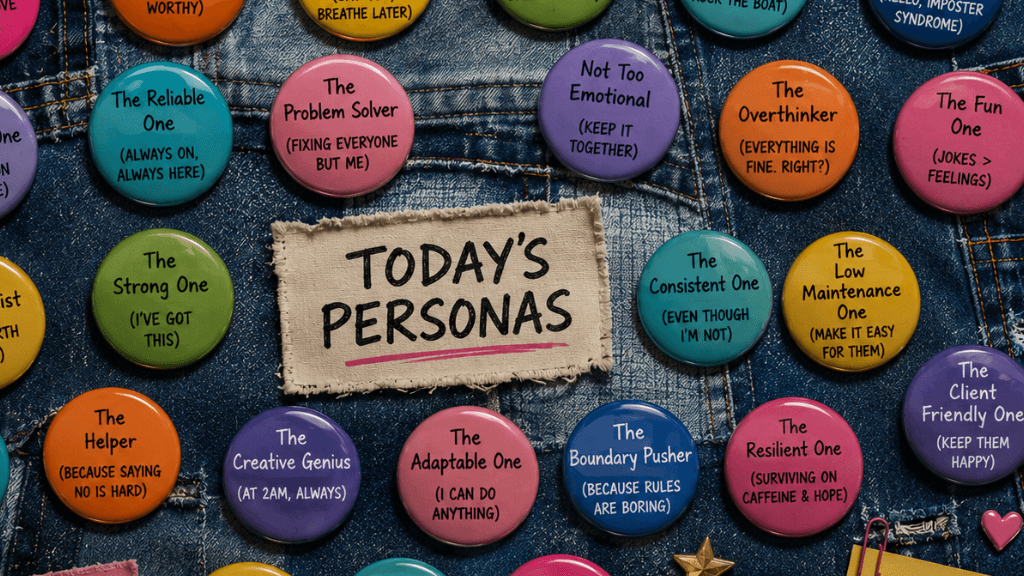
We don’t perform fake competence. We buffer real competence. We smooth the edges, downplay the effort, and make difficult things look easier than they feel. Over time, that constant translation can solidify into a persona — the version of us others rely on, even when it costs more than anyone realises. The problem isn’t that the version exists. The problem is when she follows you home, sits on the sofa, and refuses to shut up.
So you keep reassuring. Keep editing. Keep smoothing the edges. You keep saying things like “it’s all fine.” Not because it isn’t, but because you’re translating when you actually need to sit in silence for twenty minutes, scrolling absolutely nothing, while your nervous system whispers kind words to itself.
Home slowly becomes another place where you’re on. And that’s exhausting in a way sleep alone doesn’t fix.
Neurodivergent stress is famously bad at behaving itself. It’s like a cat that is determined to tap all the precious things off the worktops onto the floor below. And it’s also almost always really unpredictable. Often, there’s a delay where we cope beautifully in the moment, lulling those around us into a false sense of security. Then unravel later while loading the dishwasher or standing in the shower, suddenly furious about something that happened last Tuesday.
This is where stress can start leaking out as irritability, withdrawal, or over-talking. Sudden emotional fireworks that seem wildly out of proportion to whatever happened. People around us can often get confused here because, from the outside, it can look like anger, disinterest, or distance. When, really, it’s the nervous system finally processing something it didn’t have time to deal with earlier.
So many of us default to jokes. Or silence. Or insisting everything’s fine until it very much isn’t.
Dropping the mask at home doesn’t mean narrating every anxious thought like an audiobook nobody asked for. There’s a difference between honesty and emotional dumping, and most of us are trying to find the middle ground without traumatising our loved ones or imploding quietly instead.
Being honest can be as simple as translation. “I’m stressed about work” lands very differently from “I am spiralling, and you are now responsible for fixing it.”
“I don’t need fixing — I just need to talk this out” is, frankly, the king of sentences.
Timing matters too. Mid-meltdown is rarely the moment for a nuanced discussion about cash flow or existential dread. Whereas when we wait until we are more regulated, the outcomes are almost always much better. Believe me, I’ve tried the alternative multiple times, and it’s not a winner! And waiting for that regulated moment, when she arrives, isn’t avoidance. It’s the smart choice if you still want to get on with your family, ha ha!
Here’s the deeply irritating truth: people can’t support what they don’t understand. I’ve dreamt of a psychic husband for many years now, but sadly, he has not materialised.
If all our family ever hears is that things are going well, they’ll assume they are. Not because they don’t care, but because they’re working with the information available to them. So when we are more transparent about how we feel about our work, they have a fair chance of understanding better. That’s not to say that we need to unveil our stress in a way that creates panic. It’s just about giving them context, for example, explaining patterns, and letting them know when our stress is a background noise rather than a car alarm.
Without that context, any concern they share with us can quickly morph into pressure. Especially around money and stability. Advice offered kindly can feel like judgment. Reassurance can feel like monitoring. Suddenly, “how’s work?” feels like an interrogation, and you’d rather fake your own disappearance than answer it.
Unmasking doesn’t mean talking about business constantly. In fact, boundaries are usually what sustain honesty. That might mean limiting business talk in the evenings or having a loose container for venting rather than letting it seep into every conversation.
It might also mean choosing one trusted friend (thanks, Stu!) who understands self-employment in its ever-changing landscape of grassy fields and quicksand swamps. And better still, someone who is prepared to hear the gritty details, or at least nod and smile in the right places, without wanting to slap you.
Because, regardless of how much your family love you, and hopefully wants to be supportive, there is a limit to the breadth of their goodwill if you are expecting them to be your accountant, therapist, and crisis-response team all at once.
Now, I appreciate the irony in typing these next words that are basically my spirit animal. But try to avoid oversharing. Yes, yes, I literally overshare on everything. Sorry, not sorry. But just because I do, doesn’t mean you have to. Relationships where everything is shared can be as draining as those where nothing is. The goal is enough openness to feel supported, and enough structure to feel safe.
Remember, boundaries aren’t secrecy. They’re nervous system management.
In healthy, honest relationships, you’re allowed to be uncertain without being fixed. You can admit when you’re tired without being judged. And be honest with those closest to you, without making them feel they need to manage it.
Being able to say “I’m not okay, but I am handling it” and be believed, is life-changing. Especially if you have spent a large portion of your life trying to avoid that at all costs.
It creates emotional safety, a shared language, and a sense that you’re not carrying self-employment entirely alone. Dropping the mask at home doesn’t make you less professional. It makes self-employment survivable.
Because when you stop performing competence everywhere, you get some energy back. Enough to rest. Enough to regulate. Enough to show up again without dragging yesterday’s stress into every room. You’re allowed to be capable, whilst still feeling unsure. Being human doesn’t prevent us from being successful…however we define that. And we can still be professional at work and still be fully ourselves at home.
That balance isn’t indulgent. It’s how you last.

There are two types of people in the world: the ones with colour-coded five-year plans, laminated vision boards, and a spreadsheet that could probably file their taxes — and then there’s me. And if you’re reading this, there’s a decent chance you’re also in the “I’m just trying to get through the next five minutes without accidentally starting a new career as a candle-maker” camp.
The five-year plan is one of those culturally approved things we’re all supposed to have, like a skincare routine, a pension, or a consistent personality. And sure — for some brains, a five-year plan is motivating and grounding, a helpful lighthouse guiding you through the fog. For other brains (hi), it’s a pressure cooker. A shame-generator. A glittery trap disguised as “success”.
So let’s talk about what happens when you don’t have a five-year plan — and how you can still thrive, grow, and build long-term awesomeness without setting fire to your nervous system.
A five-year plan assumes you can reliably do two things: predict the future, and be the same version of yourself every day for five years. If companies packed full of mega brain analysts can’t predict this stuff accurately, then what sort of hope (none… the answer’s none) does a small business owner with a spoon deficit and a squirrel chasing brain have of being able to map out the rest of the month, let alone 5 long years.
If a five-year plan genuinely works for you, I mean this sincerely: I love that for you. But if it fills you with fear, and makes you feel like you’re failing before you’ve even started, you’re not broken. It’s just not a tool that’s built for your brain.
I’d be lying if I said I had ever truly understood the concept of a five-year plan in life or business. I understand direction. I understand having something vaguely on a hill that you’re aiming for — a general “over there”. What I don’t understand is the rigid, milestone-heavy version where by Year Two you’re meant to have achieved X, become Y, and be emotionally stable by Year Four (I’m not emotionally stable by year 51!). That’s not planning. That’s inviting your inner perfectionist to move in permanently and redecorate using paint shade ‘shame’.
What actually helps is a looser kind of vision that gives you direction without demanding you predict every step. For me, my goals tend to sound less like “I will triple my revenue and expand into three new markets” and more like wanting to work less, enjoy my client base, feel calmer about my work, and earn enough that I’m not living ten days from payday in a constant state of dread. That’s not a five-year plan. That’s an anti-meltdown, sustainable lifestyle..
If you want long-term awesome without the five-year straight jacket, the trick is to stop trying to build the whole staircase and just focus on the next step. Short-term goals work well for neurodivergent brains because they’re visible, achievable, motivating, and adjustable. They give you something solid to aim for without locking you into a version of the future you might outgrow
This is why I love working in short sprints. Well, I have since Stu introduced me to the concept. Before that I was just bumbling along with no plans on adulting when it came to business at all. I miss those days! No, focus Hannah, focus!
Ninety days, thirty days, a season, whatever chunk doesn’t make you want to crawl under a table. You pick something specific, give it a defined window of time, and treat it like an experiment. Does it work? Does it pay? Does it drain you? Do you enjoy it? Is it sustainable? Is it moving you vaguely toward the hill? At the end of the sprint, you reassess. No drama, no shame, no “I’ve ruined my entire future”. Just interesting data and a chance to pivot.
One of the biggest lies hustle culture tells us is that success means sticking with one idea forever, even when it’s clearly not working. But self-employment is messy and stop-start. Some months are great; other months you’re wondering if you should become a barista purely for the predictable schedule and the free pastries.
If something isn’t working — financially, emotionally, practically — pivoting isn’t weak. It’s smart. And honestly, who are these imaginary people we’re trying to impress? What committee is meeting weekly to review your career choices and announce that you’ve pivoted again and they disapprove? There isn’t one. And even if there was: fuck em.
This might be the most important part, so I’ll say it slowly: if you don’t plan around your energy, your business will plan your burnout for you. Neurodivergent energy isn’t linear. It doesn’t show up like a tidy nine-to-five battery bar. Some days you’re focused and flying; other days you’re technically present but running on fumes and a slightly haunted vibe.
So instead of demanding consistency from yourself, you build systems that support variability. That might mean time-blocking, protecting recovery time, pushing “urgent” work to next week, or recognising that doing more now usually means borrowing from future-you. As we’ve said repeatedly in past blogs and episodes, rest isn’t a reward for getting everything done — it’s preparation for the work ahead.
I don’t think consistency itself is the enemy. What is unhelpful is the idea that consistency means showing up as the same version of yourself every single day. When we have already established that that is not going to happen for a lot of us! What actually matters, especially in business, is consistency of outcome rather than consistency of energy.
My clients don’t need me to be the same Hannah every day. They need good work, delivered when it’s promised — reliability in results, not access to my internal battery levels. So I do focus-heavy work on days when focus exists, I protect recovery so future-me doesn’t suffer, and I design systems that absorb variability instead of pretending it isn’t happening. From the outside, it looks consistent; from the inside, it’s flexible, responsive, and intentional. That distinction matters, because forcing “perfect consistency” is often what breaks people, whereas systems that expect variability are what keep things moving.
The ideas. The sudden obsessions. The “maybe I should retrain as something wildly unrelated” moments. Curiosity isn’t the enemy, and learning things isn’t wasted. Sometimes finishing isn’t even the point — the learning is. But not every idea needs to hijack the entire business.
Having an idea bank helps. Write it down, capture the dopamine, park it. If it keeps coming back and aligns with the hill, you can revisit it later. Not everything needs to become a full identity.
If you’ve got tasks that have been sitting on your list for months, chatting shit about you, it’s probably time to be honest. Delete them, outsource them, or accept they’re not realistic right now. A to-do list that makes you feel permanently behind isn’t a productivity tool — it’s a stress list.
It might look like earning enough to cover your bills without panic, doing work that doesn’t destroy your nervous system, and setting goals that flex as your life changes. It might look like a business that evolves with you instead of demanding you stay the same.
And maybe — just maybe — thriving without a five-year plan isn’t chaotic. Maybe it’s wise. Maybe it’s the most neurodivergent thing in the world to say: “I don’t know exactly where I’ll be in five years, but I know what matters to me. I know what drains me. I know what brings me joy. And I’m going to build from there.”
Short-term wins. Long-term awesome. No pretending to be someone you’re not.

I have a complicated relationship with New Year.
On the one hand, my inner golden-retriever loves the idea of a fresh start. New calendar, new notebook, new chance to believe that this year I’ll drink water like a functional adult and not live on caffeine and Netflix. Especially if the previous year has been a bit of a car crash, there’s something comforting about drawing a line under it and going, “Redo”
But then the rest of me remembers what New Year actually comes with. One of my biggest kryptonites: pressure. “What are your resolutions?” “How are you going to improve?” “What horribly unachievable goals have you set yourself?” Apparently “continuing to exist and not murdering anyone who chews loudly” is not an acceptable answer. Who knew!
There’s this unspoken expectation that we must want to be fitter, more productive, more disciplined, more something. And once you say a resolution out loud, it suddenly feels like the whole world’s watching. “Oh, I thought you were cutting down on biscuits?” “Didn’t you say you were going to the gym?” No, Carol, I said it once in a burst of delusional optimism. That doesn’t mean I consented to being put under lifestyle surveillance for the next twelve months. Get back in your box.
For my neurodivergent brain, New Year’s resolutions tend to go in one of two directions: either I go rogue and make a grand announcement that I am the boss of me and don’t have to conform to such bullshit… or I get boss-level FOMO and make a list long enough to qualify as a cry for help.
This can look something like:
“This year I will drink more water, stop eating biscuits, exercise three times a week, have a weekly rest day, be more organised, reply to messages like a real grown-up, and definitely, definitely not work late every night.”
Cut to mid-January and I’ve already “failed” half of them, promptly launching myself into a shame spiral because apparently I can’t even keep a promise to myself for more than eleven days.
The annoying thing is: it’s never due to laziness. I just… forget I even set the resolution. A few months ago, I bought vitamins after some very predictable blood tests (vitamin D? Low. Shocking). I bought one of those little pill organisers – Monday to Sunday – and for two months I was religious about taking them. Felt better for it too. Then one day I missed them. Then another. And then my brain quietly decided, “We don’t do supplements anymore,” and that was that. The box is still in the cupboard, full, quietly judging me every time I reach for the tea bags.So, it’s not that we can’t be consistent with anything. I’ve been with my husband for 21 years – clearly I can stick at some stuff (yay me!). But standard resolution culture assumes a brain that remembers what it decided, experiences time in a straight line, and doesn’t regularly drop whole habits down the back of the sofa of consciousness. Mine does not.
One line I heard recently really stuck with me: “You didn’t fail the plan. The plan wasn’t designed for you.”
That hit me right in the executive function.
Because even when we design the plan, we’re often doing it based on bad information. We’re designing for the fantasy version of ourselves — the one who always has energy, never gets overwhelmed, and apparently turns into a completely different person the moment Jools Holland starts getting overexcited.
Tangent time: were you aware, dear reader, that Jools Holland’s Hootenanny is not live? It’s pre-recorded. I learned this at the grand old age of 50 and it destroyed the joy completely. And yet I still watch it so I can check how convincing the guests are. That’s how dedicated my tism is.
Right, back to the point.
For a lot of us, real us has things like ADHD time-blindness, autistic sensory overload, rejection sensitivity, chronic fatigue, pain, anxiety, depression, and a nervous system already working overtime just to exist in the world. The care label on a neurodivergent person should probably read something like:
“Before committing to anything, check: current energy budget, sensory load, existing obligations, and the likelihood of forgetting this even exists by February.”
So instead of asking, “What should I do next year?”, I’ve started asking, “What should I do given the life I actually have?” Then I can pass it through the realism filter: where would this shiny new idea fit with work, relationships, downtime, health? What has to be reduced or removed to make space for it? And crucially: what will my actual brain and energy allow me to do? Not fantasy-me who rides around on her unicorn — the real me, who is pretty awesome but has her limits.
Neurotypical hustle culture loves consistency. “Show up every day.” “Discipline over motivation.” “You just have to want it enough.” My ADHD brain hears that and laughs in 17 open browser tabs.
For a lot of us, consistency in the traditional sense is a myth. Our capacity fluctuates. Our focus fluctuates. Our executive function fluctuates. Sleep, hormones, sensory input, other people’s drama — it all messes with what we can realistically do on any given day.
So if we latch onto “New Year, new me” and set ambitious (read: unrealistic) resolutions that rely on perfect consistency, we are setting ourselves up to fail. Why would we want to do that?
Stuart introduced me to a fabulous term: minimum viable progress — asking “What’s the smallest version of this that still counts?” What would “good enough” look like, not “ideal Hannah on a TED stage”? If everything went sideways, what’s the baseline I’d still be proud of?
And this really works. I urge you to try it yourself — if you’re silly enough to welcome New Year’s resolutions into your life.
The more I think about it, the more I realise I don’t actually want more goals next year. I want fewer.
Neurodivergent life already comes with a ridiculous amount of invisible work: managing sensory input, masking, unmasking, scripting social interactions, tracking everyone’s emotional state, battling executive dysfunction and decision fatigue before we’ve even opened our laptops. Slapping ten extra “improvement projects” on top of that isn’t self-development. It’s self-sabotage on roids!
So my New Year’s resolutions for 2026 are looking less like, “I will become a totally upgraded, sleek, consistent, disciplined version of myself,” and more like, “I will stop doing things that drain my energy for no good reason.”
That might look like saying yes to fewer things I already know I’ll resent, taking on fewer “little favours” that come with large emotional price tags, and stopping agreeing to projects that require a personality I simply do not have. It absolutely looks like treating rest as something I’m entitled to and need, not as a reward I have to earn by grinding myself into the floor first.
It’s less “What will you add?” and more “What will you gently but firmly remove?” Consider it an anti-resolution resolution — a boundary-setting exercise in disguise.
Stuart taught me (think Karate Kid but with less waxing) that rest isn’t a reward you get for being productive enough. It’s preparation for everything that’s coming. That’s true whether you’re training for a marathon, running a business, raising kids, or simply surviving late-stage capitalism with a frazzled brain.
So for 2026, I’m far more interested in building in rest on purpose, not only when I’m already in pieces. I’m more interested in choosing tiny habits that work with my rhythms, not against them. I’m much keener on letting go of goals that only exist because they sound good on LinkedIn, and treating my energy like the finite resource it is — not like some infinite well I can plunder because I’ve bought a fancy planner.
Here’s where I’ve landed with New Year, resolutions and goal setting: You don’t need a “new you”. You need more support for the you that already exists.
The you who loses track of supplements but shows up for friends.
The you who forgets resolutions but remembers everyone’s emotional temperature at a party.
The you who can’t stick to habit trackers but can hyperfocus for 14 hours on something you care about.
The you who gets overwhelmed by change but has probably survived more of it than most people will ever understand.
That version of you doesn’t need to be replaced. She needs to be listened to, accommodated, and designed around. So if you’re staring down another January thinking, “I cannot face another round of ‘New Year, new me’ nonsense,” consider this your official permission slip to opt out.
You are allowed to have no resolutions at all.
You are allowed to pick one tiny, kind goal and let that be enough.
You are allowed to focus on what you’ll stop doing, not what you’ll cram in.
You are absolutely allowed to decide that your main achievement next year will be: “stayed vaguely functional and didn’t combust.”
You’re not behind. You’re not broken. You’re not failing because you can’t reinvent yourself every January. You are a neurodivergent human doing your best with a brain that was never invited to the planning meeting for “how life is supposed to work.” Designing your year around that reality isn’t failure. It’s self-respect.
And if anyone asks you what your New Year’s resolution is, you can smile and say:
“Supporting the current me a bit better, thanks. As I’m already doing enough.”