Neurodiverse Networking Pt. 2 – People You Don’t Want to Meet – S01E11
Welcome back to The Business Oddcast! We’re diving straight into the characters you meet at networking — especially through a neurodivergent lens. We swap real stories and name names (kind of): the Octopus (uninvited hugger), the Megaphone (too loud, too close), the Pitch Machine (selling at you), the Name-Dropper (one-upping royalty), the Energy Vampire (joy drain), and the Vanisher (Houdini exit).
We continue last weeks deep dive on business networking events, and we talk
- consent and boundaries (bags as buffers, yes)
- why you don’t sell in the room but through the room
- how to prep light “what I’m working on” lines to dodge small-talk doom.
Tangents include:
- Hannah’s new “Tangy” persona
- noise-cancelling sanity,
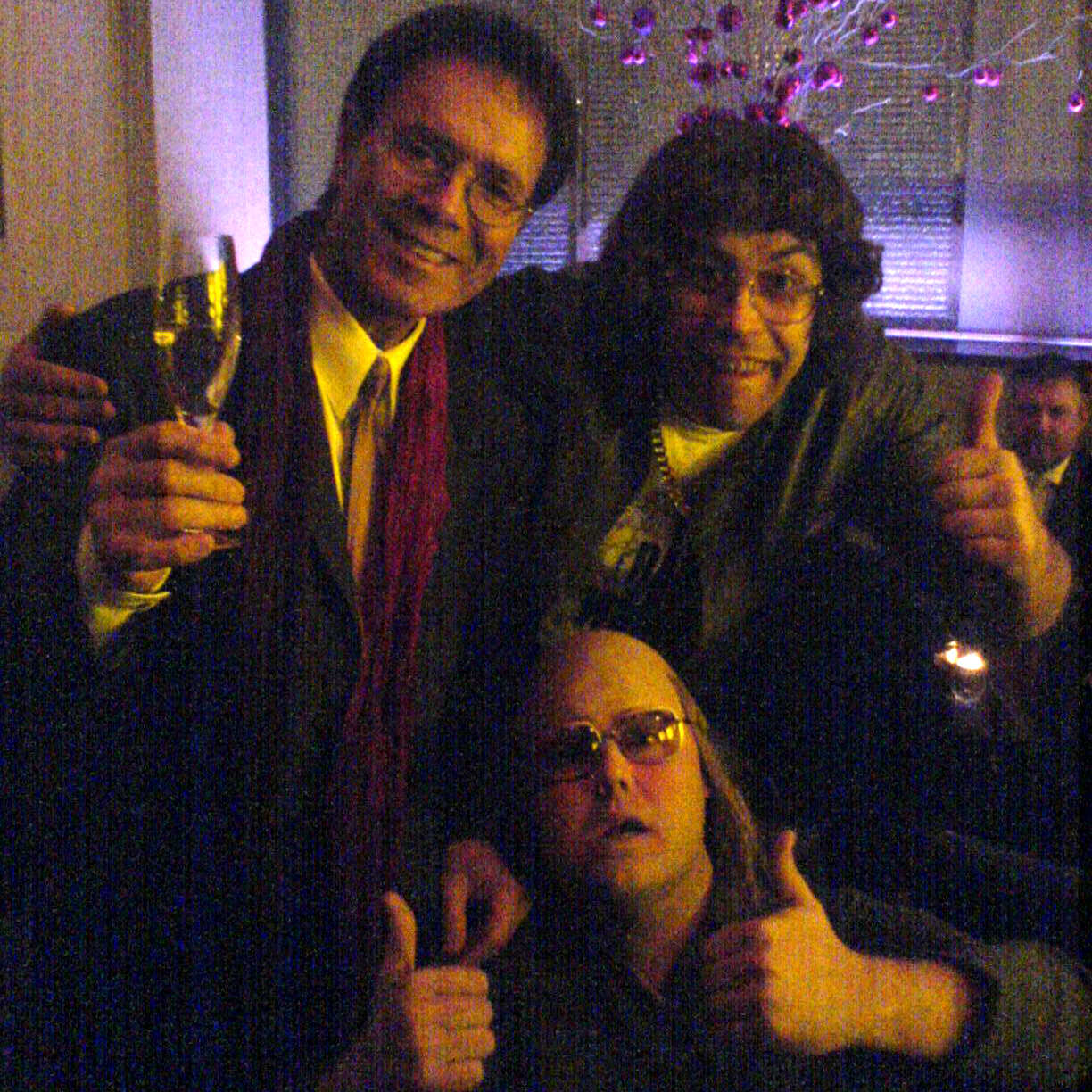
- and a gloriously odd Cliff Richard photo moment. (Scroll down below to see photo)
We also visit another lovely local networking event, the BiZHUB and discuss their event, and what they offer the local small business community.
Takeaways: pick events that fit your sensory bandwidth, arrive/leave strategically, aim for one genuine connection = success, and remember: rest isn’t a reward — it’s preparation. Come for the tips, stay for the honesty (and the chaos).
Share with anyone you think this will resonate with and we can build a healthier, happier way to work!
Don’t forget to like, share and subscribe and send any questions or suggestions to: hosts@businessoddcast.com
Or follow along on the socials see low timeline for details.
Plus, we’ve created a FREE Survival Guide (linked in the resources section too) packed with practical tools to help you plan, prep, and walk away from your next event with confidence — not exhaustion.
Whether you’re a local small business owner, a solo entrepreneur, or someone still figuring out how to “do” networking without the panic, this episode is your permission slip to show up as you.
Tune in, take notes, and laugh with us as we unpack the beautiful chaos of connecting in a neurotypical world.
Hit play now — and let’s turn networking from a nightmare into your next big opportunity.
(Part 1 from last week is here!)
TIMELINE
00:00:00 – Introduction.
00:00:40 – Hannah’s weekly tangent
00:01:35 – Topic of the Week – People You Might Meet Networking
00:01:50 – SiGNAL BiZHUB review
00:04:35 – Nobody can build a business alone
00:05:26 – Building your business locally
00:06:30 – Use the “Kevin Bacon network effect”
00:10:16 – The types of people you will meet networking
00:10:35 – The Octopus
00:13:01 – The Megaphone
00:13:42 – The Pitch Machine
00:17:21 – The Namedropper
00:20:27 – Sir Cliff Richard puts in an appearance
00:21:44 – The Energy Vampire
00:25:23 – What keeps women down?
00:27:35 – The Vanisher
00:29:47 – Wrapping up with key takeaways
00:36:00 – Mandatory You Tube close, like share and subscribe.
RESOURCES
https://bigmoosecharity.co – Emergency mental health support, Big Moose provides fast and effective therapy for people who are struggling.
https://embrace-autism.com/autism-tests – if this topic responates perhaps you might want to look into the subject a little more. Use these tests to have a clearer understanding of your own neurotype profile.
Neurodiverse Networking Survival Guide – the Business Oddcast accompanying resource for small business owners https://businessoddcast.com/neurodiverse-networking-survival-guide
STAY IN TOUCH
Don’t forget to Like, Share and Subscribe and join the OddSquad, sign up for our weekly newsletter and get our resources all for free!
We share links to resources and remind you of new episodes, which if your Executive Dysfunction is like ours, will be a useful weekly reminder! Lists and alarms for DAYS! We will also be sharing useful info, coping strategies and survival guides, so you can access hints and tips in handy reference form.
Our homepage businessoddcast.com and sign up for our newsletter, we will ask for your email address but we will NEVER sell that to any 3rd party.
Or contact us here or email hosts@businessoddcast.com
Typos By Heathens, Vegas by Las, AI? O.No.
Stuart: The Business Oddcast. Hello and welcome to The Business Oddcast. Episode 11 — we’ve made it all the way to episode 11. Apparently episode 20 is where most people drop off.
Hannah: Oh, we are not quitters.
Stuart: We are over halfway there. All the time I’ve got a voice, I’m going to keep doing this. So this could be a lot of years. I’ve got a lot of opinions. It’s all backed up. So this week, we continue in the topic that we started last week. But before we get to that, and before we continue with that, what you’ve been doing this week — what is on the list?
Hannah: What is on my list this week? I’ve got a blog to write for a client, which I love, although normally the info comes to me at about three in the morning. So I’ve got to manage my energy around that. But I look forward to that stuff, because it’s creative. What else? Just gotta wrap up a couple of other little bits. And just lots of— I’m committing, committing. That sounds wrong. I’m committing recently to reading more or listening. I like listening to audiobooks, but I don’t do enough of that. And that’s important. So yeah.
Stuart: I noticed the word. Yeah, I noticed that Audible is now rolled into your Prime subscription. And I was thinking about getting rid of Prime, and now that that’s occurred, I’m thinking to myself, there’s a ton of books that I now need to go and listen to that I was putting off, because it was £7.99 a book.
Hannah: I didn’t even know it was included. I’m going to check that out. I’ve got Prime.
Stuart: I’m pretty certain I saw that Audible is now rolled in as part of your Prime membership. So yeah, yeah. I mean, there we go. Top tip. I am a listener of books. I find, if I’m doing something physical, I can listen to a book — but sitting with my mind enough to read a book, I find really… my brain jumps all over the place too much. I can only do it if it’s a kind of bedtime reading, and it’s quiet and it’s still light. And I’ve got a Kindle with— you know, back to the Kindle. Gemma swears by a Kindle. Gemma swears by her Kindle. And I did try a Kindle for a bit, but I found it was all too fiddly. But I had one of the ones with all the buttons on the bottom and the thing — but I know that they’ve improved. So maybe, maybe I’ll return. And I’ve got an old iPad mini; I might stick Amazon audiobooks on that and try and have a listen.
Hannah: It’s a good idea, because it’s the only time that I can read — because I need it to be quiet. You know, I couldn’t read on a bus or any of that stuff.
Stuart: Hey, just got it.
Hannah: Yes.
Stuart: One: noise-cancelling headphones.
Hannah: I’ve done that.
Stuart: One — noise-cancelling headphones with nothing on them other than the noise cancelling. Sorry to everybody who’s wearing noise-cancelling headphones having to listen to my shushing then. It’s just like— But, you know, so — from last week: we didn’t introduce ourselves.
Hannah: We didn’t introduce ourselves.
Stuart: People will be confused. So I am your host, Stuart Morrison, and this is the Tangent Queen.
Hannah: Hello again. Proud to be tangenty.
Stuart:Tangenty.
Hannah: Tangenty — a new word.
Stuart: Or maybe, maybe instead of tangenty, introduce the concept of spicy — you’re tangy.
Hannah: Oh my gosh, yes, that’s good.
Stuart: Hannah “Tangy”—
Hannah: No, no, no — I’m sorry. That’s my mission statement now. Tangy.
Stuart: Tangy.
Hannah: It’s spicy, but it’s some extra stuff.
Stuart: But with, like, citrus — like a hint of that taste.
Hannah: Oh, rather than that… it’s a bit—
Stuart: Oh— makes one eyebrow go.
Hannah: I love it.
Stuart:listening to each other rambling on about — business networking. And we went last week and we recounted our experiences. We’ll be recovering and going over that again, and we’re going to be talking about the types of people we might meet. But let’s get on with it. So, should we go on to— I’m going to try really hard (brain, don’t let me down). I’m going to try really hard not to out any individuals. But should we talk about the types of people?
Hannah: Not only should we talk about the types of people—
Stuart: I’ve got names for them.
Hannah: Yes, share your names.
Stuart: Right, so first one — my favourite person to avoid: the Octopus.
Hannah: Ooh.
Stuart: What does— many, many people, they love a handshake, a firm, grippy handshake. They may slap you on the shoulder and may give you a hug.
Just— you’ve never met this person before — what? I don’t even hug my family. They’re having a conversation and they’re like, “Oh!” It’s like, you know — “Stu!” Oh, you know — and it’s all a bit like, “Who gave you permission?” I’m thinking about electrifying one of my suits.
Hannah: Tasers then.
Stuart: That would be incredible. Charge myself up with static electricity and just walk in. Right. But you know, it’s maybe not so obvious to the gentlemen, but the women suffer from it as well. You know, there is a certain type of gentleman who does like a hug from a lady.
Hannah: Oh, I got one of those at the end of last night — a closely chest-pressed—
Stuart: Ooh.
Hannah: Yeah, there are very few exceptions to the hug. And there was a socially awkward one I had last night where I just— it was— yeah.
Stuart: And it’s like, you remember the bucket-of-water challenge? Cold— was it cold-water challenge? For me, it’s like that. It’s like, “Would you like a hug?” “Go on then.” Pour the bucket of water over — get it over and done with — and dry off. Suit now. You feel me— it’s like frozen. Top tip: don’t go “ugh” afterwards. People don’t like that. I’m really just shaking off their vibes.
The second one — let’s talk about the second one. Creating those physical boundaries can be difficult. A large bag, a rucksack — hold that between you and them. A physical barrier. Big courier bag — I used to have a big courier bag with a laptop in it, and that would be slung around my front.
Hannah: Nobody’s hugging you around
Stuart: No one could get anywhere near you. You’ve created your own— I had a 17-inch monitor — it was a massive thing. “I was getting past that.” “I don’t know how to approach him.” They’re like, “Can I hug you?” “Go on — try. I dare you — try. Bring it on. If you get close enough, you can have one.”
OK, the second one: the Megaphone. You can hear them from the other side of the room, and even when they’re like that, it’s the same volume at you — usually with terrible coffee breath. And they lean in like you need a little bit extra proximity. It’s like, “No, guy. No.” I suffer from sensory overwhelm. I’m getting all of you — and nothing but you — in this mix. I’m hearing the cutlery in the kitchen, you know, usually. I can hear the light bulbs. I can hear your fillings clacking together.
Hannah: Yeah, yeah, yeah, yeah, yeah.
Stuart: The third one: the Pitch Machine. Intent on talking to you, giving you their business cards, telling you everything about their business, highlighting their website, getting phone out. Dude, I don’t need a quantity surveyor.
Hannah: I don’t care.
Stuart: That’s not all in particular— I don’t know any quantity surveyors. I picked on a— Quantity surveyors are not all Megaphones.
Hannah: Yes, this guy— but if you’re a quantity surveyor, please don’t sue us.
Stuart: That’s not personal. But, I mean, networking is a skill. It’s a skill you pick up over time. And one of the early, early skills that you learn is: don’t be a Pitch Machine. Don’t be selling. You don’t sell in the room; you sell through the room. The people that know the— “Oh, you know, I met this guy last night. He seems to know what he’s talking about.” That’s the kind of thing. Or if that person goes away and needs you in future, they remember you and they come back to you. And they obviously have your details — LinkedIn, whatever you have shared. But we’re talking about that very specific person who arrives and they may have a sample of what they sell. I had somebody once pitch— so they pitched customised labels on chocolate bars. And he had his box, but it wasn’t like a professional box — it was just like a rummage box of chocolate bars that he’d printed in for favour, and he would get them out and even show you. And he’d make you— you weren’t allowed to eat the chocolate bars.
Hannah: Oh, thank you.
Stuart: “No, no, no — that’s just an example of what we—” Okay.
Hannah: You can’t eat it? What is your chocolate bar? She’s getting violent at that point.
Stuart: Hannah.
Hannah: I’m sorry. Do you— really?
You can’t, like, put it in front of me and then take it back. That’s a hard no. My family know that. They offer me chocolate — or the hope of chocolate — and then get rid of it. No chocolate bar.
I went— I was at one event — this is a very tiny tangent. I was at an event where we got to— it was a very pitchy guy, like you were saying. And he gave me— oh, I’m going to be sorry when he listens to this— he gave me a mug. Like, instead of a business card, I got given a mug — a branded mug for his… what he does. I’m not going to out him anymore and get sued— and I just thought— all I thought was not gratitude; I just thought, “I’ve got to carry this bloody thing now. I’ve got to walk around the rest of the networking thing with a mug in the box.”
Stuart: That’s not helpful.
Hannah: I’m remembering you because you’re an idiot. I’m not remembering you because I’m going to use your service anymore. You’ve added baggage to my evening. I don’t know— I’m going to tell people you were up yourself. That marketing didn’t work, if you’re me. See, this is where the one that we did about marketing— it doesn’t have the same effect.
Stuart: It doesn’t go in a pocket.
Hannah: I’ll tell you what I did with it: recycled it when I got home.
Stuart: Was it a china mug?
Hannah: Yeah, but it’s just, you know, rubbish.
It’s the printing. Sorry, Mr Print — don’t sue me. Just a mass-produced, you know, branded thing. One visit in the dishwasher — I’m sure it’s gone. It’s just a plain white one after that.
Stuart: I’ve literally had something similar — mugs that, in the dishwasher, completely annihilated — completely unbranded them in one heated cycle. Not sure you thought this through. I’m sorry.
The fourth one — and this one drives me absolutely insane. OK. It manifests in one way, but it also has another manifestation, and I’ll explain both of them: the Name-Dropper.
Hannah: Oh, yes.
Stuart: Doesn’t matter what you’ve done. Doesn’t matter who you’ve spoken to. Doesn’t matter the thing you’ve had in your life — they’ve done it better, improved on it. They’ve met the King.
Hannah: You met the Queen; I met the King.
Stuart: I met God.
Hannah: Jesus.
Stuart: Jesus.
Hannah: Yeah, Jesus.
Stuart:That’s not God.
Hannah: What?
Stuart:See how it goes. But I understand. Right — so there’s this thing with the ’tism, where somebody says something and you say something that is very similar to that, and what you’re doing is showing empathy and sympathy for that situation. You’re chiming with them, not over them. You’re saying, “I recognise that intrinsically, because I did this,” or “this happened to me.” And it can seem like a topper.
Hannah: Yeah.
Stuart: But it’s not intended that way. This particular trait is somebody who — doesn’t matter what you say — “Oh yeah, I parachuted out of a Chinook with the SAS.” Did you now? Did you? I was just saying that I got on a plane and went to Ibiza. I wasn’t saying that I was flying with the Red Arrows and we did a stunt.
Hannah: I was saving people.
Stuart: Yeah.
Hannah: No, we don’t care.
Stuart: Yeah. Or they weave in — doesn’t matter what the conversation is — they weave in this kind of, you know, “Oh yeah, so when I was on stage doing a guitar solo with Prince, we were comparing business cards afterwards. We had the same colour top on.”
Hannah: Really.
Stuart: Yeah. We all know that type of person. But it can be very difficult to get away from this type of person in a networking event, because I find them both fascinating and repulsive at the same time. It’s like, “What are they going to say next? What can I get them to say next? What could I say?” Because I’ve done some pretty, pretty fun, interesting, outrageous, weird, name-droppery things — which are, you know, the time that Cliff Richard took a photograph of us being looked on by Virginia Wade and Kriss Akabusi. I mean, that could be a fever dream.
Hannah: That’s so cool.
Stuart: We rolled up to Cliff Richard dressed as Little Britain — Andy and Lou. And Andy — Gavin, my other half in this endeavour — goes up to Cliff Richard: “Mr Richards, can I get a photograph?” He goes, “Yeah, sure,” and he hands him his camera and sits back.
Hannah: amazing.
Stuart: He’s like, “What?” Absolutely honking. Kriss Akabusi over here. Right — “I think he wants you in the picture.” There’s a grainy-ass picture of Cliff Richard hugging us. We’re deep flinching. Every man. But, you know, I don’t go around mentioning that when you’re talking about meeting the mayor. “I’ll go one up — the mayor.”
Hannah: I did a post the other day and it just— you know, the only bit of cheer there is: the people that keep telling you how amazing they are… Because if they are that amazing, they don’t need to tell you. You already know. You’re amazing, but you don’t walk up to people all the time like, “I’m amazing.” You know, if you are, it just comes out of you, right? It’s obvious. You don’t need to tell everybody. So, yeah. The one-upper — stop. Stop trying so hard. That’s why customer reviews — slight business tangent — that’s why customer reviews and testimonials are so important, because it’s other people talking about you, rather than on your website— what are you going to say? “We’re a bit shit, really. Don’t use us.”
Stuart: We’re going to fuck it right up.“I met the Queen.”
Hannah: “Did you? When?”
Stuart: “Last week.”
Hannah: “OK. You met a queen. I’m not sure which one.”
Stuart: The next up: the Energy Vampire.
Hannah: Oh my God.
Stuart: So, you know, you say something like, “Oh, it was an amazing weekend — went away to a fantastic little B&B and we had, you know, mussels on the beach at midnight,” or whatever. Not trying to impress people — just, you know, what you did. “I had mussels once and— oh, it was the worst weekend I ever had. I think they were off.” “Gippy tummy. Went and saw the doctor.” What? You’re ruining it. You sucked all the fire out of my memory. Just turned all of the colour down — just drained it out — vibrance to zero, colour to zero. Maybe a black-and-white version of yourself.
Hannah: Why do they do that? I remember saying to somebody — ages ago — I booked on to this really cool workshop, free workshop thing. And I was like, “Ah, I’m going to this amazing workshop on— whenever it was — Friday, you know, the Friday coming.” And they were like, “Ah, I’ve done one of those before. It’s rubbish — total waste of my time.” “Oh, OK — thanks, Dave.” It wasn’t a Dave, by the way. “Brilliant, thanks. OK, so I’m already booked on to it, so… yeah, brilliant. I’m not looking forward to it anymore. Thanks for crushing that fun.”
Stuart: There’s a fantastic series called *What We Do in the Shadows*, and it’s about vampires. If you’ve not seen it — hilarious. Just because Matt Berry is hilarious. There’s a character — Colin Robinson—
Hannah: You have to say it in Nadja’s voice.
Stuart: But yeah — Colin Robinson is an energy vampire, and they bring him in — he’s superb — just gets off on draining the life out of people. Maybe that’s it. We’re meeting, like, the Colin Robinsons of the networking world. Anyway — anyone who’s been in life in general and been to any kind of social gathering will know — they may have relatives. We’ve all got relatives, you know. “What did you do over the summer?” “Not a lot. There’s not a lot to do.” Oh great — this conversation’s gone nowhere. Thanks.
Hannah: “Make some fun — come on. Make up some fun stuff.”
Stuart: Nobody’s fact-checking.
Hannah: I sometimes worry — and I’ve said this phrase a few times to people — sometimes I’ve said to people, “Gosh, I think you’re now going to go and lie down in a dark room for a bit,” because I talk a lot. I worry that I— it’s not obvious to me first — because I talk a lot, I worry… and this is a different version of energy vampire — but I worry if that makes people feel a bit exhausted, because kind of keeping up with the talking maybe zaps their energy a bit. And I know that’s not our definition of energy vampire here.
Stuart: I hear you. But keep up. I want sparkling repartee. I expect— I expect people to be like Oscar Wilde. I’m sure Dorothy— what’s her— do you know— what’s-the-face— Dorothy—
Hannah: Dorothy Parker.
Stuart: Dorothy Parker. You know, I want— I want sparkling repartee. One of my best friends ever — I’ll tell this story and we’ll move on. One of my best friends ever — and this is how I met him. I decided to join an amateur theatre company. I wanted to do that, but I also just needed some socialisation. I was getting a bit stir-crazy. So I joined this theatre company — it was my first ever time — and at the time I was a smoker. And it was in a school drama building — a local school. And everyone, when they smoked, stepped outside the fire door and had a cigarette. And so when I saw this first— the first break — everyone sort of trooped outside and— “Oh, OK, that’s where they go.” And I walked outside, and there was a circle of ladies — they were all talking and they were all stood smoking. And I was kind of doing the really awkward neurodiverse: “I’ll stand near you. Hopefully you’ll notice me — the group will open up and I can step in.” What it actually looked like was a creepy dude standing next to a load of women with an unlit cigarette, earwigging, trying to— I— Anyway, Jay — who ran the group, was the director of the group — stepped out and he sparked up a cigarette, and he saw that I needed a cigarette, and he went and lit my cigarette. And I said— I was trying to— you know, I don’t do “bloke,” but I thought I’ll try and do bloke. Bloke works well. And so I said, “If hot air rises, what keeps women down?” He went, “Sexism.” Straight to my face. “Sexism.” Turned, stepped into the circle — which opened up and sealed itself — with me stood on the outside, now smoking a cigarette on my own.
Hannah: And now he’s your best friend.
Stuart: Best friend, yeah. I fucking roared. I did. Funniest thing. It was the most honest, real truth I’d heard spoken without flinching — like he wanted nothing to do with that kind of toxic masculinity. And rightly so — it wasn’t me; I was just trying to do it to kind of— to bloke. “Let’s talk about football.” I know nothing. I’m coming up with no blokey stuff.
Hannah: So that’s, you know, you dug into your brain for—
Stuart: Yeah. I tried trawling — you know, listening to my uncles for the last 25 years. They’re all dead now. They can’t sue me.
Hannah: Right.
Stuart: Very dead uncles. And the final one — the final one. And if you’re neurodiverse, this has happened to you not in a networking meeting — this has happened to you in parties, in pubs, in social gatherings, your entire life. I think of them as the Vanisher. They do a Houdini. You’ll have a conversation with them — and, oh, they might be part of, like, two or three people, and they’re having a conversation — you’re having quite this conversation — and they’ll just go, “Oh, hang on a second,” and they’ll disappear. And they’ll make some excuse like, “I need the loo.” “All right, fine.” “I need to get a drink.” Or “I need to go do something other than be here,” is what they’re saying. And they disappear, and you see them over the other side of the room, having a conversation — having not gone to the toilet, or having not done the thing they said. Or: “Oh, I’ve got to leave now.” “All right.” “See you — bye.” They’re over there. No, what you meant was: “You are boring me. I need to escape.”
Hannah: I just— yeah, I think that’s happened to me. You know, they’re not gone. They’re over there. I can see you. You’re not invisible. Just be honest, people, come on.
Stuart: You know what? I’d rather somebody say, “Sexism,” and F.O., than lie to me blatantly. “You’re too much. I haven’t got anything.” But Stuart, that’s not how social interaction works. I’m an artist. I want the honest truth. I vanish all the time — I know where I am.
Hannah: Yes. Because also that plays with— that plays with my brain. I’ve got, kind of, you know, that fear of not being good enough. And then you see the person that was like, “Oh, this is amazing, but I’ve just quickly got to pop to the loo.” Oh — there you are talking to Karen at the other side. What? Why could you not just tell me I was rubbish? You didn’t have the balls to tell me that. “Hannah, this is too much. I’m going to talk to the nice, quiet lady in the corner.”
Stuart: Thanks for all that — that’s brilliant — yeah, great, great, great — I’m just going to go over here and open a vein.
Hannah: Yeah.
Stuart: Oh, was I that— Oh.
Hannah: I’m going to take a vow of silence.
Stuart: I get it — you know, sometimes I— if I’m off on one, as demonstrated — look at this — this episode will be our longer— so you feel the pain in this episode. I’m not editing it. It’s— again— it’s three episodes. This number 10 is the bonus episode. We might make it two episodes. How about “Networking Part 2.0: The Shit People Say.” Right. Things I’ve heard.
So, to bring this neat — work — to a close, because I’m sure we could ramble on about this—
Hannah: We can, we can.
Stuart: Some key takeaways — some wrap-up — some things to think about and to go away; take— We’ve given you a lot of tips, hints, and suggestions and ideas. Take what works for you. Leave on the table what doesn’t. It’s a grab-bag of ideas. We’ve got to where we’ve got to by making trial-and-error mistakes and feeling the pain. So we’re not going to say it’s going to be any easier. Hopefully we can laugh — laugh at our common pain. But networking, in and of itself for business, is a good idea. It’s useful — adapt to your circumstances and your situations and the energy you have. Manage it. That’s why we’re self-employed: to give ourselves the time and space to manage our energy. Any key takeaways, Hannah? Any tips that you think we haven’t covered?
Hannah: Tips: just prepping ahead of time, picking the networks — the networking events — that work for you. And for me, the best tip really is: I look at networking as building my community. It isn’t trying to sell myself into everybody. It’s building a community of like-minded people — they’ve got your back. When we’re self-employed, often we don’t have an office of people around us. That is your community — the people that you meet along the way, particularly at networking events. That’s where my strongest allies have come from — including yourself, Stuart.
Stuart: Yeah — and it makes going to the networking events a lot nicer if there are people there that you are looking forward to going and seeing. I wonder if Ben will be there, because I’m already thinking, “I’ll go next month,” because I didn’t get really— there was a little bit of a distance between me and Amy, because you were sat next to her, and I was talking more to Michelle, but Amy seemed really interesting and I was having trouble with some of the distractions — the sensory stuff — and she seemed fascinating, and she sounds like she’s got loads of stories, and I want to hear them all. So again, you know, that takeaway of: if you make one genuine connection out of a networking event, it’s been a success. And acknowledge that you’re not going to go away with 20 new friends — that’s not how it works. But if you go away with somebody who you look forward to having a chat to next time — success.
Hannah: Yeah, just set yourself some realistic expectations — just go in, see how it, you know, see how it goes.
Stuart: It’s really hard with the black-and-white thinking, though — you know, it’s all or nothing. “I will conquer them all, and they will all buy from me. Or I will die”
So— and I think the only thing I would add to what you say is: plan your following time — whether it’s in the morning and your rest of your day, or it’s getting home and knowing that you’re going to have to kind of get the event out of your head and settle. You know, I came home, similar to you. I had to put something on to distract me; Gemma was in bed and I had to have a cup of tea and a biscuit — just to, you know, put a full stop at the end of the day and let my brain, you know, wind down. So choose your event — and the aftermath. Aftermath. But it can— if you’ve got a high— look at your diary, you know. If you’ve got a highly busy day the following day, and you think, “Do I really must be at that networking event?” OK — those two things are unmovable, but what’s happening on the weekend, or what’s happening the day before? And one of the takeaways that I read recently — really recently — was, and this resonated hard: rest is not the reward for a busy day; rest is the preparation for a busy day. And I think turning it around and thinking, “I’m not working this afternoon because I’m going to go and do that networking event” — from door to door for me — and this, you know, this just was what it was — I mean, I can choose where I go and what I do — but I left home at six o’clock, and I arrived back home at a little after half past ten. That was four and a half hours of intense energy use — you know, chatting, driving, networking, driving — all of that. And so today I’ve planned a fairly low-impact day. Now, you know, customers being what they are, that might change — but my evening: I’ve already got my evening planned for this evening to meet a friend who energises me. You know, so reward yourself — yes — but prepare with rest. And, you know, I wouldn’t have done the friend thing the night before, because then that’s two nights on the bounce and no weekend. So tonight — brilliant. Tomorrow is my day off, pretty much — the weekend I will— there are some work things — but, you know, like we talked about: three, four I do. So that’s all I would say on that — is that that can make a difference. That can spoil the otherwise useful, interesting, fun thing you’ve done — or will do — if you’re not in the right energy frame, mind-frame. And there’s nothing wrong with noping out, even if you get to the venue and you go—actually, on second thoughts—I’ve done that. I have sent someone a text: “Really sorry — got caught up.”
Hannah: Yeah, self care, isn’t it? I hate the word “self-care,” but actually it’s just being self-aware and understanding what saps you and what doesn’t, and how to manage your energy and stuff.
Stuart: I’m sure this is a topic we will return to at some point. It’s endlessly fruitful and it’s a fascinating insight into small business.So especially for the neurodiverse and how you handle the common occurrence of networking. Thank you for listening. Thank you for joining us. Please like, share and subscribe — as all the best hosts have to say — it’s mandatory. If you don’t, apparently YouTube come round and they take your front door away.
Hannah: Tell your friends.
Stuart: Yeah, tell your friends. We’ve got several episodes live. You can go to businessoddcast.com and have a look through the catalogue. We’re on all of the major platforms — we’re on your Apples and your Spotifys and wherever you get your podcasts. If we’re not there, let us know and we’ll try and figure out what numbers and buttons and ones and zeros to line up to make that happen. Hannah, what have you got going on for the rest of the week — anything exciting?
Hannah: Exciting — not massively, but productive — yeah, just a couple of little work projects and, yeah, just get ready for the weekend in which I will be doing not a lot — just chilling.
Stuart: No, no — what you are doing (reframe it) is you are resting. So you can prepare for the following week. Yeah — actually banking that energy. I may be going to parkrun. I’ve said it now — I’ve got to do it. I may be going to parkrun and I’ve not parkrun’d for about three months. It’s not that I’ve been doing nothing — I’ve been shifting soil and moving — but I needed to, and needed to recover a couple of little minor niggles — one involving a chisel, a hammer and my calf.
Hannah: Don’t—
Stuart: Yeah — it wasn’t the chisel that hit my calf; it was my calf between the head of the hammer and the chisel. Yeah — anyway, on that energy bombshell — on that note: thank you for listening. The notes are below the timeline, etc. We’ll put this all into a little PDF and write it up. We’ll probably do a blog post. This will go into the resources. Do follow along, tell your friends — tell your neurodiverse friends — tell your weird, wacky, fun, oddball friends in business about us — and, you know, come along, like, share and do all the rest of it. So thank you very much and we’ll see you next time.
Hannah: Goodbye.